
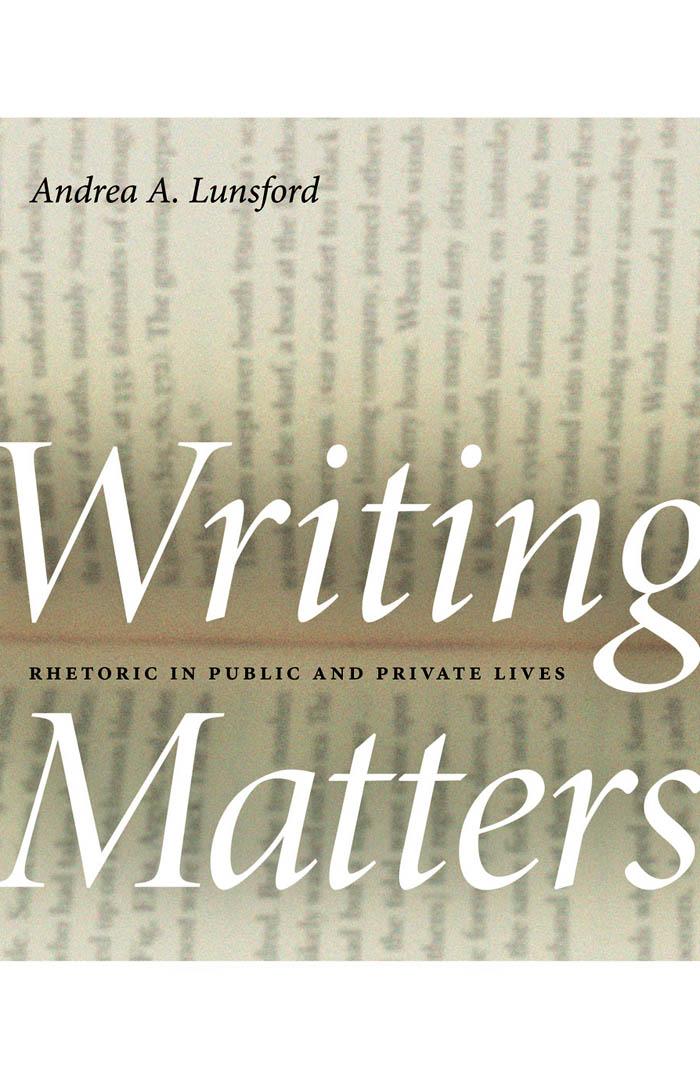
Anyone who laments the demise of print text would find a sympathetic listener in Andrea A. Lunsford. Anyone who bemoans the lack of respect for blogs, graphic novels, and other new media would find her no less understanding. Lunsford is at home in both camps because she sees beyond writing's ever-changing forms to the constancy of its power to "make space for human agency—or to radically limit such agency."
Lunsford is a celebrated scholar of rhetoric and composition, and many undergraduates taking courses in those subjects have used her textbooks. Here she helps us see that writing is not just a mode of communication, persuasion, and expression, but a web of meanings and practices that shape our lives. Lunsford tells how she gained a new respect for our digital culture's three v's—vocal, visual, verbal—while helping design and teach a course in multimedia writing. On the importance of having a linguistically pluralistic society, Lunsford draws links between such varied topics as the English Only movement, language extinction, Ebonics, and the text messaging shorthand "l33t."
Lunsford has seen how words, writing, and language enforce unfair power relationships in the academy. Most classroom settings, she writes, are authority based and stress "individualism, ranking, hierarchy, and therefore—we have belatedly come to understand—exclusion." Concerned about the paucity—still—of tenured women and minority faculty, she urges schools to revisit admission and retention practices. These are tough and divisive problems, Lunsford acknowledges. Yet if we can see that writing has the power to help prolong or solve them—that writing matters—then we have a common ground.
Lunsford is a celebrated scholar of rhetoric and composition, and many undergraduates taking courses in those subjects have used her textbooks. Here she helps us see that writing is not just a mode of communication, persuasion, and expression, but a web of meanings and practices that shape our lives. Lunsford tells how she gained a new respect for our digital culture's three v's—vocal, visual, verbal—while helping design and teach a course in multimedia writing. On the importance of having a linguistically pluralistic society, Lunsford draws links between such varied topics as the English Only movement, language extinction, Ebonics, and the text messaging shorthand "l33t."
Lunsford has seen how words, writing, and language enforce unfair power relationships in the academy. Most classroom settings, she writes, are authority based and stress "individualism, ranking, hierarchy, and therefore—we have belatedly come to understand—exclusion." Concerned about the paucity—still—of tenured women and minority faculty, she urges schools to revisit admission and retention practices. These are tough and divisive problems, Lunsford acknowledges. Yet if we can see that writing has the power to help prolong or solve them—that writing matters—then we have a common ground.
Kategori: Språk & Lingvistik
e-ISBN: 9780820342818
Betal nemt med kort, Klarna, Apple Pay eller Google Pay. Ikke tilfreds? Du har altid 14 dages fortrydelsesret. Læs mere i vores vilkår. Har du spørgsmål, så send os en mail på hello@memmo.org.
Memmo gør det nemmere at studere – uanset hvor du er i verden. Hos os samler du dine kursusbøger og smarte studieværktøjer ét sted: resuméer, quizzer, podcasts og flashcards. Og så er der Ted, din studieven, der svarer på alt, du undrer dig over. Over 50 000 studerende studerer allerede her – bygget til at hjælpe dig med at lære hurtigere og stresse mindre.
Du kan måske også lide
Køb bogen0