
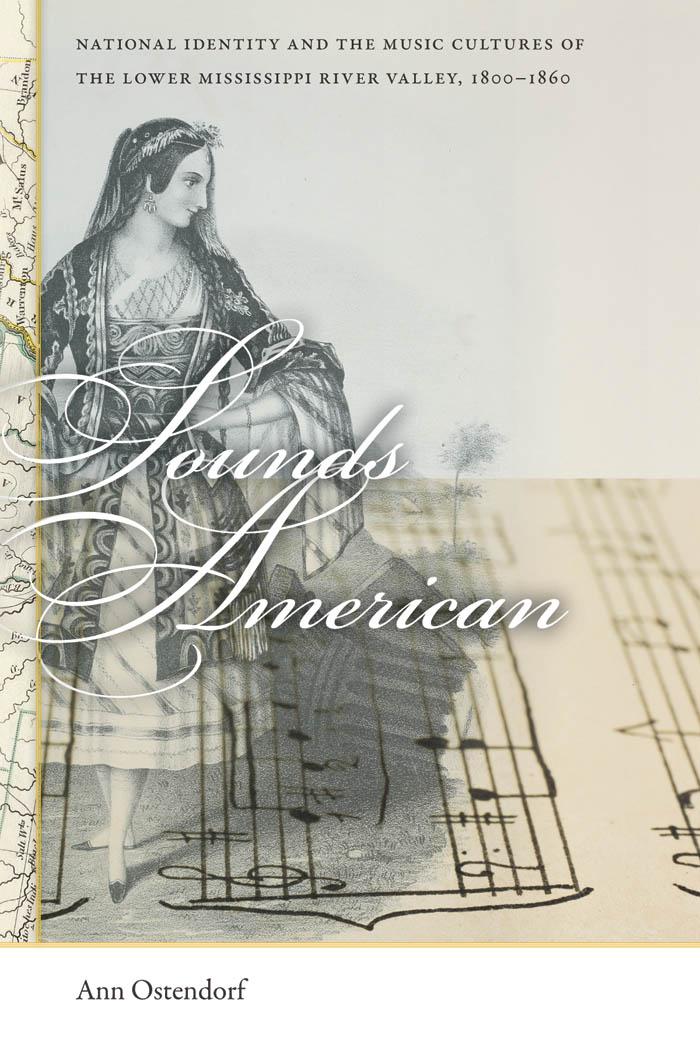
Sounds American provides new perspectives on the relationship between nationalism and cultural production by examining how Americans grappled with musical diversity in the early national and antebellum eras.
During this period a resounding call to create a distinctively American music culture emerged as a way to bind together the varied, changing, and uncertain components of the new nation. This played out with particular intensity in the lower Mississippi River valley, and New Orleans especially. Ann Ostendorf argues that this region, often considered an exception to the nation—with its distance from the center of power, its non-British colonial past, and its varied population—actually shared characteristics of many other places eventually incorporated into the country, thus making it a useful case study for the creation of American culture.
Ostendorf conjures the territory’s phenomenally diverse “music ways” including grand operas and balls, performances by church choirs and militia bands, and itinerant violin instructors. Music was often associated with “foreigners,” in particular Germans, French, Irish, and Africans. For these outsiders, music helped preserve collective identity. But for critics concerned with developing a national culture, this multitude of influences presented a dilemma that led to an obsessive categorization of music with racial, ethnic, or national markers. Ultimately, the shared experience of categorizing difference and consuming this music became a unifying national phenomenon. Experiencing the unknown became a shared part of the American experience.
Betal nemt med kort, Klarna, Apple Pay eller Google Pay. Ikke tilfreds? Du har altid 14 dages fortrydelsesret. Læs mere i vores vilkår. Har du spørgsmål, så send os en mail på hello@memmo.org.
Memmo gør det nemmere at studere – uanset hvor du er i verden. Hos os samler du dine kursusbøger og smarte studieværktøjer ét sted: resuméer, quizzer, podcasts og flashcards. Og så er der Ted, din studieven, der svarer på alt, du undrer dig over. Over 50 000 studerende studerer allerede her – bygget til at hjælpe dig med at lære hurtigere og stresse mindre.