
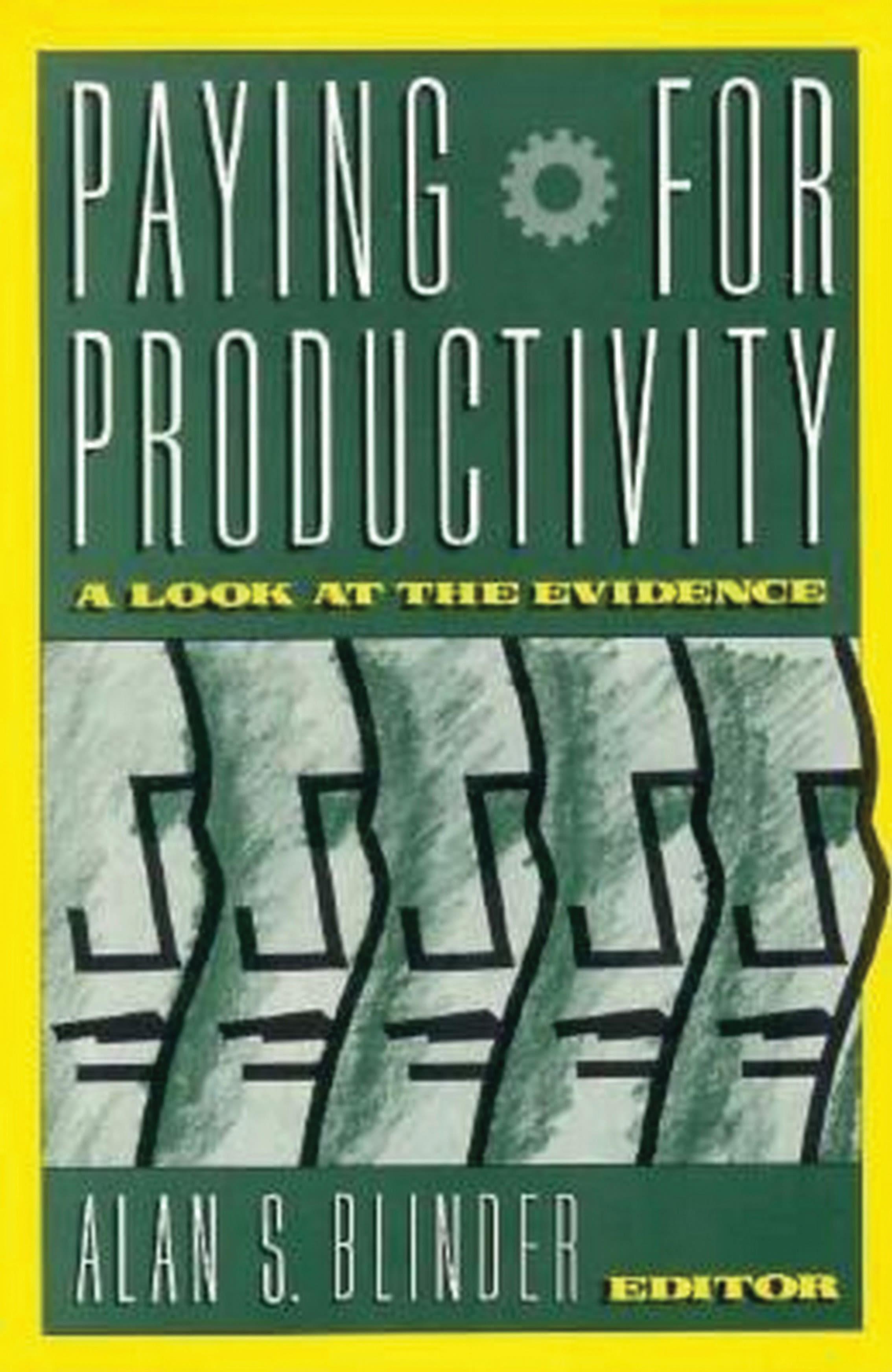
Will higher pay provide an incentive for better work? Can productivity be increased by changing the way workers are compensated? In response to the urgent need to improve productivity performance in American industry, leading economists examine alternative compensation schemes to assess their efficiency in raising productivity.
Over the years a number of suggestions have been made for improving labor productivity by changing the manner in which laborers are compensated for their efforts. The ideas presented and analyzed in this volume have all been put into practice, in modified form or on a small scale, in the United States or elsewhere. Some are new; others quite old.
David I. Levine and Laura D'Andrea Tyson consider the effects of employee participation in decisionmaking on firm performance, and Martin L. Weitzman and Douglas L. Kruse discuss the implications of profit sharing and related forms of pay for group performance. Michael A. Conte and Jan Svejnar analyze employee stock ownership plans in the United States and other forms of worker ownership in Europe; Masanore Hashimoto uses a transaction-cost perspective to assess Japanese employment and wage systems. Daniel J. B. Mitchell, David Lewin, and Edward E. Lawler III give an overall analysis of traditional and alternative pay systems, their history, development, and curent use, and recommend further experimentation with alternative compensation plans to ensure more adaptability on the part of U.S. firms. Blinder provides an overview of the findings and conclusions.
Over the years a number of suggestions have been made for improving labor productivity by changing the manner in which laborers are compensated for their efforts. The ideas presented and analyzed in this volume have all been put into practice, in modified form or on a small scale, in the United States or elsewhere. Some are new; others quite old.
David I. Levine and Laura D'Andrea Tyson consider the effects of employee participation in decisionmaking on firm performance, and Martin L. Weitzman and Douglas L. Kruse discuss the implications of profit sharing and related forms of pay for group performance. Michael A. Conte and Jan Svejnar analyze employee stock ownership plans in the United States and other forms of worker ownership in Europe; Masanore Hashimoto uses a transaction-cost perspective to assess Japanese employment and wage systems. Daniel J. B. Mitchell, David Lewin, and Edward E. Lawler III give an overall analysis of traditional and alternative pay systems, their history, development, and curent use, and recommend further experimentation with alternative compensation plans to ensure more adaptability on the part of U.S. firms. Blinder provides an overview of the findings and conclusions.
Sider: 308
Kategori: Ekonomi & Utveckling
e-ISBN: 9780815717126
Forsendelsesvægt: 1.2 kg
Sendes inden for: 1-2 dage
Betal nemt med kort, Klarna, Apple Pay eller Google Pay. Ikke tilfreds? Du har altid 14 dages fortrydelsesret. Læs mere i vores vilkår. Har du spørgsmål, så send os en mail på hello@memmo.org.
Memmo gør det nemmere at studere – uanset hvor du er i verden. Hos os samler du dine kursusbøger og smarte studieværktøjer ét sted: resuméer, quizzer, podcasts og flashcards. Og så er der Ted, din studieven, der svarer på alt, du undrer dig over. Over 50 000 studerende studerer allerede her – bygget til at hjælpe dig med at lære hurtigere og stresse mindre.