
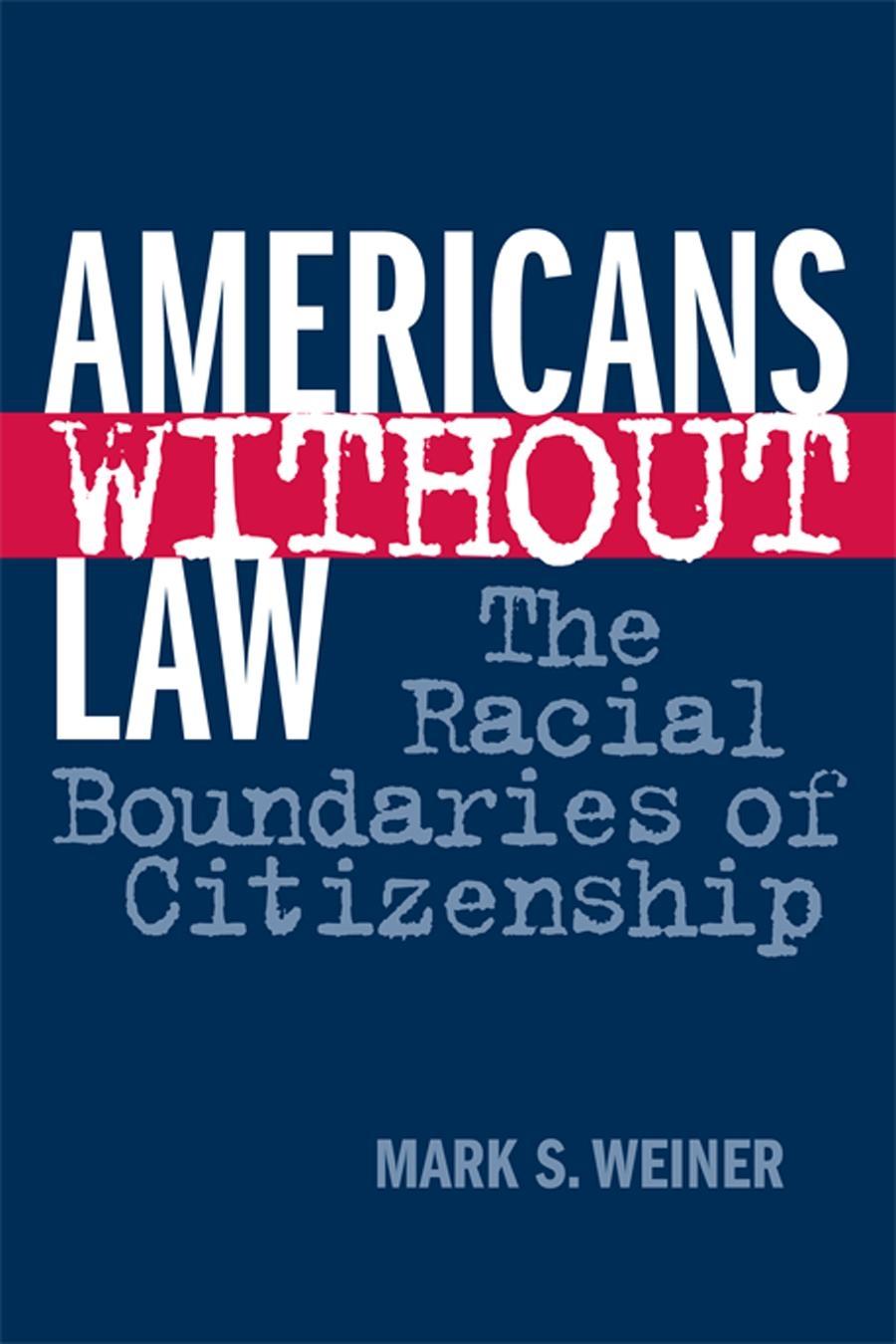
Americans Without Law shows how the racial boundaries of civic life are based on widespread perceptions about the relative capacity of minority groups for legal behavior, which Mark S. Weiner calls “juridical racialism.” The book follows the history of this civic discourse by examining the legal status of four minority groups in four successive historical periods: American Indians in the 1880s, Filipinos after the Spanish-American War, Japanese immigrants in the 1920s, and African Americans in the 1940s and 1950s.
Weiner reveals the significance of juridical racialism for each group and, in turn, Americans as a whole by examining the work of anthropological social scientists who developed distinctive ways of understanding racial and legal identity, and through decisions of the U.S. Supreme Court that put these ethno-legal views into practice. Combining history, anthropology, and legal analysis, the book argues that the story of juridical racialism shows how race and citizenship served as a nexus for the professionalization of the social sciences, the growth of national state power, economic modernization, and modern practices of the self.
Betal nemt med kort, Klarna, Apple Pay eller Google Pay. Ikke tilfreds? Du har altid 14 dages fortrydelsesret. Læs mere i vores vilkår. Har du spørgsmål, så send os en mail på hello@memmo.org.
Memmo gør det nemmere at studere – uanset hvor du er i verden. Hos os samler du dine kursusbøger og smarte studieværktøjer ét sted: resuméer, quizzer, podcasts og flashcards. Og så er der Ted, din studieven, der svarer på alt, du undrer dig over. Over 50 000 studerende studerer allerede her – bygget til at hjælpe dig med at lære hurtigere og stresse mindre.