
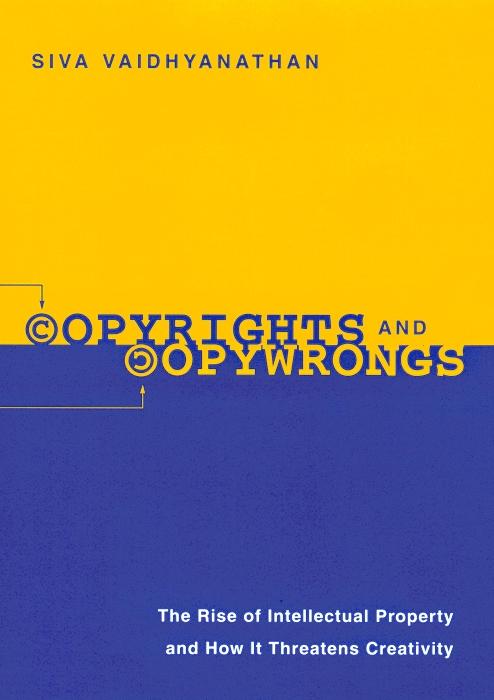
An in-depth look at American copyright law and the flaws of its current legal framework
Copyright reflects far more than economic interests. Embedded within conflicts over royalties and infringement are cultural values—about race, class, access, ownership, free speech, and democracy—which influence how rights are determined and enforced. Questions of legitimacy—of what constitutes “intellectual property” or “fair use,” and of how to locate a precise moment of cultural creation—have become enormously complicated in recent years, as advances in technology have exponentially increased the speed of cultural reproduction and dissemination.
In Copyrights and Copywrongs, Siva Vaidhyanathan tracks the history of American copyright law through the 20th century, from Mark Twain’s vehement exhortations for “thick” copyright protection, to recent lawsuits regarding sampling in rap music and the “digital moment,” exemplified by the rise of Napster and MP3 technology. He argues persuasively that in its current punitive, highly restrictive form, American copyright law hinders cultural production, thereby contributing to the poverty of civic culture.
In addition to choking cultural expression, recent copyright law, Vaidhyanathan argues, effectively sanctions biases against cultural traditions which differ from the Anglo-European model. In African-based cultures, borrowing from and building upon earlier cultural expressions is not considered a legal trespass, but a tribute. Rap and hip hop artists who practice such “borrowing” by sampling and mixing, however, have been sued for copyright violation and forced to pay substantial monetary damages. Similarly, the oral transmission of culture, which has a centuries-old tradition within African American culture, is complicated by current copyright laws. How, for example, can ownership of music, lyrics, or stories which have been passed down through generations be determined? Upon close examination, strict legal guidelines prove insensitive to the diverse forms of cultural expression prevalent in the United States, and reveal much about the racialized cultural values which permeate our system of laws. Ultimately, copyright is a necessary policy that should balance public and private interests but the recent rise of “intellectual property” as a concept have overthrown that balance. Copyright, Vaidhyanathan asserts, is policy, not property.
Bringing to light the republican principles behind original copyright laws as well as present-day imbalances and future possibilities for freer expression and artistic equity, this volume takes important strides towards unraveling the complex web of culture, law, race, and technology in today's global marketplace.
Betal nemt med kort, Klarna, Apple Pay eller Google Pay. Ikke tilfreds? Du har altid 14 dages fortrydelsesret. Læs mere i vores vilkår. Har du spørgsmål, så send os en mail på hello@memmo.org.
Memmo gør det nemmere at studere – uanset hvor du er i verden. Hos os samler du dine kursusbøger og smarte studieværktøjer ét sted: resuméer, quizzer, podcasts og flashcards. Og så er der Ted, din studieven, der svarer på alt, du undrer dig over. Over 50 000 studerende studerer allerede her – bygget til at hjælpe dig med at lære hurtigere og stresse mindre.