
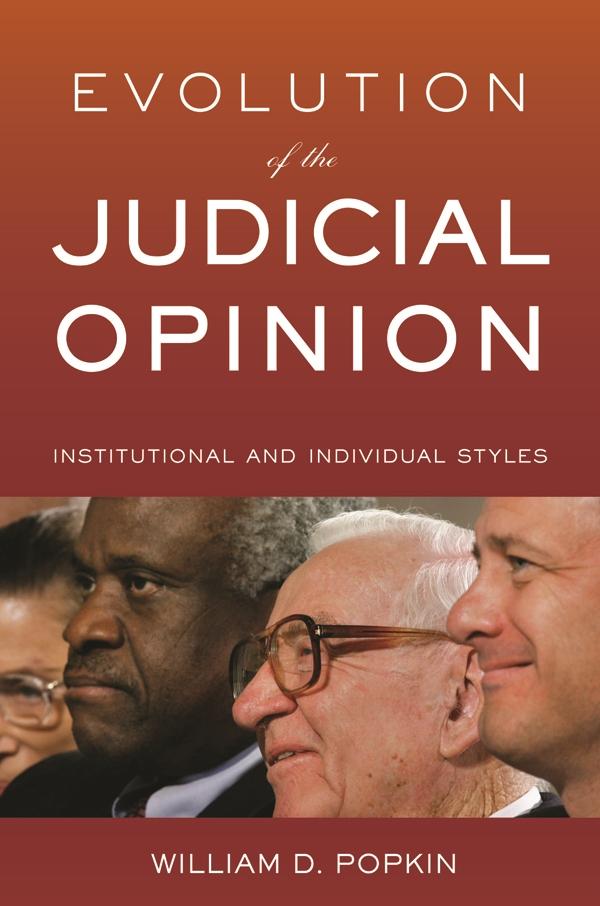
In this sweeping study of the judicial opinion, William D. Popkin examines how judges' opinions have been presented from the early American Republic to the present. Throughout history, he maintains, judges have presented their opinions within political contexts that involve projecting judicial authority to the external public, yet within a professional legal culture that requires opinions to develop judicial law through particular institutional and individual judicial styles.
Tracing the history of judicial opinion from its roots in English common law, Popkin documents a general shift from unofficially reported oral opinions, to semi-official reports, to the U.S. Supreme Court's adoption in the early nineteenth century of generally unanimous opinions. While this institutional base was firmly established by the twentieth century, Popkin suggests that the modern U.S. judicial opinion has reverted—in some respects—to one in which each judge expresses an individual point of view. Ultimately, he concludes that a shift from an authoritative to a more personal and exploratory individual style of writing opinions is consistent with a more democratic judicial institution.
Betal nemt med kort, Klarna, Apple Pay eller Google Pay. Ikke tilfreds? Du har altid 14 dages fortrydelsesret. Læs mere i vores vilkår. Har du spørgsmål, så send os en mail på hello@memmo.org.
Memmo gør det nemmere at studere – uanset hvor du er i verden. Hos os samler du dine kursusbøger og smarte studieværktøjer ét sted: resuméer, quizzer, podcasts og flashcards. Og så er der Ted, din studieven, der svarer på alt, du undrer dig over. Over 50 000 studerende studerer allerede her – bygget til at hjælpe dig med at lære hurtigere og stresse mindre.