
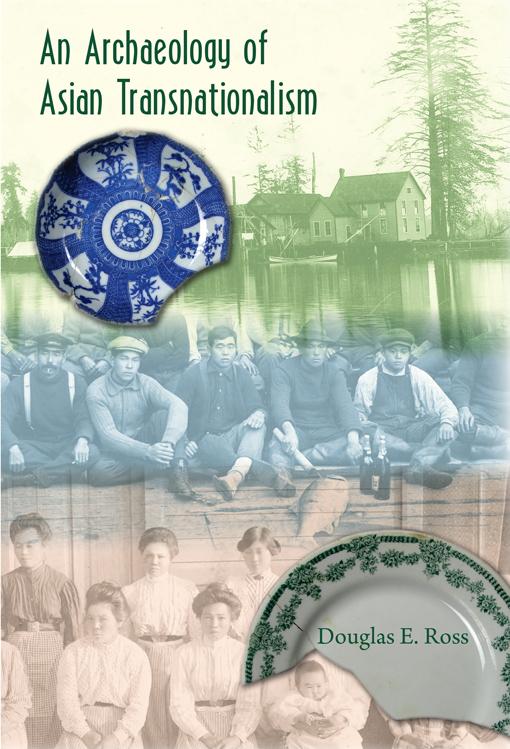
In the early twentieth century, an industrial salmon cannery thrived along the Fraser River in British Columbia. Chinese factory workers lived in an adjoining bunkhouse, and Japanese fishermen lived with their families in a nearby camp. Today the complex is nearly gone and the site overgrown with vegetation, but artifacts from these immigrant communities linger just beneath the surface.
In this groundbreaking comparative archaeological study of Asian immigrants in North America, Douglas Ross excavates the Ewen Cannery to explore how its immigrant workers formed a new cultural identity in the face of dramatic displacement. Ross demonstrates how some homeland practices persisted while others changed in response to new contextual factors, reflecting the complexity of migrant experiences. Instead of treating ethnicity as a bounded, stable category, Ross shows that ethnic identity is shaped and transformed as cultural traditions from home and host societies come together in the context of local choices, structural constraints, and consumer society.
Betal nemt med kort, Klarna, Apple Pay eller Google Pay. Ikke tilfreds? Du har altid 14 dages fortrydelsesret. Læs mere i vores vilkår. Har du spørgsmål, så send os en mail på hello@memmo.org.
Memmo gør det nemmere at studere – uanset hvor du er i verden. Hos os samler du dine kursusbøger og smarte studieværktøjer ét sted: resuméer, quizzer, podcasts og flashcards. Og så er der Ted, din studieven, der svarer på alt, du undrer dig over. Over 50 000 studerende studerer allerede her – bygget til at hjælpe dig med at lære hurtigere og stresse mindre.