
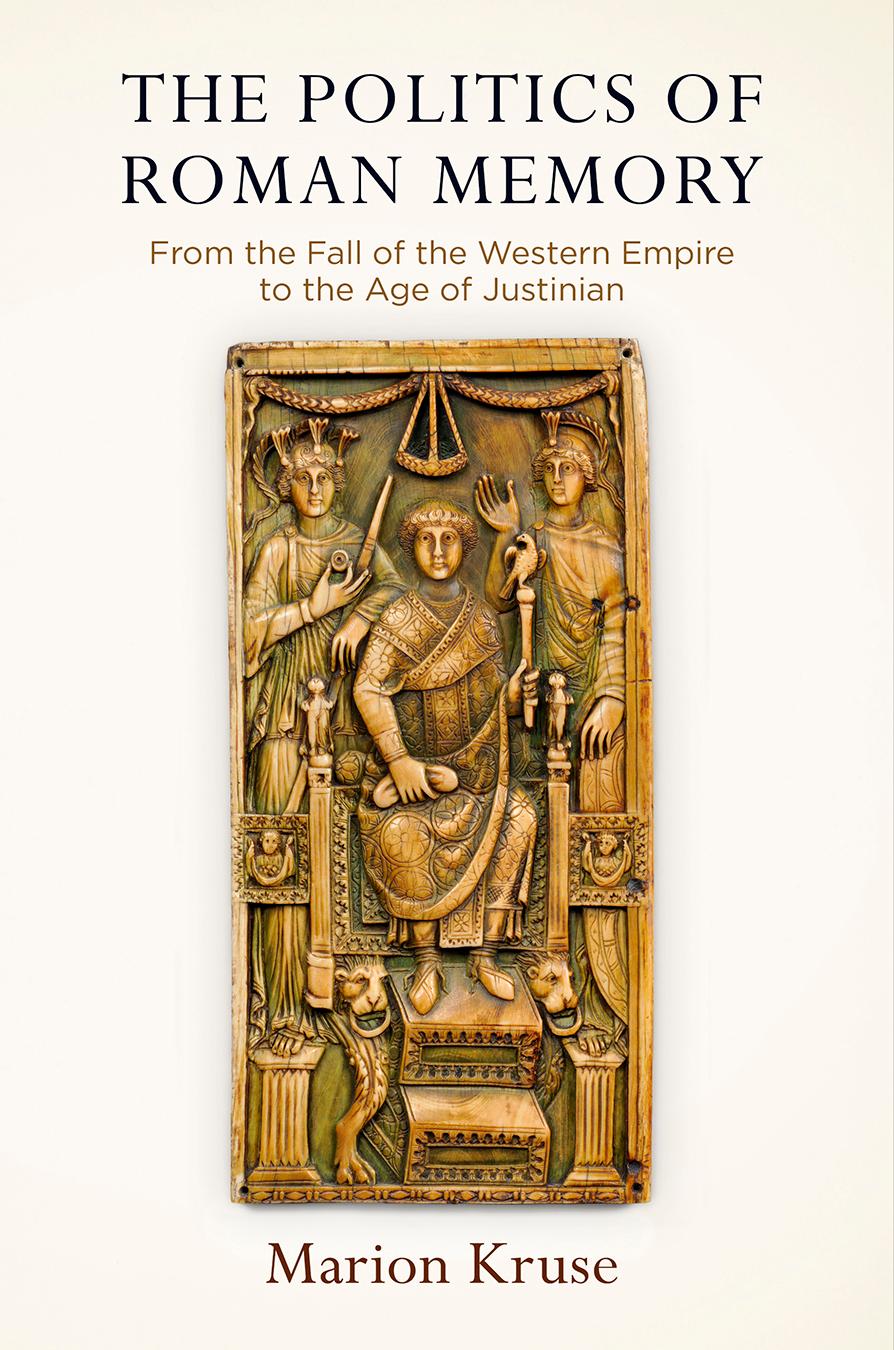
What did it mean to be Roman after the fall of the western Roman empire in 476, and what were the implications of new formulations of Roman identity for the inhabitants of both east and west? How could an empire be Roman when it was, in fact, at war with Rome? How did these issues motivate and shape historical constructions of Constantinople as the New Rome? And how did the idea that a Roman empire could fall influence political rhetoric in Constantinople? In The Politics of Roman Memory, Marion Kruse visits and revisits these questions to explore the process by which the emperors, historians, jurists, antiquarians, and poets of the eastern Roman empire employed both history and mythologized versions of the same to reimagine themselves not merely as Romans but as the only Romans worthy of the name.
The Politics of Roman Memory challenges conventional narratives of the transformation of the classical world, the supremacy of Christian identity in late antiquity, and the low literary merit of writers in this period. Kruse reconstructs a coherent intellectual movement in Constantinople that redefined Romanness in a Constantinopolitan idiom through the manipulation of Roman historical memory. Debates over the historical parameters of Romanness drew the attention of figures as diverse as Zosimos—long dismissed as a cranky pagan outlier, but here rehabilitated—and the emperor Justinian, as well as the major authors of Justinian's reign, such as Prokopios, Ioannes Lydos, and Jordanes. Finally, by examining the narratives embedded in Justinian's laws, Kruse demonstrates the importance of historical memory to the construction of imperial authority.
Betal nemt med kort, Klarna, Apple Pay eller Google Pay. Ikke tilfreds? Du har altid 14 dages fortrydelsesret. Læs mere i vores vilkår. Har du spørgsmål, så send os en mail på hello@memmo.org.
Memmo gør det nemmere at studere – uanset hvor du er i verden. Hos os samler du dine kursusbøger og smarte studieværktøjer ét sted: resuméer, quizzer, podcasts og flashcards. Og så er der Ted, din studieven, der svarer på alt, du undrer dig over. Over 50 000 studerende studerer allerede her – bygget til at hjælpe dig med at lære hurtigere og stresse mindre.