
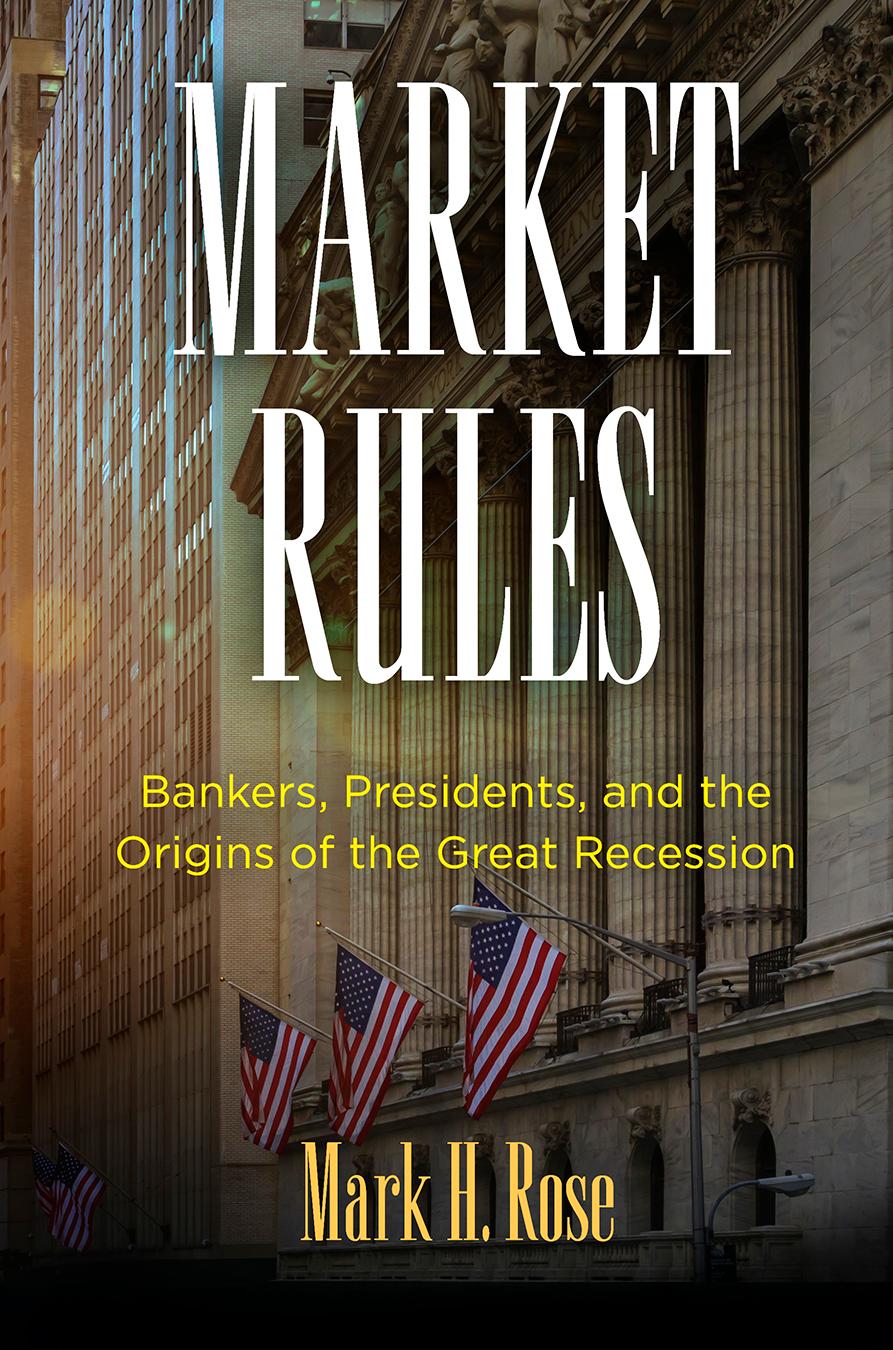
Although most Americans attribute shifting practices in the financial industry to the invisible hand of the market, Mark H. Rose reveals the degree to which presidents, legislators, regulators, and even bankers themselves have long taken an active interest in regulating the industry.
In 1971, members of Richard Nixon's Commission on Financial Structure and Regulation described the banks they sought to create as "supermarkets." Analogous to the twentieth-century model of a store at which Americans could buy everything from soft drinks to fresh produce, supermarket banks would accept deposits, make loans, sell insurance, guide mergers and acquisitions, and underwrite stock and bond issues. The supermarket bank presented a radical departure from the financial industry as it stood, composed as it was of local savings and loans, commercial banks, investment banks, mutual funds, and insurance firms. Over the next four decades, through a process Rose describes as "grinding politics," supermarket banks became the guiding model of the financial industry. As the banking industry consolidated, it grew too large while remaining too fragmented and unwieldy for politicians to regulate and for regulators to understand—until, in 2008, those supermarket banks, such as Citigroup, needed federal help to survive and prosper once again.
Rose explains the history of the financial industry as a story of individuals—some well-known, like Presidents Kennedy, Carter, Reagan, and Clinton; Treasury Secretaries Donald Regan and Timothy Geithner; and JP Morgan CEO Jamie Dimon; and some less so, though equally influential, such as Kennedy's Comptroller of the Currency James J. Saxon, Citicorp CEO Walter Wriston, and Bank of America CEOs Hugh McColl and Kenneth Lewis. Rose traces the evolution of supermarket banks from the early days of the Kennedy administration, through the financial crisis of 2008, and up to the Trump administration's attempts to modify bank rules. Deeply researched and accessibly written, Market Rules demystifies the major trends in the banking industry and brings financial policy to life.
Betal nemt med kort, Klarna, Apple Pay eller Google Pay. Ikke tilfreds? Du har altid 14 dages fortrydelsesret. Læs mere i vores vilkår. Har du spørgsmål, så send os en mail på hello@memmo.org.
Memmo gør det nemmere at studere – uanset hvor du er i verden. Hos os samler du dine kursusbøger og smarte studieværktøjer ét sted: resuméer, quizzer, podcasts og flashcards. Og så er der Ted, din studieven, der svarer på alt, du undrer dig over. Over 50 000 studerende studerer allerede her – bygget til at hjælpe dig med at lære hurtigere og stresse mindre.