
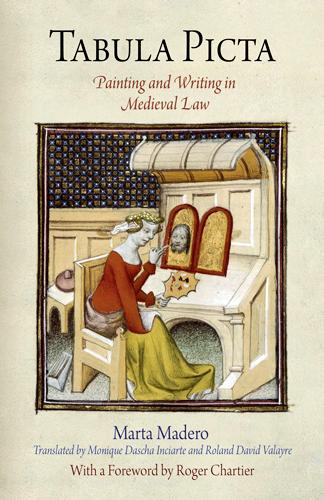
To whom does a painted tablet—a tabula picta—belong? To the owner of the physical piece of wood on which an image is painted? Or to the person who made the painting on that piece of wood? By extension, one might ask, who is the owner of a text? Is it the person who has written the words, or the individual who possesses the piece of parchment or slab of stone on which those words are inscribed?
In Tabula Picta Marta Madero turns to the extensive glosses and commentaries that medieval jurists dedicated to the above questions when articulating a notion of intellectual and artistic property radically different from our own. The most important goal for these legal thinkers, Madero argues, was to situate things—whatever they might be—within a logical framework that would allow for their description, categorization, and placement within a proper hierarchical order. Only juridical reasoning, they claimed, was capable of sorting out the individual elements that nature or human art had brought together in a single unit; by establishing sets of distinctions and taxonomies worthy of Borges, legal discourse sought to demonstrate that behind the deceptive immediacy of things, lie the concepts and arguments of what one might call the artifices of the concrete.
Betal nemt med kort, Klarna, Apple Pay eller Google Pay. Ikke tilfreds? Du har altid 14 dages fortrydelsesret. Læs mere i vores vilkår. Har du spørgsmål, så send os en mail på hello@memmo.org.
Memmo gør det nemmere at studere – uanset hvor du er i verden. Hos os samler du dine kursusbøger og smarte studieværktøjer ét sted: resuméer, quizzer, podcasts og flashcards. Og så er der Ted, din studieven, der svarer på alt, du undrer dig over. Over 50 000 studerende studerer allerede her – bygget til at hjælpe dig med at lære hurtigere og stresse mindre.