
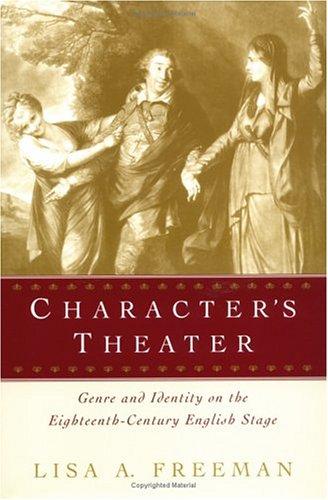
If the whole world acted the player, how did the player act the world? In Character's Theater, Lisa A. Freeman uses this question to test recent critical discussion of eighteenth-century literature and culture. Much current work, she observes, focuses on the concept of theatricality as both the governing metaphor of social life and a primary filter of psychic perception. Hume's "theater of the mind," Adam Smith's "impartial spectator," and Diderot's "tableaux" are all invoked by theorists to describe a process whereby the private individual comes to internalize theatrical logic and apprehend the self as other. To them theatricality is a critical mechanism of modern subjectivity but one that needs to be concealed if the subject's stability is to be maintained.
Finding that much of this discussion about the "Age of the Spectator" has been conducted without reference to the play texts or actual theatrical practice, Freeman turns to drama and discovers a dynamic model of identity based on eighteenth-century conceptualizations of character. In contrast to the novel, which cultivated psychological tensions between private interiority and public show, dramatic characters in the eighteenth century experienced no private thoughts. The theater of the eighteenth century was not a theater of absorption but rather a theater of interaction, where what was monitored was not the depth of character, as in the novel, but the arc of a genre over the course of a series of discontinuous acts.
In a genre-by-genre analysis of plays about plays, tragedy, comedies of manners, humours, and intrigue, and sentimental comedy, Freeman offers an interpretive account of eighteenth-century drama and its cultural work and demonstrates that by deploying an alternative model of identity, theater marked a site of resistance to the rise of the subject and to the ideological conformity enforced through that identity formation.
Betal nemt med kort, Klarna, Apple Pay eller Google Pay. Ikke tilfreds? Du har altid 14 dages fortrydelsesret. Læs mere i vores vilkår. Har du spørgsmål, så send os en mail på hello@memmo.org.
Memmo gør det nemmere at studere – uanset hvor du er i verden. Hos os samler du dine kursusbøger og smarte studieværktøjer ét sted: resuméer, quizzer, podcasts og flashcards. Og så er der Ted, din studieven, der svarer på alt, du undrer dig over. Over 50 000 studerende studerer allerede her – bygget til at hjælpe dig med at lære hurtigere og stresse mindre.