
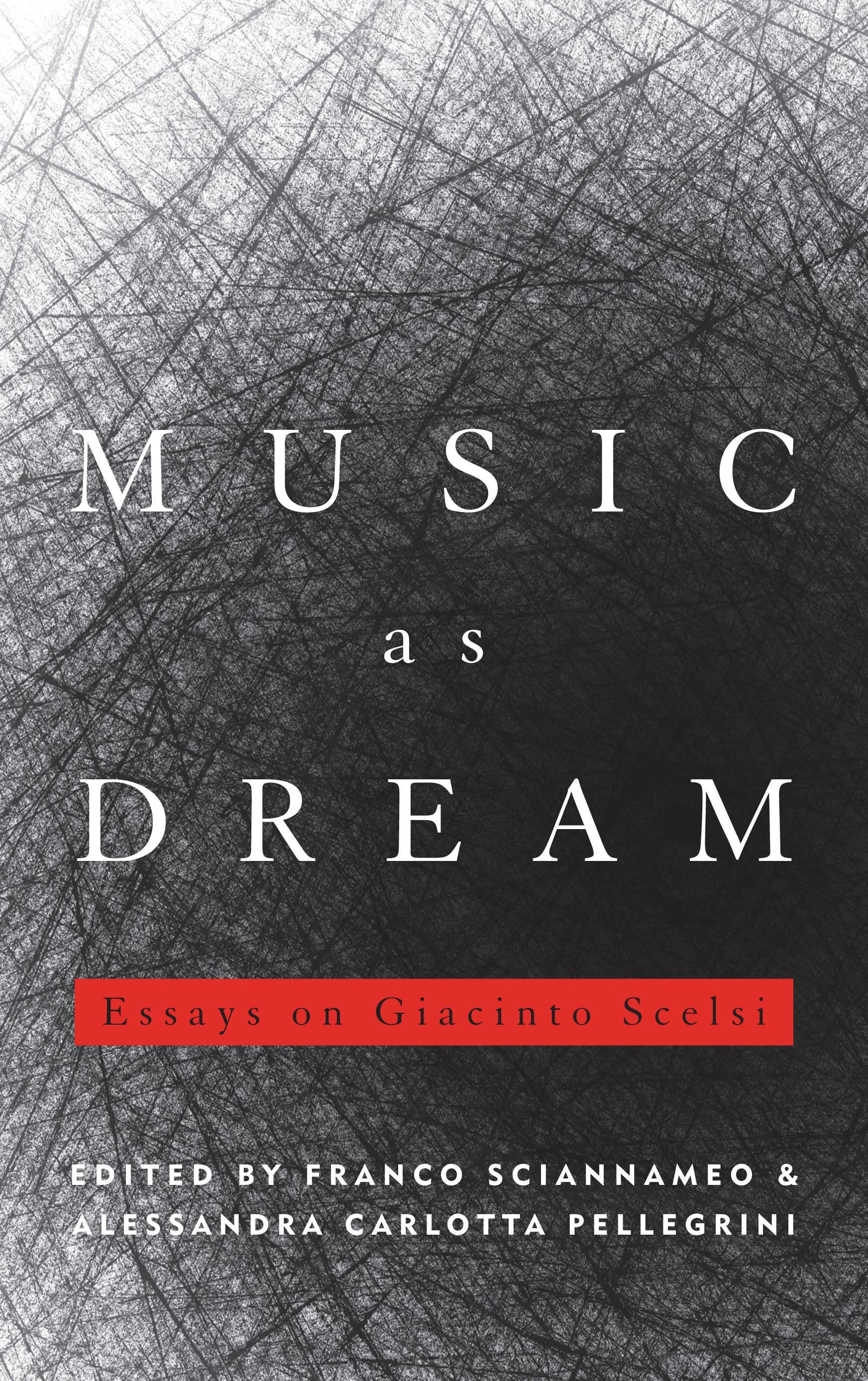
Music as Dream: Essays on Giacinto Scelsi showcases recent scholarly criticism on the music and philosophy of the brilliantly original composer Giacinto Scelsi. In this collection, Franco Sciannameo and Alessandra Carlotta Pellegrini select and translate into English for the first time essays that reflect the evolution of recent scholarship on Scelsi’s musical compositions. Music as Dream opens with “The Scelsi Case,” which erupted shortly after Scelsi’s death in 1988 when composer Vieri Tosatti claimed ownership of his works. This quarrel reached its zenith in the pages of PianoTime’s March 1989 issue, where musicologist Guido Zaccagnini questioned a group of noted composers, writers, and arts managers about whether a composer can claim sole authorship for a work accomplished in collaboration with others.
The essays are wide-ranging in scope. French musicologist Michelle Biget-Mainfroy, a specialist in “gestural” piano writing, offers an in-depth study of Scelsi’s complex piano output; Gianmario Borio looks at Scelsi’s “Sound as Compositional Process”; Alessandra Montali examines and details Scelsi’s theoretical and literary writings; Luciano Martinis and Franco Sciannameo explore the lives and whereabouts of obscure composers Giacinto Sallustio, Walther Klein, and Richard Falk, who were Scelsi’s collaborators until the early 1940s when Tosatti took sole charge; Alessandra Carlotta Pellegrini elaborates on Scelsi’s most important composition of his first period, presenting a tour-de-force that pieces together its complex story through research at the newly organized Scelsi Archive at the Fondazione Isabella Scelsi in Rome; and Friedrich Jaecker’s and Sandro Marrocu’s essays also draw on research conducted at the archive of Fondazione. Finally, an updated bibliography and discography conclude the book
The essays are wide-ranging in scope. French musicologist Michelle Biget-Mainfroy, a specialist in “gestural” piano writing, offers an in-depth study of Scelsi’s complex piano output; Gianmario Borio looks at Scelsi’s “Sound as Compositional Process”; Alessandra Montali examines and details Scelsi’s theoretical and literary writings; Luciano Martinis and Franco Sciannameo explore the lives and whereabouts of obscure composers Giacinto Sallustio, Walther Klein, and Richard Falk, who were Scelsi’s collaborators until the early 1940s when Tosatti took sole charge; Alessandra Carlotta Pellegrini elaborates on Scelsi’s most important composition of his first period, presenting a tour-de-force that pieces together its complex story through research at the newly organized Scelsi Archive at the Fondazione Isabella Scelsi in Rome; and Friedrich Jaecker’s and Sandro Marrocu’s essays also draw on research conducted at the archive of Fondazione. Finally, an updated bibliography and discography conclude the book
Betal nemt med kort, Klarna, Apple Pay eller Google Pay. Ikke tilfreds? Du har altid 14 dages fortrydelsesret. Læs mere i vores vilkår. Har du spørgsmål, så send os en mail på hello@memmo.org.
Memmo gør det nemmere at studere – uanset hvor du er i verden. Hos os samler du dine kursusbøger og smarte studieværktøjer ét sted: resuméer, quizzer, podcasts og flashcards. Og så er der Ted, din studieven, der svarer på alt, du undrer dig over. Over 50 000 studerende studerer allerede her – bygget til at hjælpe dig med at lære hurtigere og stresse mindre.