
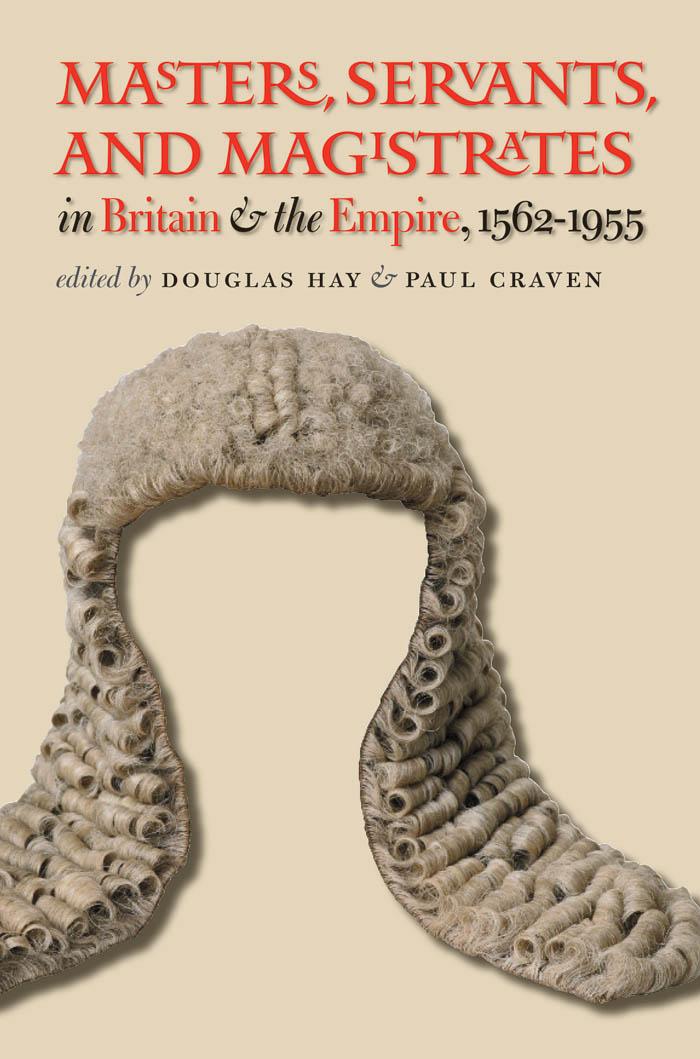
Master and servant acts, the cornerstone of English employment law for more than four hundred years, gave largely unsupervised, inferior magistrates wide discretion over employment relations, including the power to whip, fine, and imprison men, women, and children for breach of private contracts with their employers. The English model was adopted, modified, and reinvented in more than a thousand colonial statutes and ordinances regulating the recruitment, retention, and discipline of workers in shops, mines, and factories; on farms, in forests, and on plantations; and at sea. This collection presents the first integrated comparative account of employment law, its enforcement, and its importance throughout the British Empire.
Sweeping in its geographic and temporal scope, this volume tests the relationship between enacted law and enforced law in varied settings, with different social and racial structures, different economies, and different constitutional relationships to Britain. Investigations of the enforcement of master and servant law in England, the British Caribbean, India, Africa, Hong Kong, Canada, Australia, and colonial America shed new light on the nature of law and legal institutions, the role of inferior courts in compelling performance, and the definition of “free labor” within a multiracial empire.
Contributors:
David M. Anderson, St. Antony’s College, Oxford
Michael Anderson, London School of Economics
Jerry Bannister, Dalhousie University, Nova Scotia
M. K. Banton, National Archives of the United Kingdom, London
Martin Chanock, La Trobe University, Australia
Paul Craven, York University
Juanita De Barros, McMaster University
Christopher Frank, University of Manitoba
Douglas Hay, York University
Prabhu P. Mohapatra, Delhi University, India
Christopher Munn, University of Hong Kong
Michael Quinlan, University of New South Wales
Richard Rathbone, University of Wales, Aberystwyth
Christopher Tomlins, American Bar Foundation, Chicago
Mary Turner, London University
Sweeping in its geographic and temporal scope, this volume tests the relationship between enacted law and enforced law in varied settings, with different social and racial structures, different economies, and different constitutional relationships to Britain. Investigations of the enforcement of master and servant law in England, the British Caribbean, India, Africa, Hong Kong, Canada, Australia, and colonial America shed new light on the nature of law and legal institutions, the role of inferior courts in compelling performance, and the definition of “free labor” within a multiracial empire.
Contributors:
David M. Anderson, St. Antony’s College, Oxford
Michael Anderson, London School of Economics
Jerry Bannister, Dalhousie University, Nova Scotia
M. K. Banton, National Archives of the United Kingdom, London
Martin Chanock, La Trobe University, Australia
Paul Craven, York University
Juanita De Barros, McMaster University
Christopher Frank, University of Manitoba
Douglas Hay, York University
Prabhu P. Mohapatra, Delhi University, India
Christopher Munn, University of Hong Kong
Michael Quinlan, University of New South Wales
Richard Rathbone, University of Wales, Aberystwyth
Christopher Tomlins, American Bar Foundation, Chicago
Mary Turner, London University
Betal nemt med kort, Klarna, Apple Pay eller Google Pay. Ikke tilfreds? Du har altid 14 dages fortrydelsesret. Læs mere i vores vilkår. Har du spørgsmål, så send os en mail på hello@memmo.org.
Memmo gør det nemmere at studere – uanset hvor du er i verden. Hos os samler du dine kursusbøger og smarte studieværktøjer ét sted: resuméer, quizzer, podcasts og flashcards. Og så er der Ted, din studieven, der svarer på alt, du undrer dig over. Over 50 000 studerende studerer allerede her – bygget til at hjælpe dig med at lære hurtigere og stresse mindre.
Du kan måske også lide
Køb bogen0