
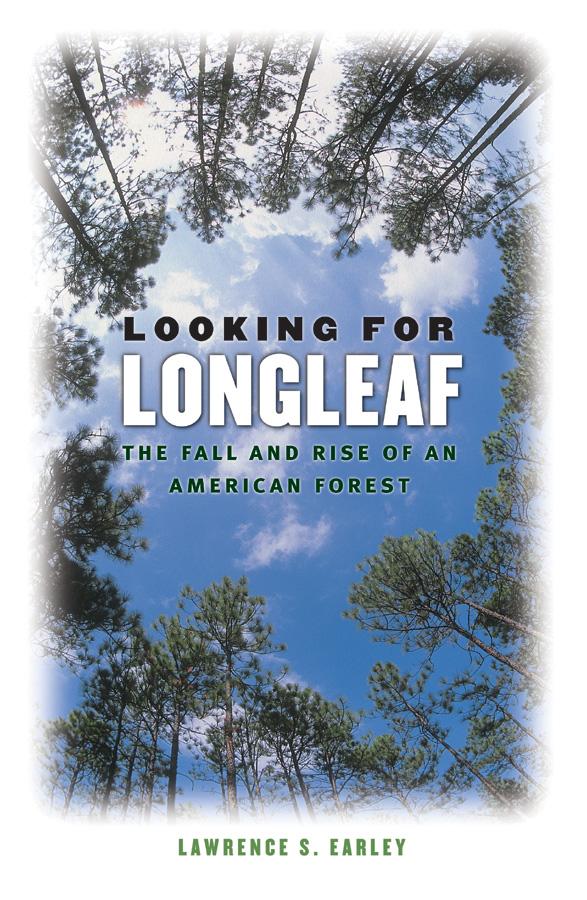
Covering 92 million acres from Virginia to Texas, the longleaf pine ecosystem was, in its prime, one of the most extensive and biologically diverse ecosystems in North America. Today these magnificent forests have declined to a fraction of their original extent, threatening such species as the gopher tortoise, the red-cockaded woodpecker, and the Venus fly-trap. Conservationists have proclaimed longleaf restoration a major goal, but has it come too late?
In Looking for Longleaf, Lawrence S. Earley explores the history of these forests and the astonishing biodiversity of the longleaf ecosystem, drawing on extensive research and telling the story through first-person travel accounts and interviews with foresters, ecologists, biologists, botanists, and landowners. For centuries, these vast grass-covered forests provided pasture for large cattle herds, in addition to serving as the world’s greatest source of naval stores. They sustained the exploitative turpentine and lumber industries until nearly all of the virgin longleaf had vanished.
Looking for Longleaf demonstrates how, in the twentieth century, forest managers and ecologists struggled to understand the special demands of longleaf and to halt its overall decline. The compelling story Earley tells here offers hope that with continued human commitment, the longleaf pine might not just survive, but once again thrive.
In Looking for Longleaf, Lawrence S. Earley explores the history of these forests and the astonishing biodiversity of the longleaf ecosystem, drawing on extensive research and telling the story through first-person travel accounts and interviews with foresters, ecologists, biologists, botanists, and landowners. For centuries, these vast grass-covered forests provided pasture for large cattle herds, in addition to serving as the world’s greatest source of naval stores. They sustained the exploitative turpentine and lumber industries until nearly all of the virgin longleaf had vanished.
Looking for Longleaf demonstrates how, in the twentieth century, forest managers and ecologists struggled to understand the special demands of longleaf and to halt its overall decline. The compelling story Earley tells here offers hope that with continued human commitment, the longleaf pine might not just survive, but once again thrive.
Betal nemt med kort, Klarna, Apple Pay eller Google Pay. Ikke tilfreds? Du har altid 14 dages fortrydelsesret. Læs mere i vores vilkår. Har du spørgsmål, så send os en mail på hello@memmo.org.
Memmo gør det nemmere at studere – uanset hvor du er i verden. Hos os samler du dine kursusbøger og smarte studieværktøjer ét sted: resuméer, quizzer, podcasts og flashcards. Og så er der Ted, din studieven, der svarer på alt, du undrer dig over. Over 50 000 studerende studerer allerede her – bygget til at hjælpe dig med at lære hurtigere og stresse mindre.
Du kan måske også lide
Køb bogen0