
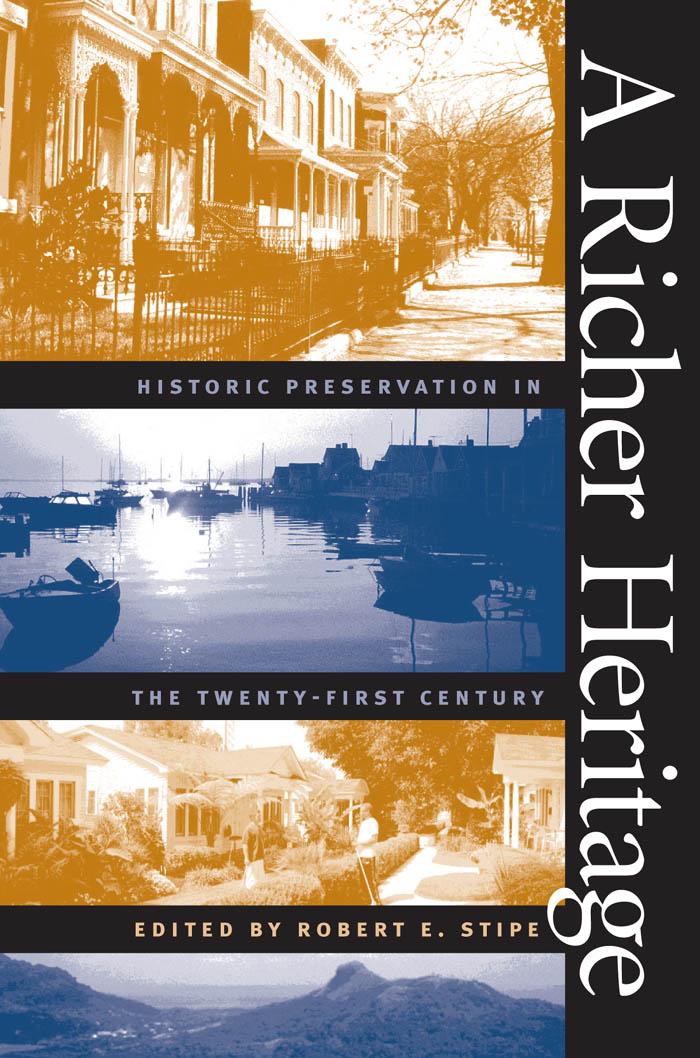
Surveying the past, present, and future of historic preservation in America, this book features fifteen essays by some of the most important voices in the field. A Richer Heritage will be an essential, thought-provoking guide for professionals as well as administrators, volunteers, and policy makers involved in preservation efforts.
An introduction traces the evolution of historic preservation in America, highlighting the principal ideas and events that have shaped and continue to shape the movement. The book also describes the workings — legal, administrative, and fiscal — of the layered federal, state, and local government partnership put in place by Congress in 1966. Individual chapters explore the preservation of designed and vernacular landscapes, the relationship between historic preservation and the larger environmental and land-trust movements, the role of new private and nonprofit players, racial and ethnic interests in historic preservation, and the preservation of our intangible cultural values. A concluding chapter analyzes the present state of the historic preservation movement and suggests future directions for the field in the twenty-first century.
Contributors include preservationists, local-government citizen activists, an architect, landscape architects, environmentalists, an archaeologist, a real-estate developer, historians, a Native American tribal leader, an ethnologist, and lawyers.
An introduction traces the evolution of historic preservation in America, highlighting the principal ideas and events that have shaped and continue to shape the movement. The book also describes the workings — legal, administrative, and fiscal — of the layered federal, state, and local government partnership put in place by Congress in 1966. Individual chapters explore the preservation of designed and vernacular landscapes, the relationship between historic preservation and the larger environmental and land-trust movements, the role of new private and nonprofit players, racial and ethnic interests in historic preservation, and the preservation of our intangible cultural values. A concluding chapter analyzes the present state of the historic preservation movement and suggests future directions for the field in the twenty-first century.
Contributors include preservationists, local-government citizen activists, an architect, landscape architects, environmentalists, an archaeologist, a real-estate developer, historians, a Native American tribal leader, an ethnologist, and lawyers.
Betal nemt med kort, Klarna, Apple Pay eller Google Pay. Ikke tilfreds? Du har altid 14 dages fortrydelsesret. Læs mere i vores vilkår. Har du spørgsmål, så send os en mail på hello@memmo.org.
Memmo gør det nemmere at studere – uanset hvor du er i verden. Hos os samler du dine kursusbøger og smarte studieværktøjer ét sted: resuméer, quizzer, podcasts og flashcards. Og så er der Ted, din studieven, der svarer på alt, du undrer dig over. Over 50 000 studerende studerer allerede her – bygget til at hjælpe dig med at lære hurtigere og stresse mindre.
Du kan måske også lide
Køb bogen0