
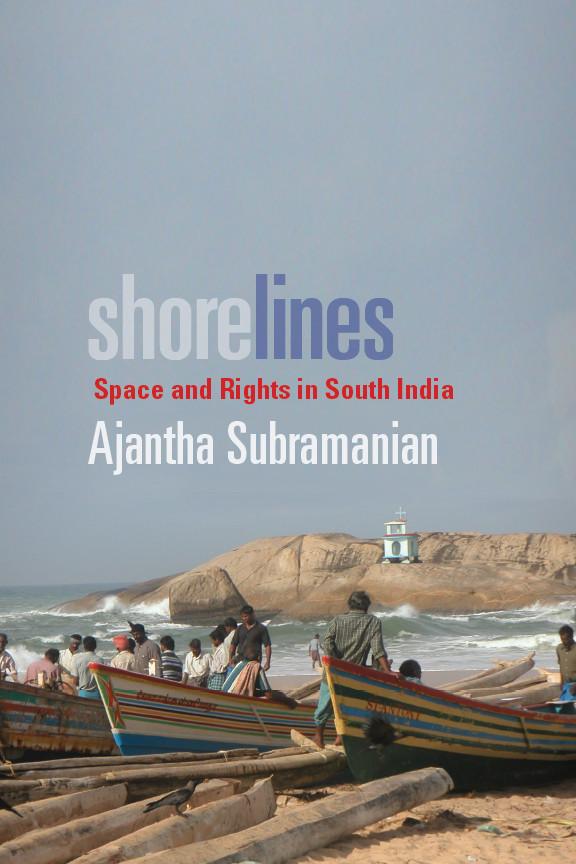
After a clerical sanction prohibited them from fishing for a week, a group of Catholic fishers from a village on India's southwestern coast took their church to court. They called on the state to recognize them as custodians of the local sea, protect their right to regulate trawling, and reject the church's intermediary role.
In Shorelines, Ajantha Subramanian argues that their struggle requires a rethinking of Indian democracy, citizenship, and environmentalism. Rather than see these fishers as non-moderns inhabiting a bounded cultural world, or as moderns wholly captured by the logic of state power, she illustrates how they constitute themselves as political subjects. In particular, she shows how they produced new geographies—of regionalism, common property, alternative technology, and fisher citizenship—that underpinned claims to rights, thus using space as an instrument of justice. Moving beyond the romantic myth of self-contained, natural-resource dependent populations, this work reveals the charged political maneuvers that bound subalterns and sovereigns in South Asia.
In rich historical and ethnographic detail, Shorelines illuminates postcolonial rights politics as the product of particular histories of caste, religion, and development, allowing us to see how democracy is always "provincial."
Betal nemt med kort, Klarna, Apple Pay eller Google Pay. Ikke tilfreds? Du har altid 14 dages fortrydelsesret. Læs mere i vores vilkår. Har du spørgsmål, så send os en mail på hello@memmo.org.
Memmo gør det nemmere at studere – uanset hvor du er i verden. Hos os samler du dine kursusbøger og smarte studieværktøjer ét sted: resuméer, quizzer, podcasts og flashcards. Og så er der Ted, din studieven, der svarer på alt, du undrer dig over. Over 50 000 studerende studerer allerede her – bygget til at hjælpe dig med at lære hurtigere og stresse mindre.