
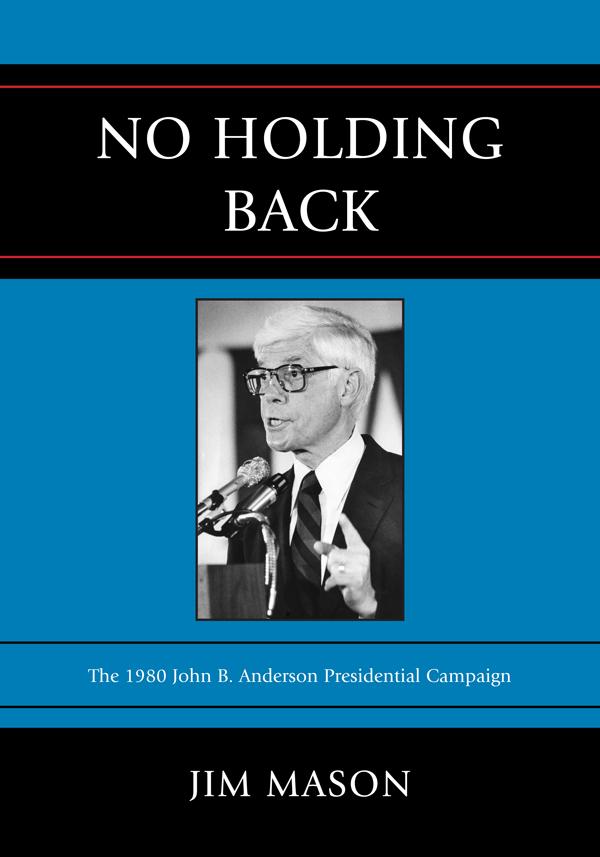
No Holding Back tells the story of John Anderson's 1980 presidential campaign. Anderson gave up a safe seat in the House of Representatives, a position in the Republican leadership, and a likely nomination for a Senate seat to run what every expert considered a hopeless race for the GOP presidential nomination. Anderson did so because he was disturbed by many of the same trends in American politics that still exist today: the proliferation of special interests, gridlock on Capitol Hill, and the unwillingness of his fellow politicians to speak honestly about the critical issues facing the nation. More than anything, Anderson wanted to make a statement about how candidates ought to run for office: by rejecting quick-fix solutions, being candid on where one stood on matters of policy, and not sugarcoating the problems that faced voters.
Anderson ran as a kind of anti-candidate. He had a unique campaigning style and offered proposals that differed greatly from the standard Republican viewpoint. People found him refreshingly direct and different. As interest turned to the campaign, he attracted widespread media attention. He performed beyond expectations in the first round of primaries and soon switched to an independent candidacy. By June, he was running at 26% in a three-way race against Jimmy Carter and Ronald Reagan. Against the backdrop of runaway inflation, the Iranian hostage situation, a debilitating energy crisis, and a discredited incumbent president, pollsters found him winning unprecedented support. But during the summer, troubled by ballot access problems, financial issues, institutional obstacles, and management difficulties, Anderson's polling totals began to fall. Once it became clear that he would not win, his support collapsed and he limped to a 7% finish.
This final result has greatly undermined the importance of this campaign. It has influenced numerous future candidates and changed the way many politicians would run for office. His was the first candidacy to expose how
Anderson ran as a kind of anti-candidate. He had a unique campaigning style and offered proposals that differed greatly from the standard Republican viewpoint. People found him refreshingly direct and different. As interest turned to the campaign, he attracted widespread media attention. He performed beyond expectations in the first round of primaries and soon switched to an independent candidacy. By June, he was running at 26% in a three-way race against Jimmy Carter and Ronald Reagan. Against the backdrop of runaway inflation, the Iranian hostage situation, a debilitating energy crisis, and a discredited incumbent president, pollsters found him winning unprecedented support. But during the summer, troubled by ballot access problems, financial issues, institutional obstacles, and management difficulties, Anderson's polling totals began to fall. Once it became clear that he would not win, his support collapsed and he limped to a 7% finish.
This final result has greatly undermined the importance of this campaign. It has influenced numerous future candidates and changed the way many politicians would run for office. His was the first candidacy to expose how
Betal nemt med kort, Klarna, Apple Pay eller Google Pay. Ikke tilfreds? Du har altid 14 dages fortrydelsesret. Læs mere i vores vilkår. Har du spørgsmål, så send os en mail på hello@memmo.org.
Memmo gør det nemmere at studere – uanset hvor du er i verden. Hos os samler du dine kursusbøger og smarte studieværktøjer ét sted: resuméer, quizzer, podcasts og flashcards. Og så er der Ted, din studieven, der svarer på alt, du undrer dig over. Over 50 000 studerende studerer allerede her – bygget til at hjælpe dig med at lære hurtigere og stresse mindre.