
Rebels of the South! It is better to die on your feet than to live on your knees.
-Inscription dated April 11, 1919, one day after the assassination of Emiliano Zapata, carved on a post at the Borda Garden in Cuernavaca, seen by Frank Tannenbaum in 1923. Peace by Revolution, An Interpretation of Mexico (New York, 1933), page179.
Do not wear a shirt of eleven yards, for he who wants to be a Redeemer will be crucified.
Guadalajara proverb, quoted in John Reed, Insurgent Mexico. 1914, page 78.
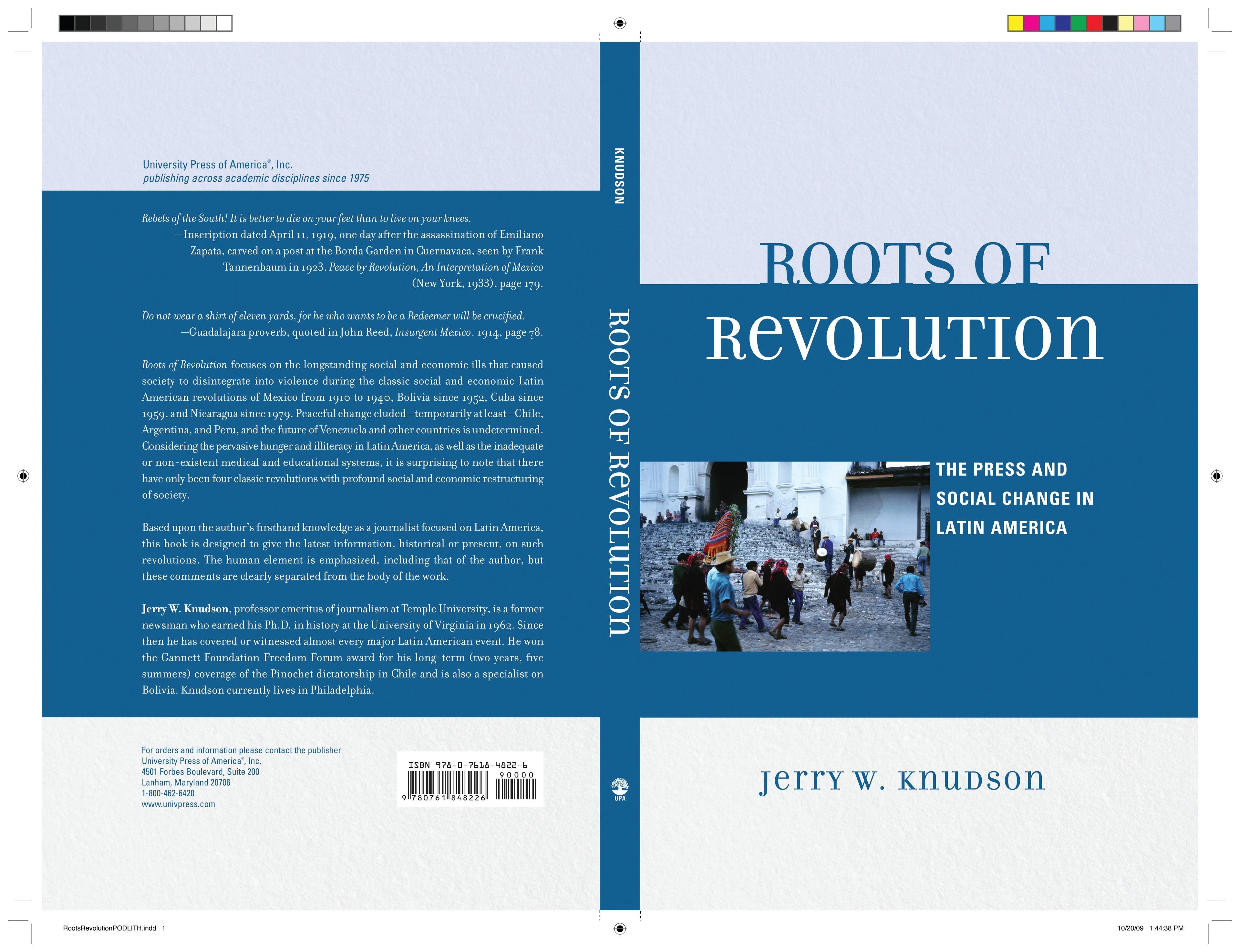
Roots of Revolution focuses on the longstanding social and economic ills that caused society to disintegrate into violence during the classic social and economic Latin American revolutions of Mexico from 1910 to 1940, Bolivia since 1952, Cuba since 1959, and Nicaragua since 1979. Peaceful change eluded - temporarily at least - Chile, Argentina and Peru, and the future of Venezuela and other countries is undetermined. Considering the pervasive hunger and illiteracy in Latin America, as well as the inadequate or non-existent medical and educational systems, it is surprising to note that there have only been four classic revolutions with profound social and economic restructuring of society.
Based upon the author's firsthand knowledge as a journalist focused on Latin America, this book is designed to give the latest information, historical or present, on such revolutions. The human element is emphasized, including that of the author, but these comments are clearly separated from the body of the work.
-Inscription dated April 11, 1919, one day after the assassination of Emiliano Zapata, carved on a post at the Borda Garden in Cuernavaca, seen by Frank Tannenbaum in 1923. Peace by Revolution, An Interpretation of Mexico (New York, 1933), page179.
Do not wear a shirt of eleven yards, for he who wants to be a Redeemer will be crucified.
Guadalajara proverb, quoted in John Reed, Insurgent Mexico. 1914, page 78.
Roots of Revolution focuses on the longstanding social and economic ills that caused society to disintegrate into violence during the classic social and economic Latin American revolutions of Mexico from 1910 to 1940, Bolivia since 1952, Cuba since 1959, and Nicaragua since 1979. Peaceful change eluded - temporarily at least - Chile, Argentina and Peru, and the future of Venezuela and other countries is undetermined. Considering the pervasive hunger and illiteracy in Latin America, as well as the inadequate or non-existent medical and educational systems, it is surprising to note that there have only been four classic revolutions with profound social and economic restructuring of society.
Based upon the author's firsthand knowledge as a journalist focused on Latin America, this book is designed to give the latest information, historical or present, on such revolutions. The human element is emphasized, including that of the author, but these comments are clearly separated from the body of the work.
Betal nemt med kort, Klarna, Apple Pay eller Google Pay. Ikke tilfreds? Du har altid 14 dages fortrydelsesret. Læs mere i vores vilkår. Har du spørgsmål, så send os en mail på hello@memmo.org.
Memmo gør det nemmere at studere – uanset hvor du er i verden. Hos os samler du dine kursusbøger og smarte studieværktøjer ét sted: resuméer, quizzer, podcasts og flashcards. Og så er der Ted, din studieven, der svarer på alt, du undrer dig over. Over 50 000 studerende studerer allerede her – bygget til at hjælpe dig med at lære hurtigere og stresse mindre.