
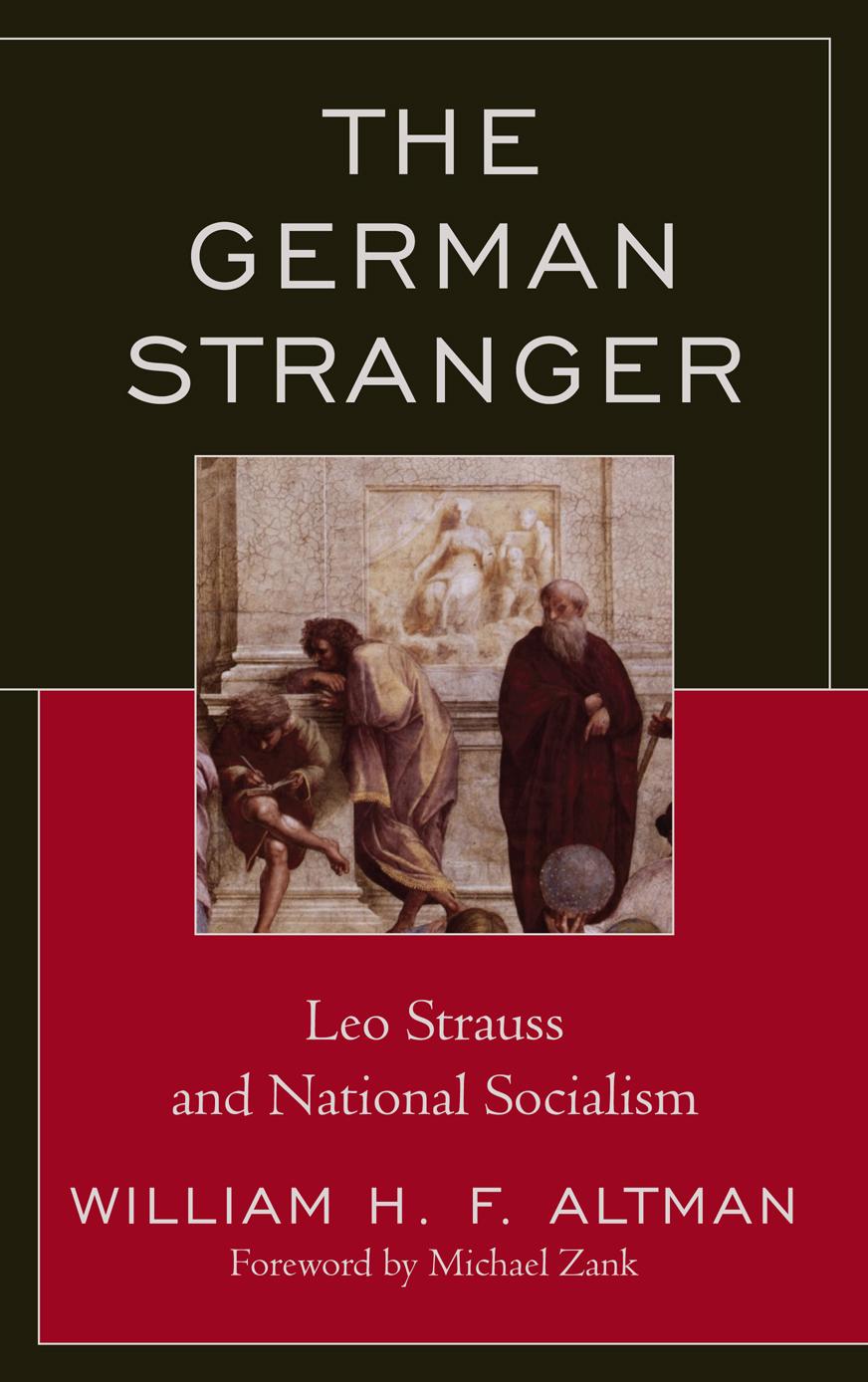
Leo Strauss's connection with Martin Heidegger and Carl Schmitt suggests a troubling proximity to National Socialism but a serious critique of Strauss must begin with F. H. Jacobi. While writing his dissertation on this apparently Christian opponent of the Enlightenment, Strauss discovered the tactical principles that would characterize his lifework: writing between the lines, a faith-based critique of rationalism, the deliberate secularization of religious language for irreligious purposes, and an "all or nothing" antagonism to middling solutions. Especially the latter is distinctive of his Zionist writings in the 1920s where Strauss engaged in an ongoing polemic against Cultural Zionism, attacking it first from an orthodox, and then from an atheist's perspective. In his last Zionist article (1929), Strauss mentions "the Machiavellian Zionism of a Nordau that would not fear to use the traditional hope for a Messiah as dynamite." By the time of his "change of orientation," National Socialism was being led by a nihilistic "Messiah" while Strauss had already radicalized Schmitt's "political theology" and Heidegger's deconstruction of the ontological Tradition. Central to Strauss's advance beyond the smartest Nazis is his "Second Cave" in which he claimed modern thought is imprisoned: only by escaping Revelation can we recover "natural ignorance." By using pseudo-Platonic imagery to illustrate what anti-Semites called "Jewification," Strauss attempted to annihilate the common ground, celebrated by Hermann Cohen, between Judaism and Platonism. Unlike those who attacked Plato for devaluing nature at the expense of the transcendent Idea, the émigré Strauss effectively employed a new "Plato" who was no more a Platonist than Nietzsche or Heidegger had been. Central to Strauss's "Platonic political philosophy" is the mysterious protagonist of Plato's Laws whom Strauss accurately recognized as the kind of Socrates whose fear of death would have caused him to flee the hemlock. Any reader who recognizes the unbridgeable gap between the real Socrates and Plato’s Athenian Stranger will understand why “the German Stranger” is the principal theoretician of an atheistic re-enactment of religion, of which genus National Socialism is an ultra-modern species.
Betal nemt med kort, Klarna, Apple Pay eller Google Pay. Ikke tilfreds? Du har altid 14 dages fortrydelsesret. Læs mere i vores vilkår. Har du spørgsmål, så send os en mail på hello@memmo.org.
Memmo gør det nemmere at studere – uanset hvor du er i verden. Hos os samler du dine kursusbøger og smarte studieværktøjer ét sted: resuméer, quizzer, podcasts og flashcards. Og så er der Ted, din studieven, der svarer på alt, du undrer dig over. Over 50 000 studerende studerer allerede her – bygget til at hjælpe dig med at lære hurtigere og stresse mindre.