
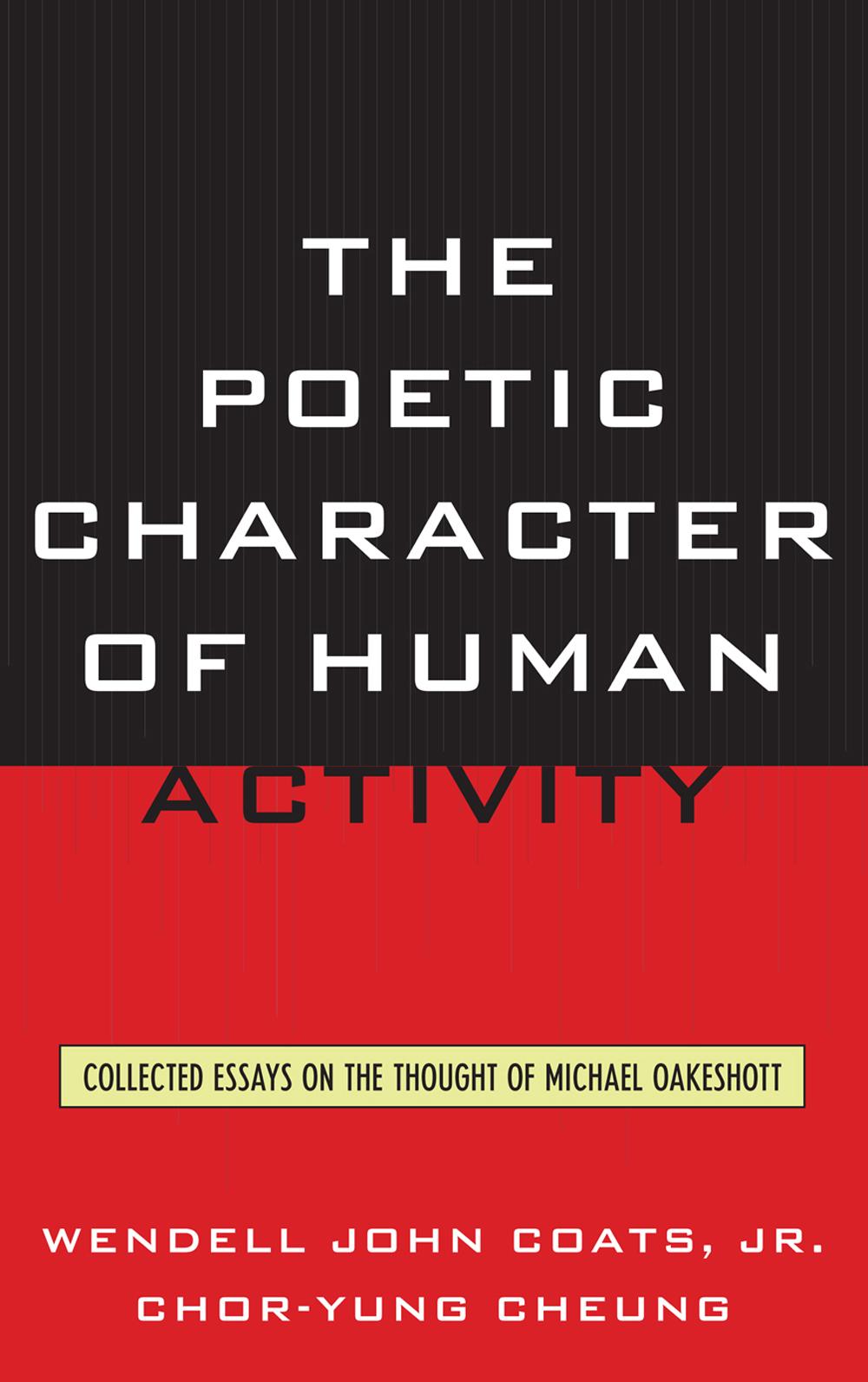
The Poetic Character of Human Activity is a collection of essays by two Oakeshott scholars, most of which explores the meaning of Oakeshott’s pregnant phrase, “the poetic character of human activity” by comparing and contrasting this idea with similar and opposing ones, in particular those of the Taoist thinker, Zhuangzi (Chuang Tzu), and his Western interpreter, A.C. Graham. Oakeshott’s deep appreciation of the poetic and non-instrumental character of human activity led him to develop an interest in the works of Zhuangzi and Confucius. Comparison of shared themes between Oakeshott and these two Chinese thinkers facilitates appreciation of his elegant analytic style and his resort to use of metaphors and story-telling when conveying some of his most profound insights. The collection also contains essays contrasting Oakeshott’s idea of the “creative” in human experience with views of, among others, Plato, Leo Strauss and Eric Voegelin.
Oakeshott used the phrase “the poetic character of human activity” (arguably the animating center of his entire thought), to refer to the “creative” character of human experiential reality, that is, to the fact that the form (the how) and content (the what) of all human experience and activity arise simultaneously and fluidly, and can be separated only at the expense of theoretical coherence and practical skill. The various essays in this collection explore the meaning of this claim, and its ramifications for the proper role of critical intellect in especially philosophy, morality, learning, and governance. There is also some brief contrast of Oakeshott with John Rawls, Alasdair MacIntyre, Charles Taylor, and Quentin Skinner.
Oakeshott used the phrase “the poetic character of human activity” (arguably the animating center of his entire thought), to refer to the “creative” character of human experiential reality, that is, to the fact that the form (the how) and content (the what) of all human experience and activity arise simultaneously and fluidly, and can be separated only at the expense of theoretical coherence and practical skill. The various essays in this collection explore the meaning of this claim, and its ramifications for the proper role of critical intellect in especially philosophy, morality, learning, and governance. There is also some brief contrast of Oakeshott with John Rawls, Alasdair MacIntyre, Charles Taylor, and Quentin Skinner.
Betal nemt med kort, Klarna, Apple Pay eller Google Pay. Ikke tilfreds? Du har altid 14 dages fortrydelsesret. Læs mere i vores vilkår. Har du spørgsmål, så send os en mail på hello@memmo.org.
Memmo gør det nemmere at studere – uanset hvor du er i verden. Hos os samler du dine kursusbøger og smarte studieværktøjer ét sted: resuméer, quizzer, podcasts og flashcards. Og så er der Ted, din studieven, der svarer på alt, du undrer dig over. Over 50 000 studerende studerer allerede her – bygget til at hjælpe dig med at lære hurtigere og stresse mindre.