
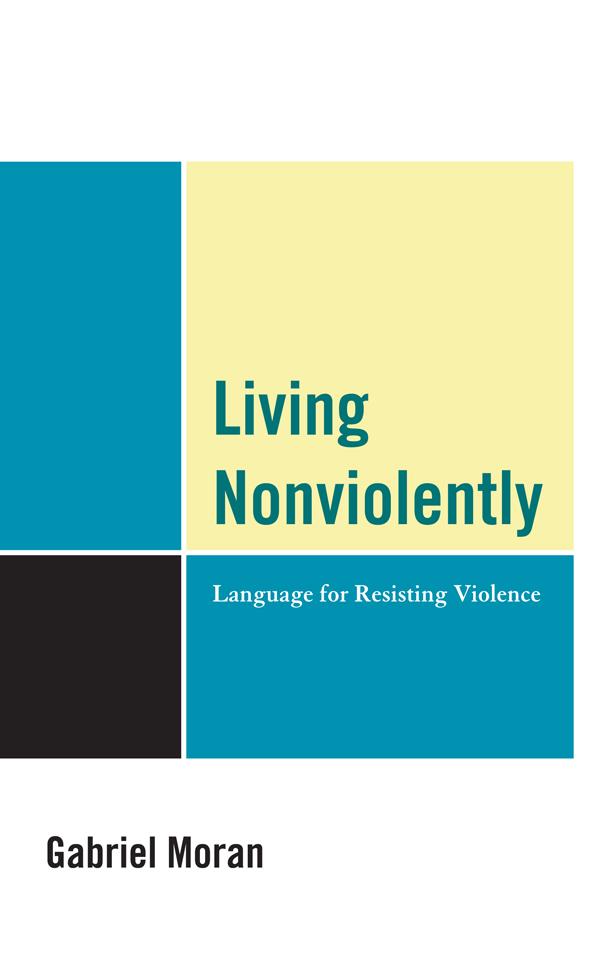
Are human beings naturally violent? Is war the fate of the human race? Despite the depressing record of the past, the world's future depends upon avoiding war and drastically reducing violence. Living Nonviolently: Language for Resisting Violence examines carefully the language of violence and war. One of the first casualties of violence is language, which in turn makes resistance to violence difficult to articulate.
In the first four chapters, Gabriel Moran proposes distinctions for the interconnected ideas of force, power, aggressiveness, violence, and war—not to invent a new and logical language but to ground the meaning of these terms in our human experience. That revitalization of ordinary language depends upon an inclusive language of men and women, adults and children, human and nonhuman animals. The fifth chapter locates the potential for both encouraging violence and resisting violence in the peculiar logic of religion. Jesus' Sermon on the Mount is commonly invoked by people who say that nonviolence may be an admirable ideal for a few people but it is irrelevant for most people and for all nations; in this chapter, Moran examines the widely misunderstood sermon in detail to illustrate its potential for resisting violence. For a conclusion, he discusses practical means of education that are helpful to reaching some understanding of violence and resistance to violence.
Living Nonviolently is written for scholars in peace studies, political philosophy, or religious studies and for anyone who wishes to understand the roots of violence and war.
In the first four chapters, Gabriel Moran proposes distinctions for the interconnected ideas of force, power, aggressiveness, violence, and war—not to invent a new and logical language but to ground the meaning of these terms in our human experience. That revitalization of ordinary language depends upon an inclusive language of men and women, adults and children, human and nonhuman animals. The fifth chapter locates the potential for both encouraging violence and resisting violence in the peculiar logic of religion. Jesus' Sermon on the Mount is commonly invoked by people who say that nonviolence may be an admirable ideal for a few people but it is irrelevant for most people and for all nations; in this chapter, Moran examines the widely misunderstood sermon in detail to illustrate its potential for resisting violence. For a conclusion, he discusses practical means of education that are helpful to reaching some understanding of violence and resistance to violence.
Living Nonviolently is written for scholars in peace studies, political philosophy, or religious studies and for anyone who wishes to understand the roots of violence and war.
Betal nemt med kort, Klarna, Apple Pay eller Google Pay. Ikke tilfreds? Du har altid 14 dages fortrydelsesret. Læs mere i vores vilkår. Har du spørgsmål, så send os en mail på hello@memmo.org.
Memmo gør det nemmere at studere – uanset hvor du er i verden. Hos os samler du dine kursusbøger og smarte studieværktøjer ét sted: resuméer, quizzer, podcasts og flashcards. Og så er der Ted, din studieven, der svarer på alt, du undrer dig over. Over 50 000 studerende studerer allerede her – bygget til at hjælpe dig med at lære hurtigere og stresse mindre.