
Since industrialization, two major theoretical perspectives have accompanied the vibrant practice of social change. The first, hegemony, emerged as a less deterministic route to revolution from Marxist theory, and forms the common sense of social movement today. Within hegemonic resistance, rhetoric links issues, ideas, and identities to form a recognizable collective agent, whose aim is to transform the status quo into its vision of the world. The second major mode of resistance, transgression, grows from anarchist and autonomous resistance to capitalism. Transgression attempts to free individuals' uniqueness and creative power by deconstructing authority and explicating the body in resistance.
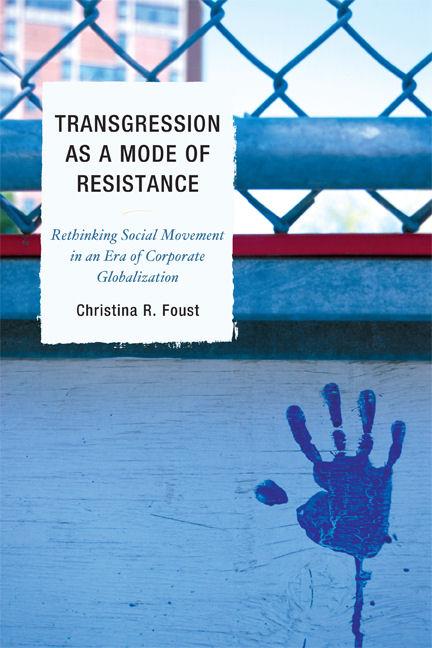
Transgression as a Mode of Resistance: Rethinking Social Movement in an Era of Corporate Globalization provides the conceptual mapping for scholars, students, and practitioners to participate in the growing debate between these rich and powerful forces of social change. Through a broad perspective on philosophy and history, Christina R. Foust demonstrates that hegemony and transgression are sometimes conflicting, oftentimes inter-related practices. She responds to critics who believe that without a social change agent, resistance appears baseless and naïve; without a representational economy to cohere and express common interests, social movement is impossible. Through alternative social relationships and political performances, transgressive resistors may reinvent daily life.
Transgression as a Mode of Resistance: Rethinking Social Movement in an Era of Corporate Globalization provides the conceptual mapping for scholars, students, and practitioners to participate in the growing debate between these rich and powerful forces of social change. Through a broad perspective on philosophy and history, Christina R. Foust demonstrates that hegemony and transgression are sometimes conflicting, oftentimes inter-related practices. She responds to critics who believe that without a social change agent, resistance appears baseless and naïve; without a representational economy to cohere and express common interests, social movement is impossible. Through alternative social relationships and political performances, transgressive resistors may reinvent daily life.
Betal nemt med kort, Klarna, Apple Pay eller Google Pay. Ikke tilfreds? Du har altid 14 dages fortrydelsesret. Læs mere i vores vilkår. Har du spørgsmål, så send os en mail på hello@memmo.org.
Memmo gør det nemmere at studere – uanset hvor du er i verden. Hos os samler du dine kursusbøger og smarte studieværktøjer ét sted: resuméer, quizzer, podcasts og flashcards. Og så er der Ted, din studieven, der svarer på alt, du undrer dig over. Over 50 000 studerende studerer allerede her – bygget til at hjælpe dig med at lære hurtigere og stresse mindre.