
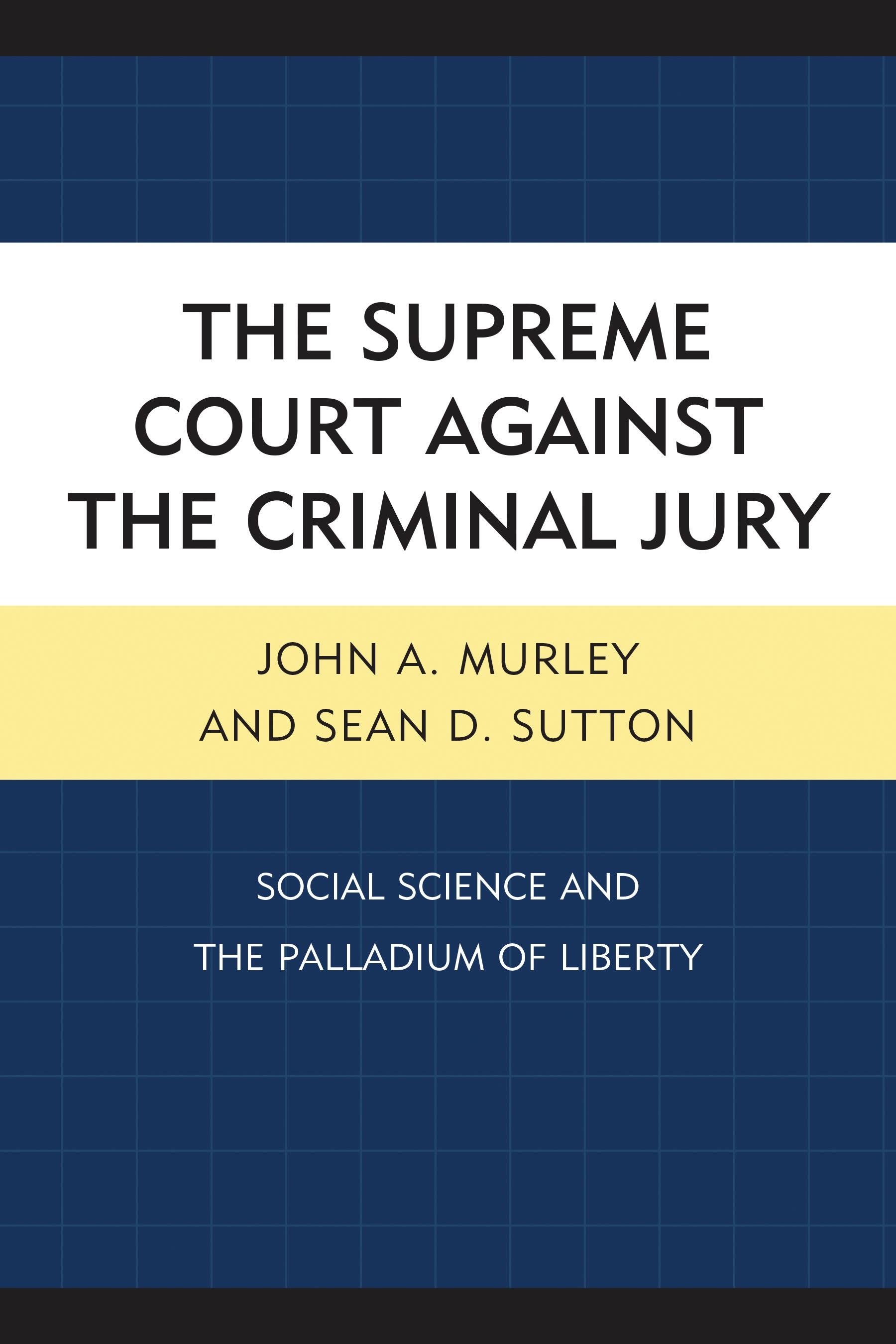
The Supreme Court against the Criminal Jury: Social Science and the Palladium of Liberty is an analysis of the United States Supreme Court decisions in what has come to be called the “jury-size” and “jury-decision rule” cases. In Williams v. Florida (1970) and Ballew v. Georgia (1978), a majority of the Supreme Court looked to history, empirical studies, and functional analysis to support its claim that there was “no discernible difference” between the verdicts of juries of six and juries of twelve. In the process the Court also decided that the number twelve was an historical accident and that the twelve-member jury was not an essential ingredient of trial by jury.
Two years later, the Court, following essentially the same line of reasoning used in Williams, decided in the companion cases Apodaca v. Oregon (1972) and Johnson v. Louisiana (1972) that defendants were as well served with juries that reached verdicts by a majority vote of 11-1,10-2 and 9-3 as they were with unanimous jury verdicts. In these cases the Supreme Court rejected the centuries old common law view that the unanimous jury verdict was an essential element of trial by jury. With these four decisions, the criminal jury as it had been known for more than six hundred years under the common law and the Constitution was in principle abandoned. We critique these decisions from the perspective of unreliable jury studies and the impact of these decision on jury nullification.
Two years later, the Court, following essentially the same line of reasoning used in Williams, decided in the companion cases Apodaca v. Oregon (1972) and Johnson v. Louisiana (1972) that defendants were as well served with juries that reached verdicts by a majority vote of 11-1,10-2 and 9-3 as they were with unanimous jury verdicts. In these cases the Supreme Court rejected the centuries old common law view that the unanimous jury verdict was an essential element of trial by jury. With these four decisions, the criminal jury as it had been known for more than six hundred years under the common law and the Constitution was in principle abandoned. We critique these decisions from the perspective of unreliable jury studies and the impact of these decision on jury nullification.
Betal nemt med kort, Klarna, Apple Pay eller Google Pay. Ikke tilfreds? Du har altid 14 dages fortrydelsesret. Læs mere i vores vilkår. Har du spørgsmål, så send os en mail på hello@memmo.org.
Memmo gør det nemmere at studere – uanset hvor du er i verden. Hos os samler du dine kursusbøger og smarte studieværktøjer ét sted: resuméer, quizzer, podcasts og flashcards. Og så er der Ted, din studieven, der svarer på alt, du undrer dig over. Over 50 000 studerende studerer allerede her – bygget til at hjælpe dig med at lære hurtigere og stresse mindre.