
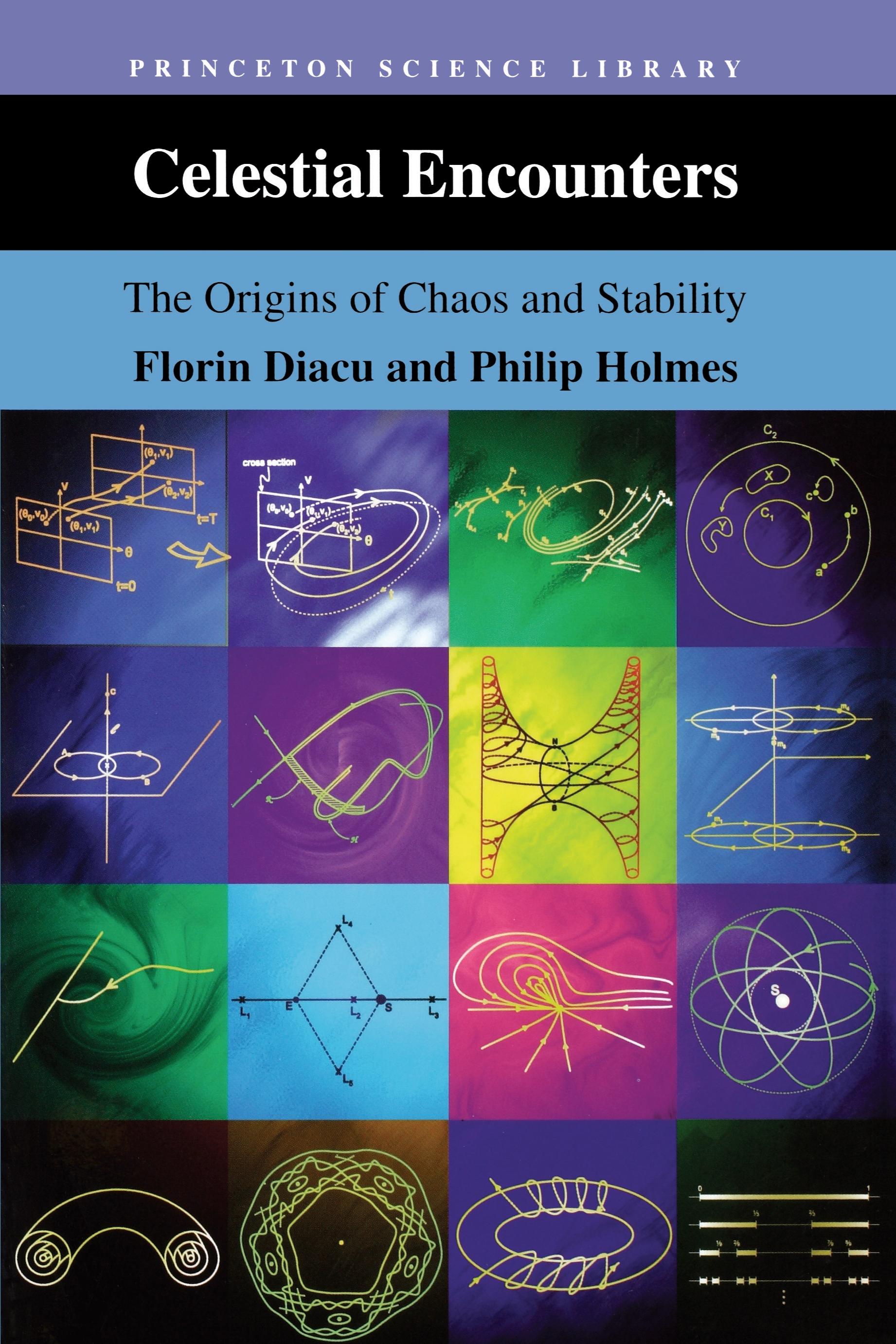
Celestial Encounters is for anyone who has ever wondered about the foundations of chaos. In 1888, the 34-year-old Henri Poincaré submitted a paper that was to change the course of science, but not before it underwent significant changes itself. "The Three-Body Problem and the Equations of Dynamics" won a prize sponsored by King Oscar II of Sweden and Norway and the journal Acta Mathematica, but after accepting the prize, Poincaré found a serious mistake in his work. While correcting it, he discovered the phenomenon of chaos.
Starting with the story of Poincaré's work, Florin Diacu and Philip Holmes trace the history of attempts to solve the problems of celestial mechanics first posed in Isaac Newton's Principia in 1686. In describing how mathematical rigor was brought to bear on one of our oldest fascinations--the motions of the heavens--they introduce the people whose ideas led to the flourishing field now called nonlinear dynamics.
In presenting the modern theory of dynamical systems, the models underlying much of modern science are described pictorially, using the geometrical language invented by Poincaré. More generally, the authors reflect on mathematical creativity and the roles that chance encounters, politics, and circumstance play in it.
Betal nemt med kort, Klarna, Apple Pay eller Google Pay. Ikke tilfreds? Du har altid 14 dages fortrydelsesret. Læs mere i vores vilkår. Har du spørgsmål, så send os en mail på hello@memmo.org.
Memmo gør det nemmere at studere – uanset hvor du er i verden. Hos os samler du dine kursusbøger og smarte studieværktøjer ét sted: resuméer, quizzer, podcasts og flashcards. Og så er der Ted, din studieven, der svarer på alt, du undrer dig over. Over 50 000 studerende studerer allerede her – bygget til at hjælpe dig med at lære hurtigere og stresse mindre.