
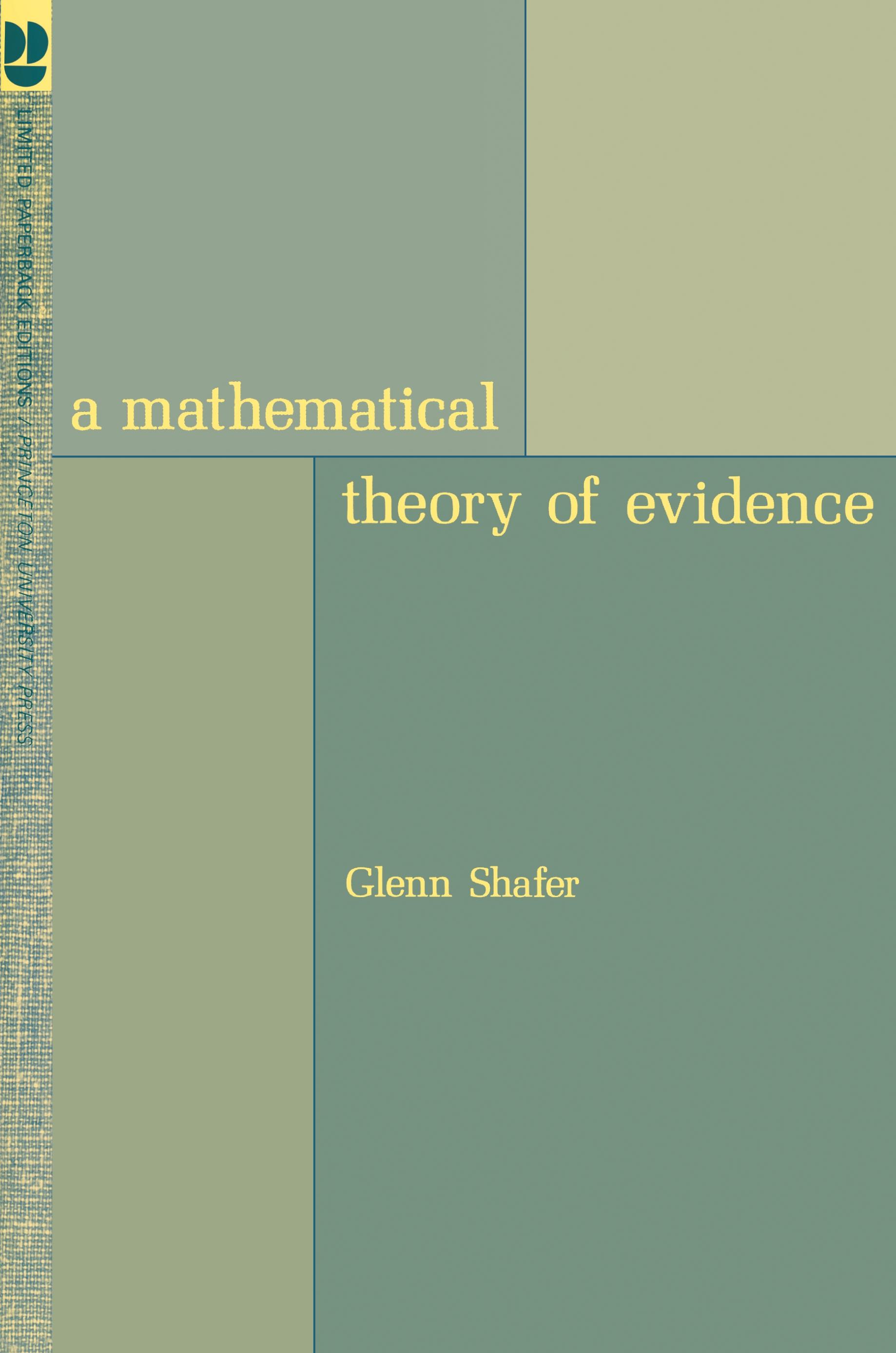
Both in science and in practical affairs we reason by combining facts only inconclusively supported by evidence. Building on an abstract understanding of this process of combination, this book constructs a new theory of epistemic probability. The theory draws on the work of A. P. Dempster but diverges from Depster's viewpoint by identifying his "lower probabilities" as epistemic probabilities and taking his rule for combining "upper and lower probabilities" as fundamental.
The book opens with a critique of the well-known Bayesian theory of epistemic probability. It then proceeds to develop an alternative to the additive set functions and the rule of conditioning of the Bayesian theory: set functions that need only be what Choquet called "monotone of order of infinity." and Dempster's rule for combining such set functions. This rule, together with the idea of "weights of evidence," leads to both an extensive new theory and a better understanding of the Bayesian theory. The book concludes with a brief treatment of statistical inference and a discussion of the limitations of epistemic probability. Appendices contain mathematical proofs, which are relatively elementary and seldom depend on mathematics more advanced that the binomial theorem.
Betal nemt med kort, Klarna, Apple Pay eller Google Pay. Ikke tilfreds? Du har altid 14 dages fortrydelsesret. Læs mere i vores vilkår. Har du spørgsmål, så send os en mail på hello@memmo.org.
Memmo gør det nemmere at studere – uanset hvor du er i verden. Hos os samler du dine kursusbøger og smarte studieværktøjer ét sted: resuméer, quizzer, podcasts og flashcards. Og så er der Ted, din studieven, der svarer på alt, du undrer dig over. Over 50 000 studerende studerer allerede her – bygget til at hjælpe dig med at lære hurtigere og stresse mindre.