
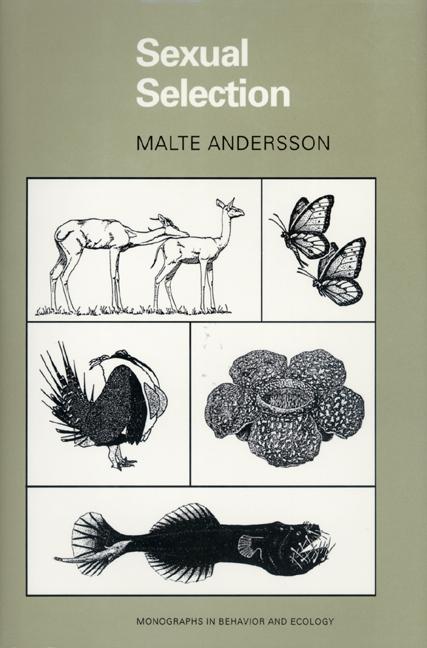
Bright colors, enlarged fins, feather plumes, song, horns, antlers, and tusks are often highly sex dimorphic. Why have males in many animals evolved more conspicuous ornaments, signals, and weapons than females? How can such traits evolve although they may reduce male survival? Such questions prompted Darwin's perhaps most scientifically controversial idea--the theory of sexual selection. It still challenges researchers today as they try to understand how competition for mates can favor the variety of sex-dimorphic traits. Reviewing theoretical and empirical work in this very active field, Malte Andersson, a leading contributor himself, provides a major up-to-date synthesis of sexual selection.
The author describes the theory and its recent development; examines models, methods, and empirical tests; and identifies many unsolved problems. Among the topics discussed are the selection and evolution of mating preferences; relations between sexual selection and speciation; constraints on sexual selection; and sex differences in signals, body size, and weapons. The rapidly growing study of sexual selection in plants is also reviewed. This volume will interest students, teachers, and researchers in behavioral ecology and evolutionary biology.
Betal nemt med kort, Klarna, Apple Pay eller Google Pay. Ikke tilfreds? Du har altid 14 dages fortrydelsesret. Læs mere i vores vilkår. Har du spørgsmål, så send os en mail på hello@memmo.org.
Memmo gør det nemmere at studere – uanset hvor du er i verden. Hos os samler du dine kursusbøger og smarte studieværktøjer ét sted: resuméer, quizzer, podcasts og flashcards. Og så er der Ted, din studieven, der svarer på alt, du undrer dig over. Over 50 000 studerende studerer allerede her – bygget til at hjælpe dig med at lære hurtigere og stresse mindre.