
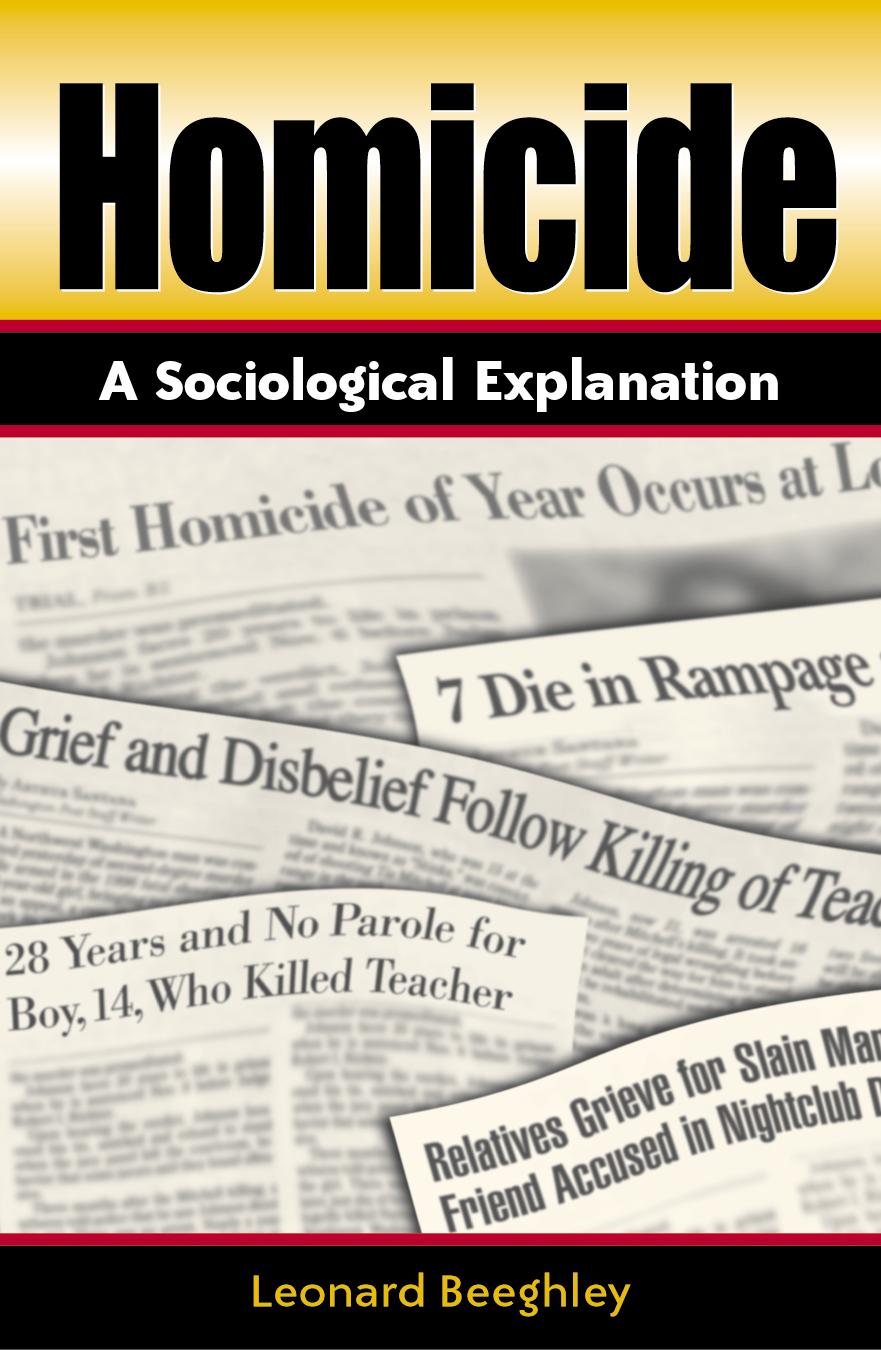
The American homicide rate remains dramatically higher than that in other Western nations. News of a murder has become a routine event. How do we explain such high levels of lethal violence in the world's leading democracy?
Echoing Durkheim's Suicide, this book focuses on one important phenomenon to explain larger currents in American society. Leonard Beeghley examines the historical and cross-national dimensions of homicides and evaluates previous attempts to explain it. He finds the sources of America's murder rate in the greater availability of guns, the expansion of illegal drug markets, greater racial discrimination, more exposure to violence, and sharper economic inequalities. He deftly blends the evidence related to each of these factors into a well-reasoned sociological analysis of the nature of American society.
Features
Highlights how sociology can be used to explain problems and seek solutions
Distinguishes between structural and social psychological levels of analysis
Provides a constrasting perspective to Messner & Rosenfeld's widely assigned Crime and the American Dream
Uses metaphors and analogies in order to make sociological ideas meaningful to students
Employs an engaging writing style to place the analysis in the scholarly literature
Offers clear explanations of Durkheim, Weber, Merton, and others, that show their usefulness for understanding modern life
Echoing Durkheim's Suicide, this book focuses on one important phenomenon to explain larger currents in American society. Leonard Beeghley examines the historical and cross-national dimensions of homicides and evaluates previous attempts to explain it. He finds the sources of America's murder rate in the greater availability of guns, the expansion of illegal drug markets, greater racial discrimination, more exposure to violence, and sharper economic inequalities. He deftly blends the evidence related to each of these factors into a well-reasoned sociological analysis of the nature of American society.
Features
Highlights how sociology can be used to explain problems and seek solutions
Distinguishes between structural and social psychological levels of analysis
Provides a constrasting perspective to Messner & Rosenfeld's widely assigned Crime and the American Dream
Uses metaphors and analogies in order to make sociological ideas meaningful to students
Employs an engaging writing style to place the analysis in the scholarly literature
Offers clear explanations of Durkheim, Weber, Merton, and others, that show their usefulness for understanding modern life
Betal nemt med kort, Klarna, Apple Pay eller Google Pay. Ikke tilfreds? Du har altid 14 dages fortrydelsesret. Læs mere i vores vilkår. Har du spørgsmål, så send os en mail på hello@memmo.org.
Memmo gør det nemmere at studere – uanset hvor du er i verden. Hos os samler du dine kursusbøger og smarte studieværktøjer ét sted: resuméer, quizzer, podcasts og flashcards. Og så er der Ted, din studieven, der svarer på alt, du undrer dig over. Over 50 000 studerende studerer allerede her – bygget til at hjælpe dig med at lære hurtigere og stresse mindre.