
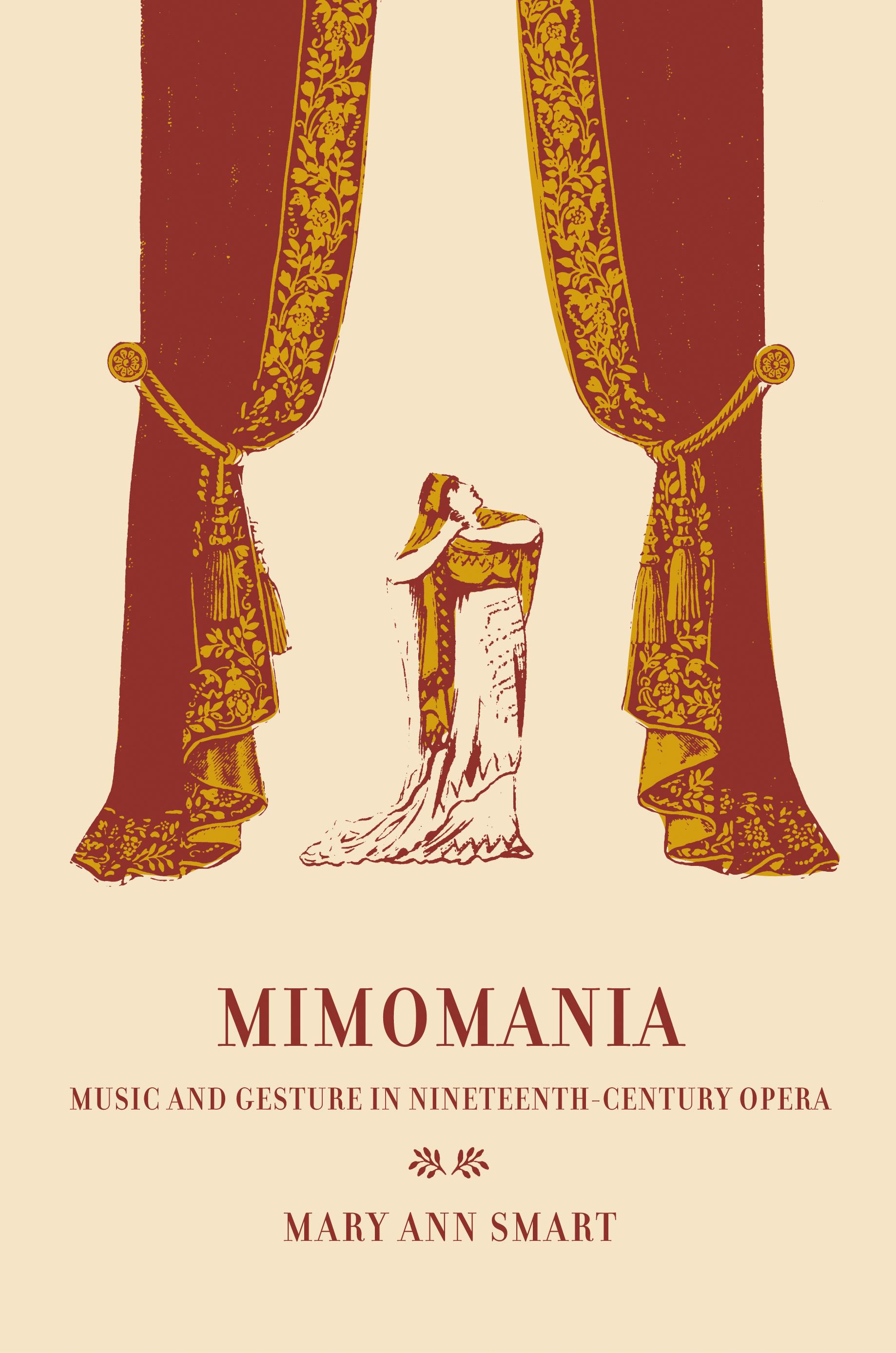
When Nietzsche dubbed Richard Wagner "the most enthusiastic mimomaniac" ever to exist, he was objecting to a hollowness he felt in the music, a crowding out of any true dramatic impulse by extravagant poses and constant nervous movements. Mary Ann Smart suspects that Nietzsche may have seen and heard more than he realized. In Mimomania she takes his accusation as an invitation to listen to Wagner's music—and that of several of his near-contemporaries—for the way it serves to intensify the visible and the enacted. As Smart demonstrates, this productive fusion of music and movement often arises when music forsakes the autonomy so prized by the Romantics to function mimetically, underlining the sighs of a Bellini heroine, for instance, or the authoritarian footsteps of a Verdi baritone. Mimomania tracks such effects through readings of operas by Auber, Bellini, Meyerbeer, Verdi, and Wagner.
Listening for gestural music, we find resemblance in unexpected places: between the overwrought scenes of supplication in French melodrama of the 1820s and a cluster of late Verdi arias that end with the soprano falling to her knees, or between the mute heroine of Auber’s La Muette de Portici and the solemn, almost theological pantomimic tableaux Wagner builds around characters such as Sieglinde or Kundry. Mimomania shows how attention to gesture suggests a new approach to the representation of gender in this repertoire, replacing aural analogies for voyeurism and objectification with a more specifically musical sense of how music can surround, propel, and animate the body on stage.
Listening for gestural music, we find resemblance in unexpected places: between the overwrought scenes of supplication in French melodrama of the 1820s and a cluster of late Verdi arias that end with the soprano falling to her knees, or between the mute heroine of Auber’s La Muette de Portici and the solemn, almost theological pantomimic tableaux Wagner builds around characters such as Sieglinde or Kundry. Mimomania shows how attention to gesture suggests a new approach to the representation of gender in this repertoire, replacing aural analogies for voyeurism and objectification with a more specifically musical sense of how music can surround, propel, and animate the body on stage.
Betal nemt med kort, Klarna, Apple Pay eller Google Pay. Ikke tilfreds? Du har altid 14 dages fortrydelsesret. Læs mere i vores vilkår. Har du spørgsmål, så send os en mail på hello@memmo.org.
Memmo gør det nemmere at studere – uanset hvor du er i verden. Hos os samler du dine kursusbøger og smarte studieværktøjer ét sted: resuméer, quizzer, podcasts og flashcards. Og så er der Ted, din studieven, der svarer på alt, du undrer dig over. Over 50 000 studerende studerer allerede her – bygget til at hjælpe dig med at lære hurtigere og stresse mindre.
Du kan måske også lide
Køb bogen0