
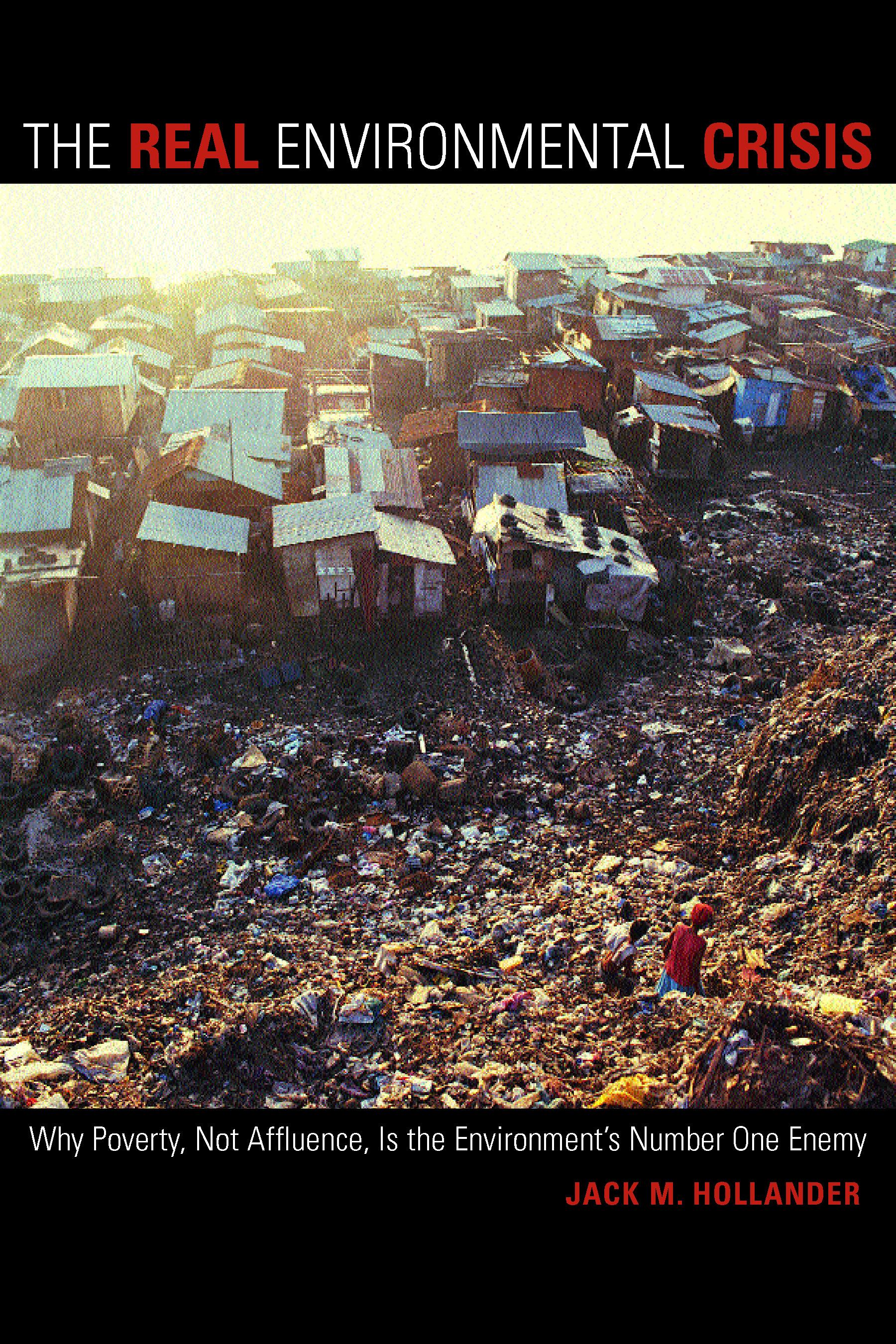
Drawing a completely new road map toward a sustainable future, Jack M. Hollander contends that our most critical environmental problem is global poverty. His balanced, authoritative, and lucid book challenges widely held beliefs that economic development and affluence pose a major threat to the world's environment and resources. Pointing to the great strides that have been made toward improving and protecting the environment in the affluent democracies, Hollander makes the case that the essential prerequisite for sustainability is a global transition from poverty to affluence, coupled with a transition to freedom and democracy.
The Real Environmental Crisis takes a close look at the major environment and resource issues—population growth; climate change; agriculture and food supply; our fisheries, forests, and fossil fuels; water and air quality; and solar and nuclear power. In each case, Hollander finds compelling evidence that economic development and technological advances can relieve such problems as food shortages, deforestation, air pollution, and land degradation, and provide clean water, adequate energy supplies, and improved public health. The book also tackles issues such as global warming, genetically modified foods, automobile and transportation technologies, and the highly significant Endangered Species Act, which Hollander asserts never would have been legislated in a poor country whose citizens struggle just to survive.
Hollander asks us to look beyond the media's doomsday rhetoric about the state of the environment, for much of it is simply not true, and to commit much more of our resources where they will do the most good—to lifting the world's population out of poverty.
The Real Environmental Crisis takes a close look at the major environment and resource issues—population growth; climate change; agriculture and food supply; our fisheries, forests, and fossil fuels; water and air quality; and solar and nuclear power. In each case, Hollander finds compelling evidence that economic development and technological advances can relieve such problems as food shortages, deforestation, air pollution, and land degradation, and provide clean water, adequate energy supplies, and improved public health. The book also tackles issues such as global warming, genetically modified foods, automobile and transportation technologies, and the highly significant Endangered Species Act, which Hollander asserts never would have been legislated in a poor country whose citizens struggle just to survive.
Hollander asks us to look beyond the media's doomsday rhetoric about the state of the environment, for much of it is simply not true, and to commit much more of our resources where they will do the most good—to lifting the world's population out of poverty.
Betal nemt med kort, Klarna, Apple Pay eller Google Pay. Ikke tilfreds? Du har altid 14 dages fortrydelsesret. Læs mere i vores vilkår. Har du spørgsmål, så send os en mail på hello@memmo.org.
Memmo gør det nemmere at studere – uanset hvor du er i verden. Hos os samler du dine kursusbøger og smarte studieværktøjer ét sted: resuméer, quizzer, podcasts og flashcards. Og så er der Ted, din studieven, der svarer på alt, du undrer dig over. Over 50 000 studerende studerer allerede her – bygget til at hjælpe dig med at lære hurtigere og stresse mindre.
Du kan måske også lide
Køb bogen0