
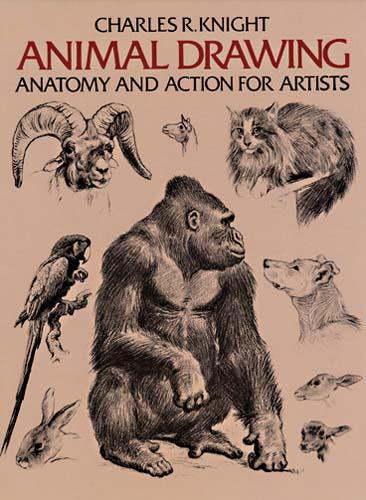
This book was written and illustrated by Charles R. Knight (1874–1953), the acknowledged master of animal drawing and the man who American Biographies agrees "was generally recognized as the most distinguished painter of animal life." Those who have seen his murals, paintings, and bronzes of both prehistoric and modern animals in the New York Museum of Natural History or any one of a dozen other major zoological museums know why his work is so highly regarded. His animal portrayals are startlingly alive with beauty, virility, charm, power, and expression. He seems to have caught animals in the very act of feeding, stalking, resting, or in any one of the thousands of completely natural attitudes that animals assume.
In this book, which is an extensive course in animal drawing, Knight offers an almost incredible wealth of practical instruction to commercial and fine artists, painters, sculptors, book illustrators, designers, decorators, and art students. He discusses animal musculature, bone structure, animal psychology, movements, habits, and habitats. He provides innumerable tips on animal proportions, the play of light and shadow, coloring, hair formation, feather arrangements of birds, scales of fish, how animals lie down, animal expressions, how a lioness bends back her ears when angry, and many others. Scores of animal categories are covered: great apes, tigers, lions, dogs, bears, cattle, horses, antelopes, sheep, goats, camels, swine, seals, rodents, young animals, exotic animals, crocodiles, snakes, fish, and birds.
This work should help both practicing artists and art students achieve more natural and lifelike drawings. Especially valuable will be the many pointers on how to avoid stiffness and gracelessness in drawings of horses, deer, and other quick-footed animals; how to introduce the proper sense of bulk and power in sketches of such heavier animals as elephants and bears; and how to put into drawings of the cat family, from the household pet to the African lion, the superb lithe grace and wealth of subtle expression that we marvel at in the originals.
In this book, which is an extensive course in animal drawing, Knight offers an almost incredible wealth of practical instruction to commercial and fine artists, painters, sculptors, book illustrators, designers, decorators, and art students. He discusses animal musculature, bone structure, animal psychology, movements, habits, and habitats. He provides innumerable tips on animal proportions, the play of light and shadow, coloring, hair formation, feather arrangements of birds, scales of fish, how animals lie down, animal expressions, how a lioness bends back her ears when angry, and many others. Scores of animal categories are covered: great apes, tigers, lions, dogs, bears, cattle, horses, antelopes, sheep, goats, camels, swine, seals, rodents, young animals, exotic animals, crocodiles, snakes, fish, and birds.
This work should help both practicing artists and art students achieve more natural and lifelike drawings. Especially valuable will be the many pointers on how to avoid stiffness and gracelessness in drawings of horses, deer, and other quick-footed animals; how to introduce the proper sense of bulk and power in sketches of such heavier animals as elephants and bears; and how to put into drawings of the cat family, from the household pet to the African lion, the superb lithe grace and wealth of subtle expression that we marvel at in the originals.
Betal nemt med kort, Klarna, Apple Pay eller Google Pay. Ikke tilfreds? Du har altid 14 dages fortrydelsesret. Læs mere i vores vilkår. Har du spørgsmål, så send os en mail på hello@memmo.org.
Memmo gør det nemmere at studere – uanset hvor du er i verden. Hos os samler du dine kursusbøger og smarte studieværktøjer ét sted: resuméer, quizzer, podcasts og flashcards. Og så er der Ted, din studieven, der svarer på alt, du undrer dig over. Over 50 000 studerende studerer allerede her – bygget til at hjælpe dig med at lære hurtigere og stresse mindre.
Du kan måske også lide
Køb bogen0