
"The collection, drawn from arithmetic, algebra, pure and algebraic geometry and astronomy, is extraordinarily interesting and attractive." — Mathematical Gazette
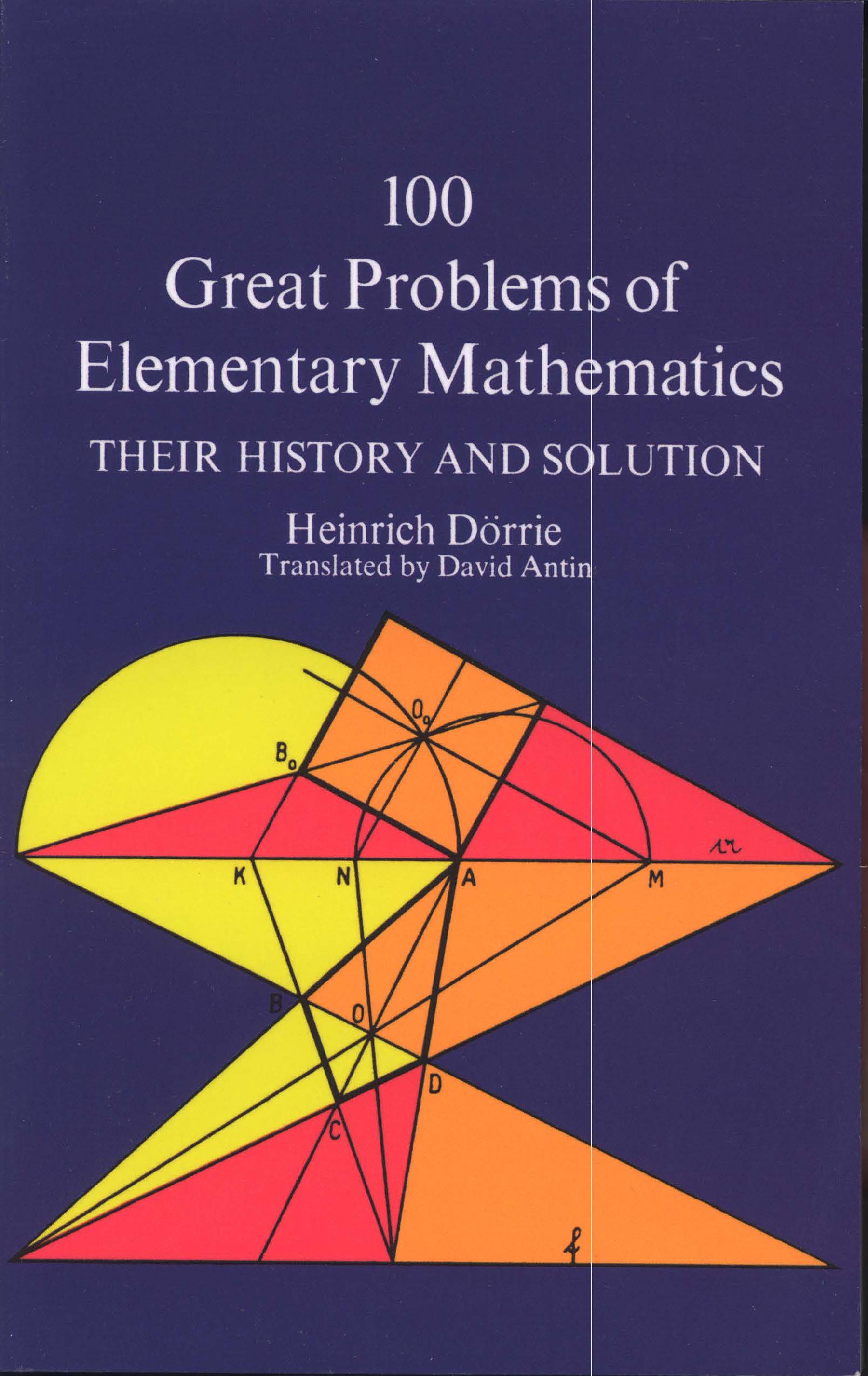
This uncommonly interesting volume covers 100 of the most famous historical problems of elementary mathematics. Not only does the book bear witness to the extraordinary ingenuity of some of the greatest mathematical minds of history — Archimedes, Isaac Newton, Leonhard Euler, Augustin Cauchy, Pierre Fermat, Carl Friedrich Gauss, Gaspard Monge, Jakob Steiner, and many others — but it provides rare insight and inspiration to any reader, from high school math student to professional mathematician. This is indeed an unusual and uniquely valuable book.
The one hundred problems are presented in six categories: 26 arithmetical problems, 15 planimetric problems, 25 classic problems concerning conic sections and cycloids, 10 stereometric problems, 12 nautical and astronomical problems, and 12 maxima and minima problems. In addition to defining the problems and giving full solutions and proofs, the author recounts their origins and history and discusses personalities associated with them. Often he gives not the original solution, but one or two simpler or more interesting demonstrations. In only two or three instances does the solution assume anything more than a knowledge of theorems of elementary mathematics; hence, this is a book with an extremely wide appeal.
Some of the most celebrated and intriguing items are: Archimedes' "Problema Bovinum," Euler's problem of polygon division, Omar Khayyam's binomial expansion, the Euler number, Newton's exponential series, the sine and cosine series, Mercator's logarithmic series, the Fermat-Euler prime number theorem, the Feuerbach circle, the tangency problem of Apollonius, Archimedes' determination of pi, Pascal's hexagon theorem, Desargues' involution theorem, the five regular solids, the Mercator projection, the Kepler equation, determination of the position of a ship at sea, Lambert's comet problem, and Steiner's ellipse, circle, and sphere problems.
This translation, prepared especially for Dover by David Antin, brings Dörrie's "Triumph der Mathematik" to the English-language audience for the first time.
This uncommonly interesting volume covers 100 of the most famous historical problems of elementary mathematics. Not only does the book bear witness to the extraordinary ingenuity of some of the greatest mathematical minds of history — Archimedes, Isaac Newton, Leonhard Euler, Augustin Cauchy, Pierre Fermat, Carl Friedrich Gauss, Gaspard Monge, Jakob Steiner, and many others — but it provides rare insight and inspiration to any reader, from high school math student to professional mathematician. This is indeed an unusual and uniquely valuable book.
The one hundred problems are presented in six categories: 26 arithmetical problems, 15 planimetric problems, 25 classic problems concerning conic sections and cycloids, 10 stereometric problems, 12 nautical and astronomical problems, and 12 maxima and minima problems. In addition to defining the problems and giving full solutions and proofs, the author recounts their origins and history and discusses personalities associated with them. Often he gives not the original solution, but one or two simpler or more interesting demonstrations. In only two or three instances does the solution assume anything more than a knowledge of theorems of elementary mathematics; hence, this is a book with an extremely wide appeal.
Some of the most celebrated and intriguing items are: Archimedes' "Problema Bovinum," Euler's problem of polygon division, Omar Khayyam's binomial expansion, the Euler number, Newton's exponential series, the sine and cosine series, Mercator's logarithmic series, the Fermat-Euler prime number theorem, the Feuerbach circle, the tangency problem of Apollonius, Archimedes' determination of pi, Pascal's hexagon theorem, Desargues' involution theorem, the five regular solids, the Mercator projection, the Kepler equation, determination of the position of a ship at sea, Lambert's comet problem, and Steiner's ellipse, circle, and sphere problems.
This translation, prepared especially for Dover by David Antin, brings Dörrie's "Triumph der Mathematik" to the English-language audience for the first time.
Betal nemt med kort, Klarna, Apple Pay eller Google Pay. Ikke tilfreds? Du har altid 14 dages fortrydelsesret. Læs mere i vores vilkår. Har du spørgsmål, så send os en mail på hello@memmo.org.
Memmo gør det nemmere at studere – uanset hvor du er i verden. Hos os samler du dine kursusbøger og smarte studieværktøjer ét sted: resuméer, quizzer, podcasts og flashcards. Og så er der Ted, din studieven, der svarer på alt, du undrer dig over. Over 50 000 studerende studerer allerede her – bygget til at hjælpe dig med at lære hurtigere og stresse mindre.
Du kan måske også lide
Køb bogen0