
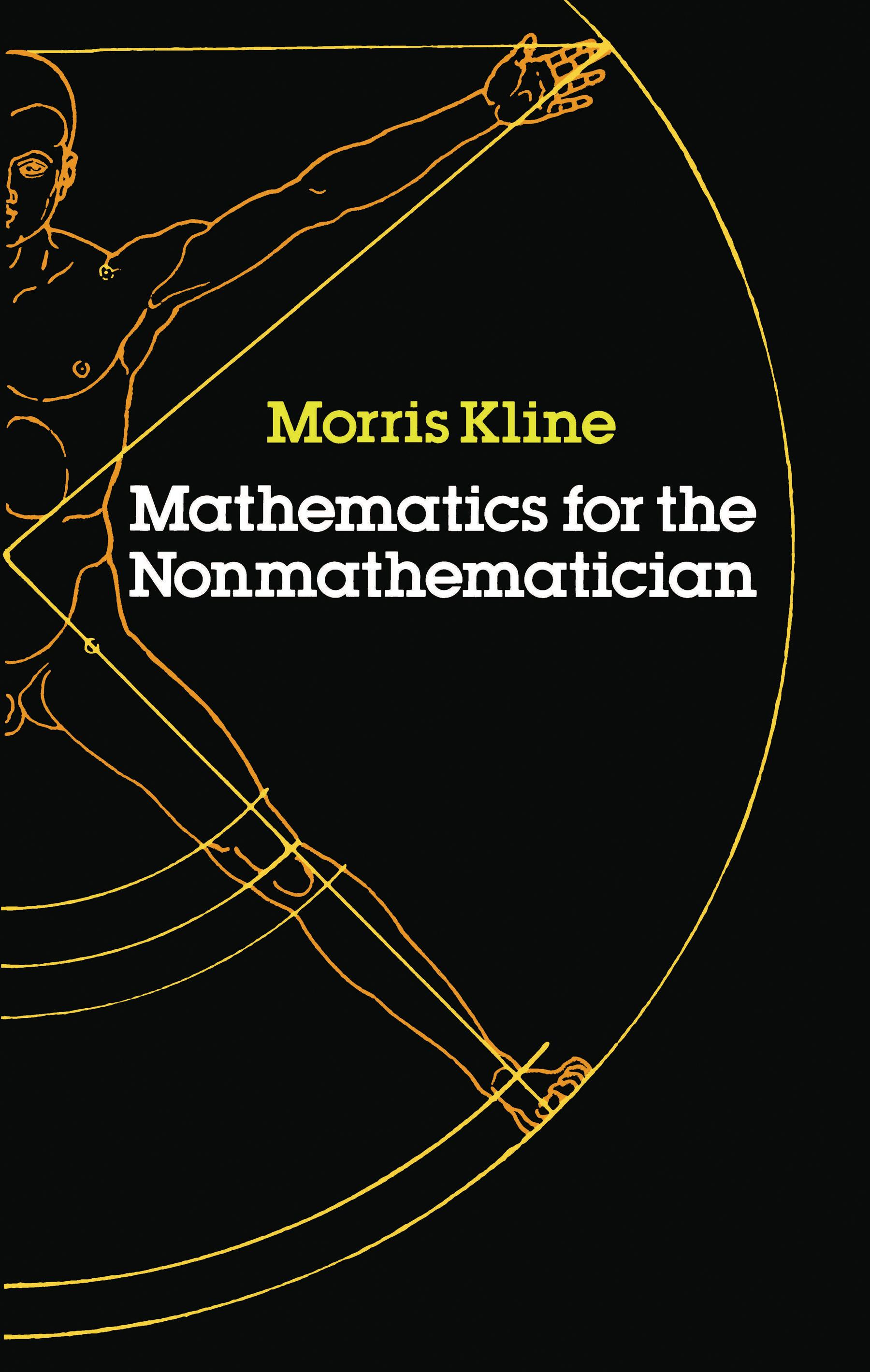
Practical, scientific, philosophical, and artistic problems have caused men to investigate mathematics. But there is one other motive which is as strong as any of these — the search for beauty. Mathematics is an art, and as such affords the pleasures which all the arts afford." In this erudite, entertaining college-level text, Morris Kline, Professor Emeritus of Mathematics at New York University, provides the liberal arts student with a detailed treatment of mathematics in a cultural and historical context. The book can also act as a self-study vehicle for advanced high school students and laymen.
Professor Kline begins with an overview, tracing the development of mathematics to the ancient Greeks, and following its evolution through the Middle Ages and the Renaissance to the present day. Subsequent chapters focus on specific subject areas, such as "Logic and Mathematics," "Number: The Fundamental Concept," "Parametric Equations and Curvilinear Motion," "The Differential Calculus," and "The Theory of Probability." Each of these sections offers a step-by-step explanation of concepts and then tests the student's understanding with exercises and problems. At the same time, these concepts are linked to pure and applied science, engineering, philosophy, the social sciences or even the arts.
In one section, Professor Kline discusses non-Euclidean geometry, ranking it with evolution as one of the "two concepts which have most profoundly revolutionized our intellectual development since the nineteenth century." His lucid treatment of this difficult subject starts in the 1800s with the pioneering work of Gauss, Lobachevsky, Bolyai and Riemann, and moves forward to the theory of relativity, explaining the mathematical, scientific and philosophical aspects of this pivotal breakthrough. Mathematics for the Nonmathematician exemplifies Morris Kline's rare ability to simplify complex subjects for the nonspecialist.
Professor Kline begins with an overview, tracing the development of mathematics to the ancient Greeks, and following its evolution through the Middle Ages and the Renaissance to the present day. Subsequent chapters focus on specific subject areas, such as "Logic and Mathematics," "Number: The Fundamental Concept," "Parametric Equations and Curvilinear Motion," "The Differential Calculus," and "The Theory of Probability." Each of these sections offers a step-by-step explanation of concepts and then tests the student's understanding with exercises and problems. At the same time, these concepts are linked to pure and applied science, engineering, philosophy, the social sciences or even the arts.
In one section, Professor Kline discusses non-Euclidean geometry, ranking it with evolution as one of the "two concepts which have most profoundly revolutionized our intellectual development since the nineteenth century." His lucid treatment of this difficult subject starts in the 1800s with the pioneering work of Gauss, Lobachevsky, Bolyai and Riemann, and moves forward to the theory of relativity, explaining the mathematical, scientific and philosophical aspects of this pivotal breakthrough. Mathematics for the Nonmathematician exemplifies Morris Kline's rare ability to simplify complex subjects for the nonspecialist.
Betal nemt med kort, Klarna, Apple Pay eller Google Pay. Ikke tilfreds? Du har altid 14 dages fortrydelsesret. Læs mere i vores vilkår. Har du spørgsmål, så send os en mail på hello@memmo.org.
Memmo gør det nemmere at studere – uanset hvor du er i verden. Hos os samler du dine kursusbøger og smarte studieværktøjer ét sted: resuméer, quizzer, podcasts og flashcards. Og så er der Ted, din studieven, der svarer på alt, du undrer dig over. Over 50 000 studerende studerer allerede her – bygget til at hjælpe dig med at lære hurtigere og stresse mindre.
Du kan måske også lide
Køb bogen0