
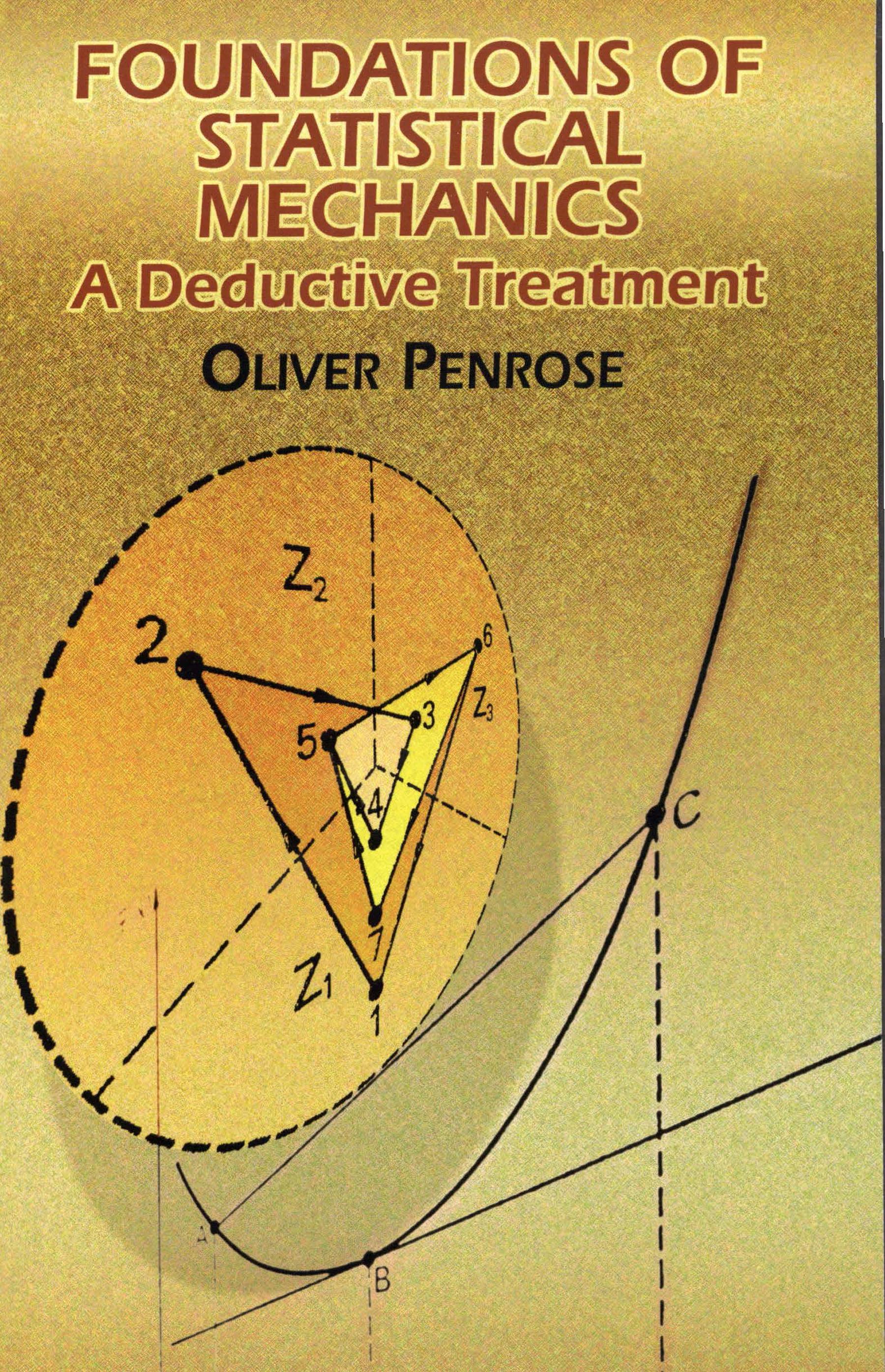
This volume demonstrates the manner in which statistical mechanics can be built up deductively from a small number of well-defined physical assumptions. A solid basis for the deductive structure is provided by embodying these assumptions in a system of five postulates that describe an idealized model of real physical systems. These postulates play a theoretical role similar to that of the first and second laws in thermodynamics.
The first chapter concerns the primary physical assumptions and their idealization in the form of postulates. The following three chapters examine the consequences of these postulates, culminating in the derivation of the fundamental formulas for calculating probabilities in terms of dynamical quantities. Two concluding chapters are devoted to an analysis of the notion of entropy, illustrating its links between statistical mechanics and thermodynamics and between statistical mechanics and communication theory. Because this book deals mostly with general principles, its only detailed considerations of physical applications are in terms of the system with the simplest possible dynamics: the ideal classical gas, which is discussed both in its equilibrium and its nonequilibrium aspects.
Intended for readers with a knowledge of physics at the advanced undergraduate and graduate levels, this volume considers topics of interest not only to physicists, but also to statisticians, communication theorists, chemists, and mathematicians.
The first chapter concerns the primary physical assumptions and their idealization in the form of postulates. The following three chapters examine the consequences of these postulates, culminating in the derivation of the fundamental formulas for calculating probabilities in terms of dynamical quantities. Two concluding chapters are devoted to an analysis of the notion of entropy, illustrating its links between statistical mechanics and thermodynamics and between statistical mechanics and communication theory. Because this book deals mostly with general principles, its only detailed considerations of physical applications are in terms of the system with the simplest possible dynamics: the ideal classical gas, which is discussed both in its equilibrium and its nonequilibrium aspects.
Intended for readers with a knowledge of physics at the advanced undergraduate and graduate levels, this volume considers topics of interest not only to physicists, but also to statisticians, communication theorists, chemists, and mathematicians.
Betal nemt med kort, Klarna, Apple Pay eller Google Pay. Ikke tilfreds? Du har altid 14 dages fortrydelsesret. Læs mere i vores vilkår. Har du spørgsmål, så send os en mail på hello@memmo.org.
Memmo gør det nemmere at studere – uanset hvor du er i verden. Hos os samler du dine kursusbøger og smarte studieværktøjer ét sted: resuméer, quizzer, podcasts og flashcards. Og så er der Ted, din studieven, der svarer på alt, du undrer dig over. Over 50 000 studerende studerer allerede her – bygget til at hjælpe dig med at lære hurtigere og stresse mindre.
Du kan måske også lide
Køb bogen0