
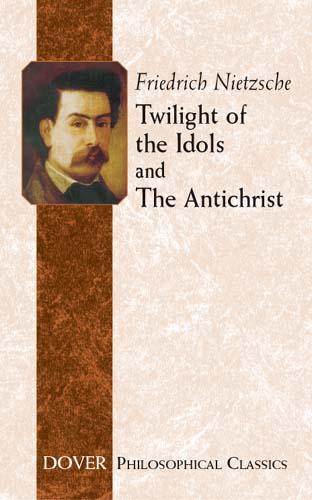
"Books for everybody are always malodorous books: the smell of petty people clings to them," scoffed Friedrich Nietzsche. These two works, Twilight of the Idols and The Antichrist, crowned the radical philosopher's career of writing books that are decidedly not for everyone. Written in 1888, while Nietzsche was at the height of his brilliance — but shortly before the onset of the insanity that gripped him until his death in 1900 — they blaze with provocative, inflammatory rhetoric.
Nietzsche's "grand declaration of war," Twilight of the Idols examines what we worship and why. Intended by the author as a general introduction to his philosophy, it assails "idols" of Western philosophy and culture (Socratic rationality and Christian morality among them) and sets the scene for The Antichrist. In addition to its full-scale attack on Christianity and Jesus Christ, The Antichrist denounces organized religion as a whole. H. L. Mencken declared that "it is, to many sensitive men, in the worst possible taste, but at bottom it is enormously apt and effective — on the surface, it is undoubtedly a good show." Students of philosophy, history, and German literature will find these works essential to an understanding of Nietzschean philosophy.
Betal nemt med kort, Klarna, Apple Pay eller Google Pay. Ikke tilfreds? Du har altid 14 dages fortrydelsesret. Læs mere i vores vilkår. Har du spørgsmål, så send os en mail på hello@memmo.org.
Memmo gør det nemmere at studere – uanset hvor du er i verden. Hos os samler du dine kursusbøger og smarte studieværktøjer ét sted: resuméer, quizzer, podcasts og flashcards. Og så er der Ted, din studieven, der svarer på alt, du undrer dig over. Over 50 000 studerende studerer allerede her – bygget til at hjælpe dig med at lære hurtigere og stresse mindre.