
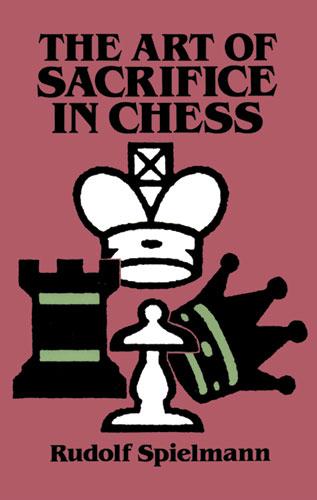
"The beauty of a game of chess is usually appraised, and with good reason, according to the sacrifices it contains. On principle we incline to rate a sacrificial game more highly than a positional game. Instinctively we place the moral value above the scientific. We honor Capablanca, but our hearts beat higher when Morphy’s name is mentioned." — Introduction.
Perhaps the strongest Austrian-born grandmaster of the20th century, Rudolf Spielmann (1883–1942) defeated such world-class opponents as Nimzovich, Tartakower, Bogoljubov — and even the great Capablanca. Among the reasons for his success was his mastery of the art of sacrifice. In this ground-breaking classic, distilled from 40 years of tournament play, he outlines the hard-won lessons that enable a player to win games by giving up pieces!
Drawing on dozens of his own games against such topflight players as Schlechter, Tartakower, Bogoljubov, Reti, Rubinstein and Tarrasch, Spielmann describes and analysis various type of sacrifices: (positional, for gain, mating) and real sacrifices: (for development, obstructive, preventive, line-clearance, vacating, deflecting and more). The result was the first systematic attempt to explain and exploit the theory of chess sacrifice; it remains an extremely helpful and useful weapon in the arsenal of chess players at every level.
Perhaps the strongest Austrian-born grandmaster of the20th century, Rudolf Spielmann (1883–1942) defeated such world-class opponents as Nimzovich, Tartakower, Bogoljubov — and even the great Capablanca. Among the reasons for his success was his mastery of the art of sacrifice. In this ground-breaking classic, distilled from 40 years of tournament play, he outlines the hard-won lessons that enable a player to win games by giving up pieces!
Drawing on dozens of his own games against such topflight players as Schlechter, Tartakower, Bogoljubov, Reti, Rubinstein and Tarrasch, Spielmann describes and analysis various type of sacrifices: (positional, for gain, mating) and real sacrifices: (for development, obstructive, preventive, line-clearance, vacating, deflecting and more). The result was the first systematic attempt to explain and exploit the theory of chess sacrifice; it remains an extremely helpful and useful weapon in the arsenal of chess players at every level.
Betal nemt med kort, Klarna, Apple Pay eller Google Pay. Ikke tilfreds? Du har altid 14 dages fortrydelsesret. Læs mere i vores vilkår. Har du spørgsmål, så send os en mail på hello@memmo.org.
Memmo gør det nemmere at studere – uanset hvor du er i verden. Hos os samler du dine kursusbøger og smarte studieværktøjer ét sted: resuméer, quizzer, podcasts og flashcards. Og så er der Ted, din studieven, der svarer på alt, du undrer dig over. Over 50 000 studerende studerer allerede her – bygget til at hjælpe dig med at lære hurtigere og stresse mindre.
Du kan måske også lide
Køb bogen0