
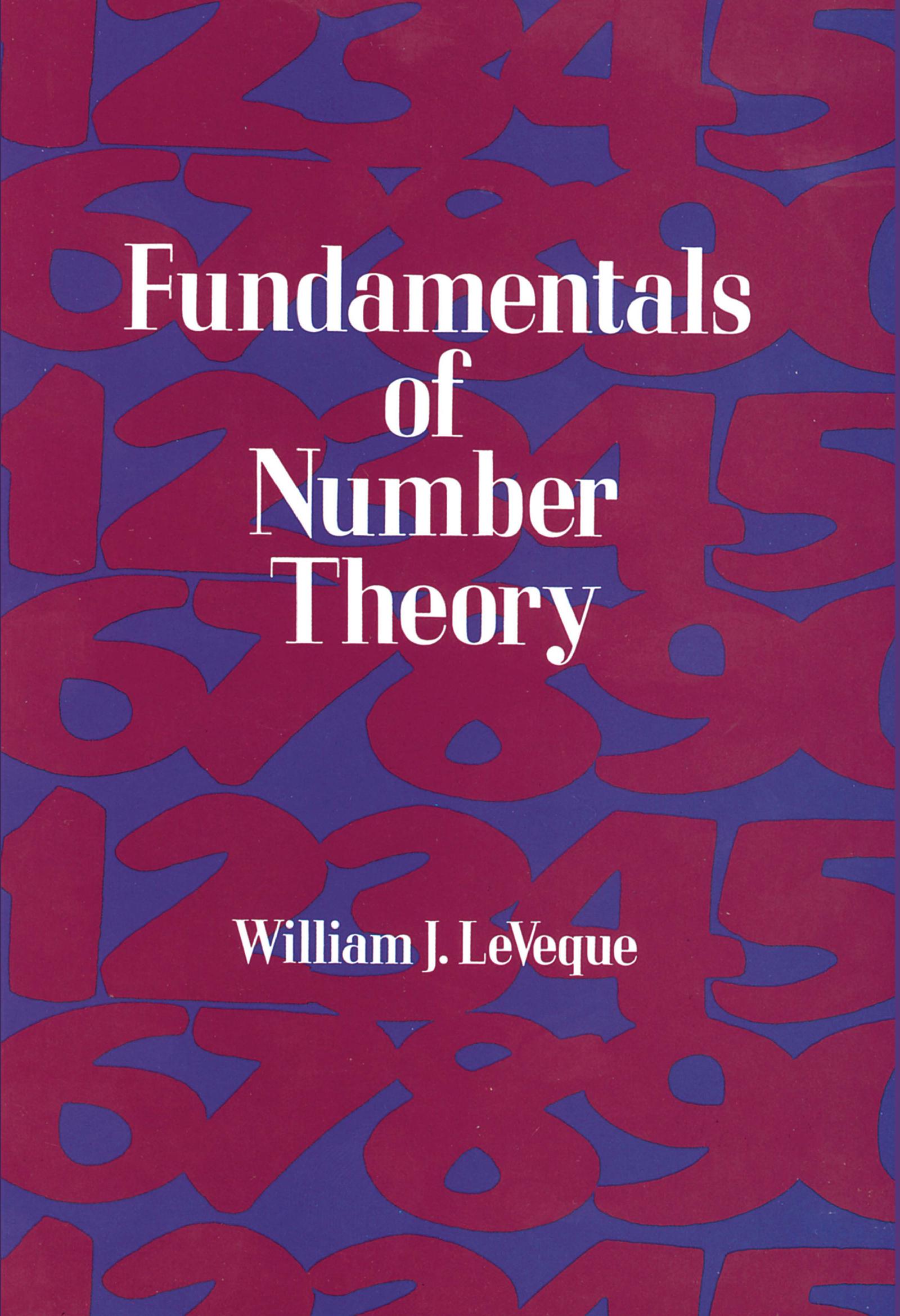
This excellent textbook introduces the basics of number theory, incorporating the language of abstract algebra. A knowledge of such algebraic concepts as group, ring, field, and domain is not assumed, however; all terms are defined and examples are given — making the book self-contained in this respect.
The author begins with an introductory chapter on number theory and its early history. Subsequent chapters deal with unique factorization and the GCD, quadratic residues, number-theoretic functions and the distribution of primes, sums of squares, quadratic equations and quadratic fields, diophantine approximation, and more. Included are discussions of topics not always found in introductory texts: factorization and primality of large integers, p-adic numbers, algebraic number fields, Brun's theorem on twin primes, and the transcendence of e, to mention a few.
Readers will find a substantial number of well-chosen problems, along with many notes and bibliographical references selected for readability and relevance. Five helpful appendixes — containing such study aids as a factor table, computer-plotted graphs, a table of indices, the Greek alphabet, and a list of symbols — and a bibliography round out this well-written text, which is directed toward undergraduate majors and beginning graduate students in mathematics. No post-calculus prerequisite is assumed. 1977 edition.
Betal nemt med kort, Klarna, Apple Pay eller Google Pay. Ikke tilfreds? Du har altid 14 dages fortrydelsesret. Læs mere i vores vilkår. Har du spørgsmål, så send os en mail på hello@memmo.org.
Memmo gør det nemmere at studere – uanset hvor du er i verden. Hos os samler du dine kursusbøger og smarte studieværktøjer ét sted: resuméer, quizzer, podcasts og flashcards. Og så er der Ted, din studieven, der svarer på alt, du undrer dig over. Over 50 000 studerende studerer allerede her – bygget til at hjælpe dig med at lære hurtigere og stresse mindre.