
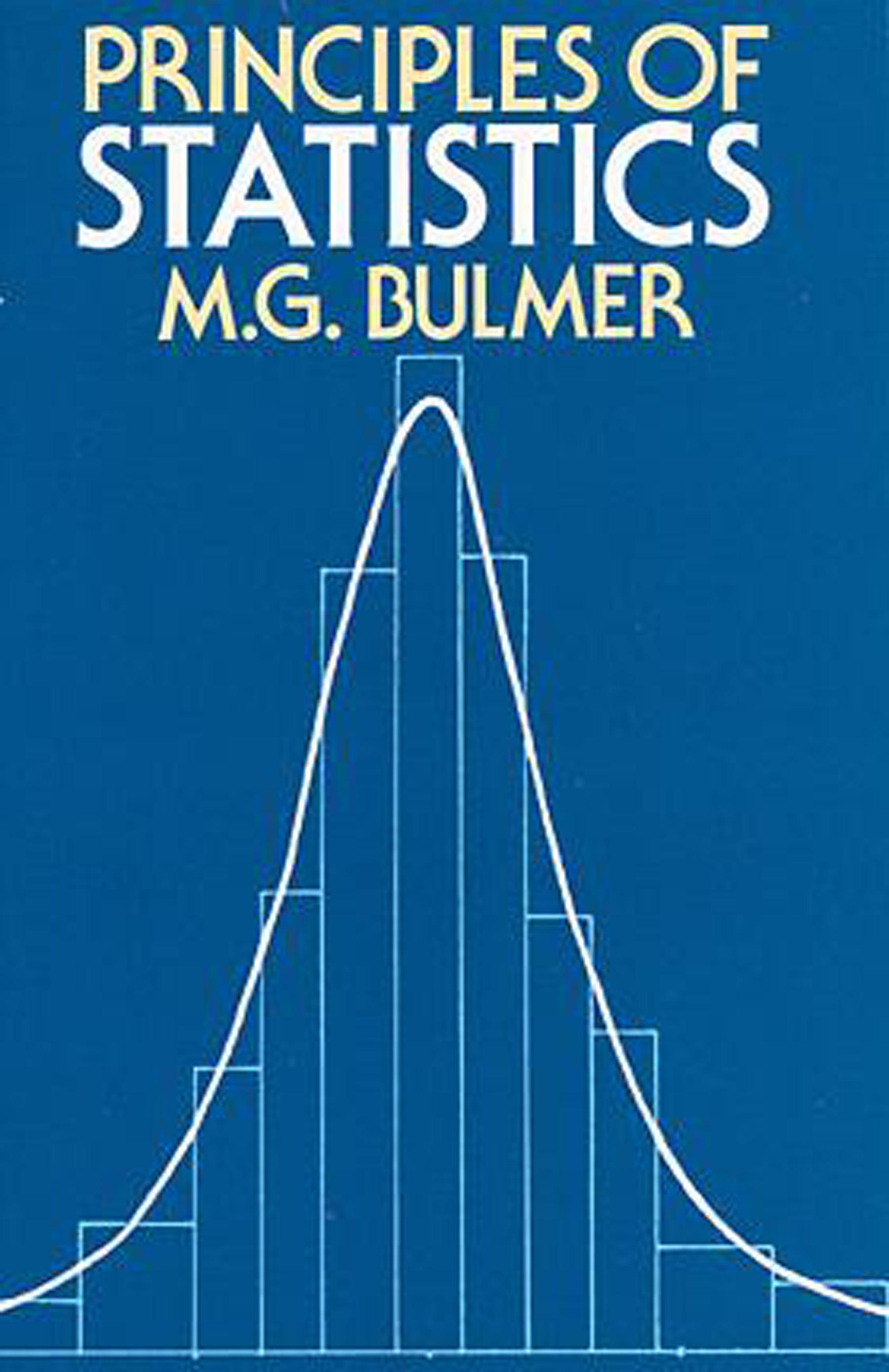
There are many textbooks which describe current methods of statistical analysis, while neglecting related theory. There are equally many advanced textbooks which delve into the far reaches of statistical theory, while bypassing practical applications. But between these two approaches is an unfilled gap, in which theory and practice merge at an intermediate level. Professor M. G. Bulmer's Principles of Statistics, originally published in 1965, was created to fill that need. The new, corrected Dover edition of Principles of Statistics makes this invaluable mid-level text available once again for the classroom or for self-study.
Principles of Statistics was created primarily for the student of natural sciences, the social scientist, the undergraduate mathematics student, or anyone familiar with the basics of mathematical language. It assumes no previous knowledge of statistics or probability; nor is extensive mathematical knowledge necessary beyond a familiarity with the fundamentals of differential and integral calculus. (The calculus is used primarily for ease of notation; skill in the techniques of integration is not necessary in order to understand the text.)
Professor Bulmer devotes the first chapters to a concise, admirably clear description of basic terminology and fundamental statistical theory: abstract concepts of probability and their applications in dice games, Mendelian heredity, etc.; definitions and examples of discrete and continuous random variables; multivariate distributions and the descriptive tools used to delineate them; expected values; etc.
The book then moves quickly to more advanced levels, as Professor Bulmer describes important distributions (binomial, Poisson, exponential, normal, etc.), tests of significance, statistical inference, point estimation, regression, and correlation. Dozens of exercises and problems appear at the end of various chapters, with answers provided at the back of the book. Also included are a number of statistical tables and selected references.
Professor Bulmer devotes the first chapters to a concise, admirably clear description of basic terminology and fundamental statistical theory: abstract concepts of probability and their applications in dice games, Mendelian heredity, etc.; definitions and examples of discrete and continuous random variables; multivariate distributions and the descriptive tools used to delineate them; expected values; etc.
The book then moves quickly to more advanced levels, as Professor Bulmer describes important distributions (binomial, Poisson, exponential, normal, etc.), tests of significance, statistical inference, point estimation, regression, and correlation. Dozens of exercises and problems appear at the end of various chapters, with answers provided at the back of the book. Also included are a number of statistical tables and selected references.
Betal nemt med kort, Klarna, Apple Pay eller Google Pay. Ikke tilfreds? Du har altid 14 dages fortrydelsesret. Læs mere i vores vilkår. Har du spørgsmål, så send os en mail på hello@memmo.org.
Memmo gør det nemmere at studere – uanset hvor du er i verden. Hos os samler du dine kursusbøger og smarte studieværktøjer ét sted: resuméer, quizzer, podcasts og flashcards. Og så er der Ted, din studieven, der svarer på alt, du undrer dig over. Over 50 000 studerende studerer allerede her – bygget til at hjælpe dig med at lære hurtigere og stresse mindre.
Du kan måske også lide
Køb bogen0