
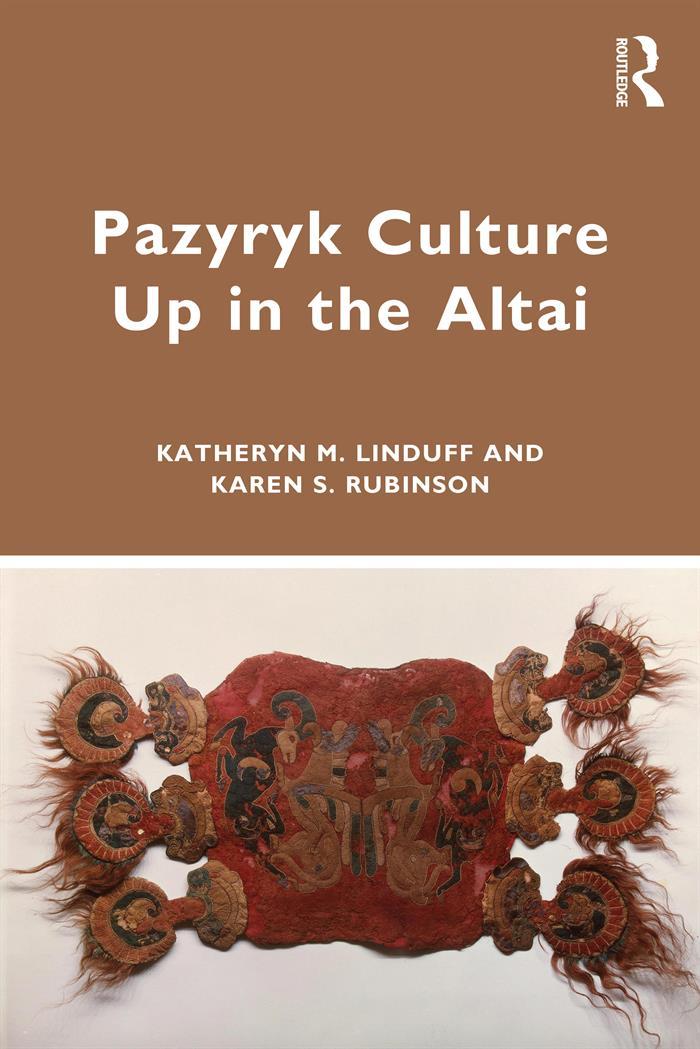
This book reconsiders the archaeology of the Pazyryk, the horse-riding people of the Altai Mountains who lived in the 4th–3rd centuries BCE, in light of recent scientific studies and excavations not only in Russia but also Kazakhstan, Mongolia and China, together with new theories of landscape.
Excavation of the Pazyryk burials sparked great interest because of their wealth of organic remains, including tattooed bodies and sacrificed horses, together with superb wooden carvings and colorful textiles. In view of this new research, the role of the Pazyryk Culture in the ancient globalized world can now be more focused and refined. In this synthetic study of the region, the Pazyryk Culture is set into the landscape using recent studies on climate, technology, human and animal DNA and local resources. It shows that this was a powerful, semi-sedentary, interdependent group with contacts in Eurasia to their west, and to their east in Mongolia and south in China.
This book is for archaeologists, anthropologists, art historians, social and economic historians as well as persons with general interests in mobile pastoralism, the emergence of complex societies, the social roles of artifacts and the diverse nature of an interconnected ancient world.
Betal nemt med kort, Klarna, Apple Pay eller Google Pay. Ikke tilfreds? Du har altid 14 dages fortrydelsesret. Læs mere i vores vilkår. Har du spørgsmål, så send os en mail på hello@memmo.org.
Memmo gør det nemmere at studere – uanset hvor du er i verden. Hos os samler du dine kursusbøger og smarte studieværktøjer ét sted: resuméer, quizzer, podcasts og flashcards. Og så er der Ted, din studieven, der svarer på alt, du undrer dig over. Over 50 000 studerende studerer allerede her – bygget til at hjælpe dig med at lære hurtigere og stresse mindre.