
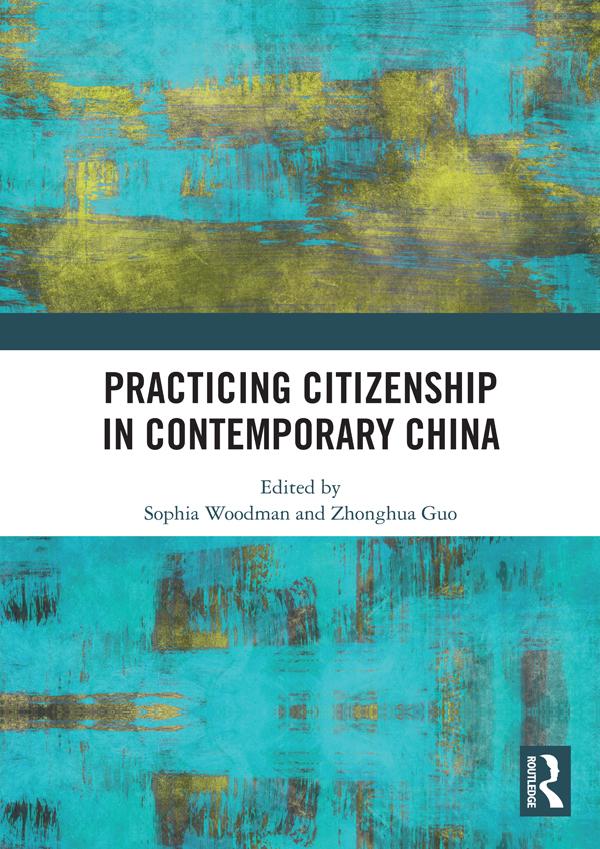
This book examines citizenship as practiced in China today from a variety of angles. Citizenship in China—and elsewhere in the Global South—has often been perceived as either a distorted echo of the ‘real’ democratic version in Europe and North America, or an orientalized ‘other’ that defines what citizenship is not. By contrast, this book sees Chinese citizenship as an aspect of a connected modernity that is still unfolding. The book focuses on three key tensions: a state preference for sedentarism and governing citizens in place vs. growing mobility, sometimes facilitated by the state; a perception that state-building and development requires a strong state vs. ideas and practices of participatory citizenship; and submission of the individual to the ‘collective’ (state, community, village, family, etc.) vs. the rising salience of conceptions of self-development and self-making projects. Examining manifestations of these tensions can contribute to thinking about citizenship beyond China, including the role of the local in forming citizenship orders; how individualization works in the absence of liberal individualism; and how ‘social citizenship’ is increasingly becoming a reward to ‘good citizens’, rather than a mechanism for achieving citizen equality. This book was originally published as a Special Issue of the journal Citizenship Studies.
Betal nemt med kort, Klarna, Apple Pay eller Google Pay. Ikke tilfreds? Du har altid 14 dages fortrydelsesret. Læs mere i vores vilkår. Har du spørgsmål, så send os en mail på hello@memmo.org.
Memmo gør det nemmere at studere – uanset hvor du er i verden. Hos os samler du dine kursusbøger og smarte studieværktøjer ét sted: resuméer, quizzer, podcasts og flashcards. Og så er der Ted, din studieven, der svarer på alt, du undrer dig over. Over 50 000 studerende studerer allerede her – bygget til at hjælpe dig med at lære hurtigere og stresse mindre.