
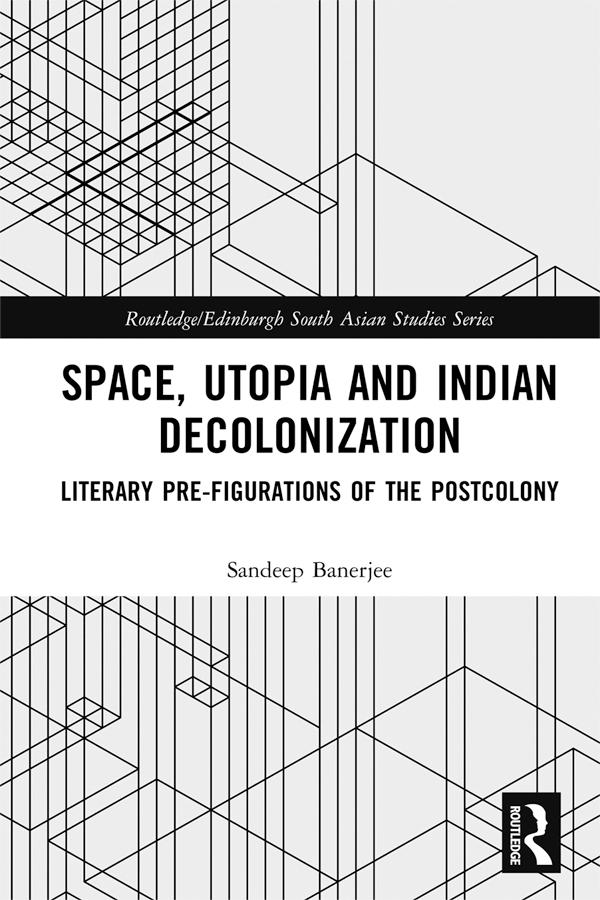
The book illuminates the spatial utopianism of South Asian anti-colonial texts by showing how they refuse colonial spatial imaginaries to re-imagine the British Indian colony as the postcolony in diverse and contested ways. Focusing on the literary field of South Asia between, largely, the 1860s and 1920s, it underlines the centrality of literary imagination and representation in the cultural politics of decolonization.
This book spatializes our understanding of decolonization while decoupling and complicating the easy equation between decolonization and anti-colonial nationalism. The author utilises a global comparative framework and reads across the English-vernacular divide to understand space as a site of contested representation and ideological contestation. He interrogates the spatial desire of anti-colonial and colonial texts across a range of genres, namely, historical romances, novels, travelogues, memoirs, poems, and patriotic lyrics.
The book is the first full-length literary geographical study of South Asian literary texts and will be of interest to an interdisciplinary audience in the fields of Postcolonial and World Literature, Asian Literature, Victorian Literature, Modern South Asian Historiography, Literature and Utopia, Literature and Decolonization, Literature and Nationalism, Cultural Geography, and South Asian Studies.
Betal nemt med kort, Klarna, Apple Pay eller Google Pay. Ikke tilfreds? Du har altid 14 dages fortrydelsesret. Læs mere i vores vilkår. Har du spørgsmål, så send os en mail på hello@memmo.org.
Memmo gør det nemmere at studere – uanset hvor du er i verden. Hos os samler du dine kursusbøger og smarte studieværktøjer ét sted: resuméer, quizzer, podcasts og flashcards. Og så er der Ted, din studieven, der svarer på alt, du undrer dig over. Over 50 000 studerende studerer allerede her – bygget til at hjælpe dig med at lære hurtigere og stresse mindre.