
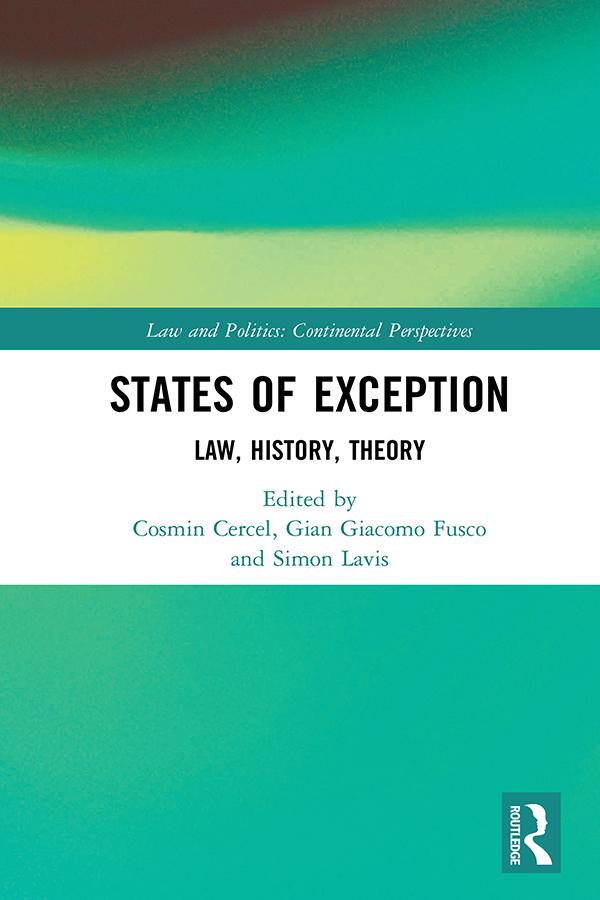
This book addresses the relevance of the state of exception for the analysis of law, while reflecting on the deeper symbolic and jurisprudential significance of the coalescence between law and force.
The concept of the state of exception has become a central topos in political and legal philosophy as well as in critical theory. The theoretical apparatus of the state of exception sharply captures the uneasy relationship between law, life and politics in the contemporary global setting, while also challenging the comforting narratives that uncritically connect democracy with the tradition of the rule of law. Drawing on critical legal theory, continental jurisprudence, political philosophy and history, this book explores the genealogy of the concept of the state of exception and reflects on its legal embodiment in past and present contexts – including Weimar and Nazi Germany, contemporary Europe and Turkey. In doing so, it explores the disruptive force of the exception for legal and political thought, as it recuperates its contemporary critical potential.
The book will be of interest to students and scholars in the field of jurisprudence, philosophy and critical legal theory.
Betal nemt med kort, Klarna, Apple Pay eller Google Pay. Ikke tilfreds? Du har altid 14 dages fortrydelsesret. Læs mere i vores vilkår. Har du spørgsmål, så send os en mail på hello@memmo.org.
Memmo gør det nemmere at studere – uanset hvor du er i verden. Hos os samler du dine kursusbøger og smarte studieværktøjer ét sted: resuméer, quizzer, podcasts og flashcards. Og så er der Ted, din studieven, der svarer på alt, du undrer dig over. Over 50 000 studerende studerer allerede her – bygget til at hjælpe dig med at lære hurtigere og stresse mindre.