
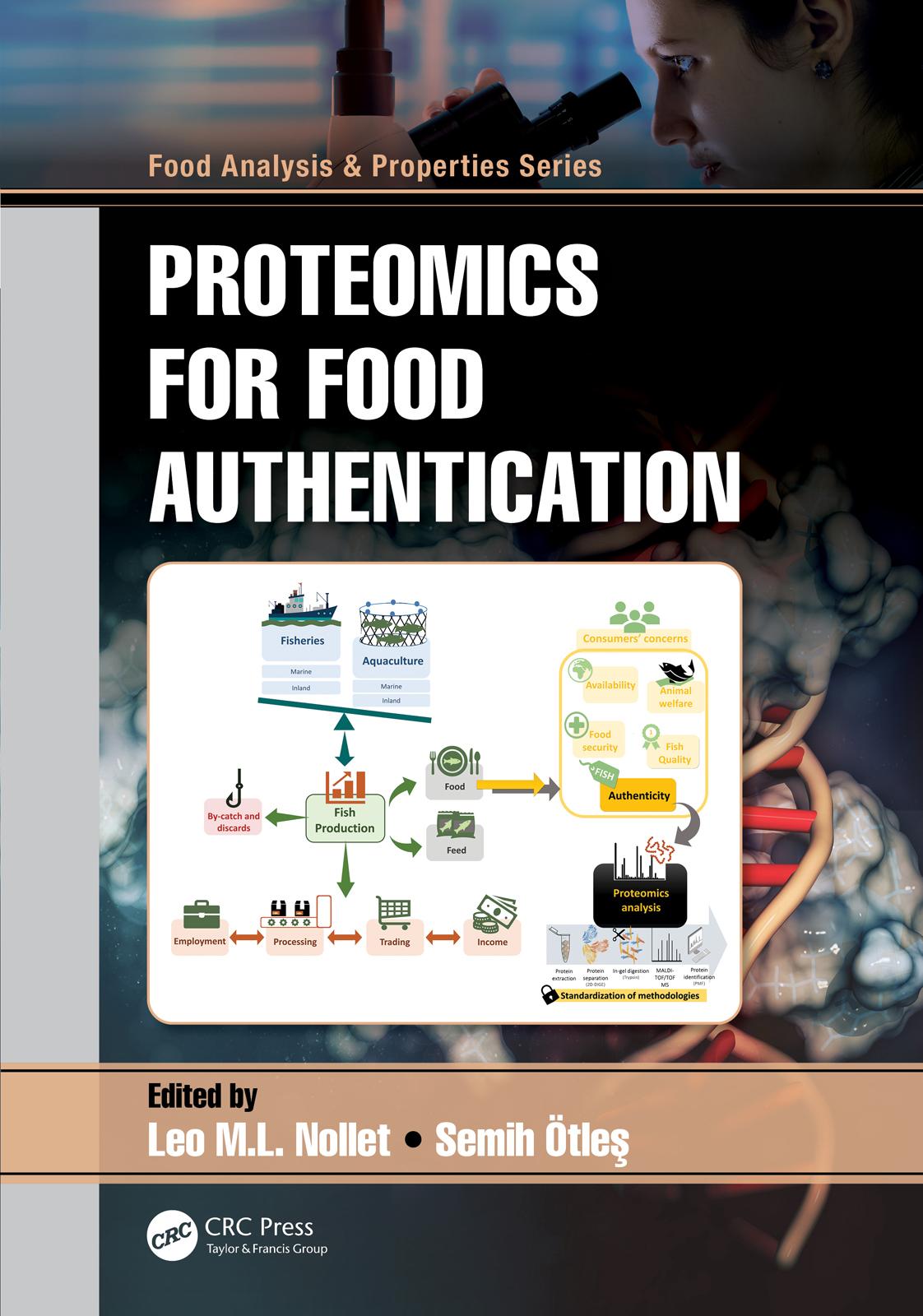
Consumers have the right to know what is in the food they are eating, and accordingly, a number of global food regulations require that the provenance of the food can be guaranteed from farm to fork. Many different instrumental techniques have been proposed for food authentication. Although traditional methods are still being used, new approaches such as genomics, proteomics, and metabolomics are helping to complement existing methodologies for verifying the claims made about certain food products.
During the last decade, proteomics (the largescale analysis of proteins in a particular biological system at a particular time) has been applied to different research areas within food technology. Since proteins can be used as markers for many properties of a food, even indicating processes to which the food has been subjected, they can provide further evidence of the foods labeling claim. Proteomics for Food Authentication, a volume in the Food Analysis and Properties Series, is a comprehensive and updated overview of the applications, drawbacks, advantages, and challenges of proteomics for food authentication.
Features:
- Provides a comprehensive and critical overview of the application of proteomics in food
- Helps food scientists determine the authenticity of several food products
- Provides applied techniques for both laboratory and industrial environments
- Describes workflows, technologies, and tools that are being assessed in proteomics-related studies
Workflows, technologies, and tools that are being assessed in proteomics-related studies are described, followed by a review of the specific applications regarding food authenticity and, now and then, food quality.
The book will provide a comprehensive and critical overview of the application of proteomics approaches to determine the authenticity of several food products updating the performances and current limitations of the applied techniques in both laboratory and industrial environments. As such it is well suited to food scientist, chemical engineers, food engineers, research labs, universities, governments, related food industries.
Also available in the Food Analysis and Properties Series:
Food Aroma Evolution: During Food Processing, Cooking, and Aging, edited by
Matteo Bordiga and Leo M.L. Nollet (ISBN: 9781138338241)
Ambient Mass Spectroscopy Techniques in Food and the Environment, edited by Leo M.L. Nollet and Basil K. Munjanja (ISBN: 9781138505568)
Hyperspectral Imaging Analysis and Applications for Food Quality, edited by N.C. Basantia, Leo M.L. Nollet, and Mohammed Kamruzzaman (ISBN: 9781138630796)
For a complete list of books in this series, please visit our website at:
www.crcpress.com/Food-Analysis--Properties/book-series/CRCFOODANPRO
Betal nemt med kort, Klarna, Apple Pay eller Google Pay. Ikke tilfreds? Du har altid 14 dages fortrydelsesret. Læs mere i vores vilkår. Har du spørgsmål, så send os en mail på hello@memmo.org.
Memmo gør det nemmere at studere – uanset hvor du er i verden. Hos os samler du dine kursusbøger og smarte studieværktøjer ét sted: resuméer, quizzer, podcasts og flashcards. Og så er der Ted, din studieven, der svarer på alt, du undrer dig over. Over 50 000 studerende studerer allerede her – bygget til at hjælpe dig med at lære hurtigere og stresse mindre.