
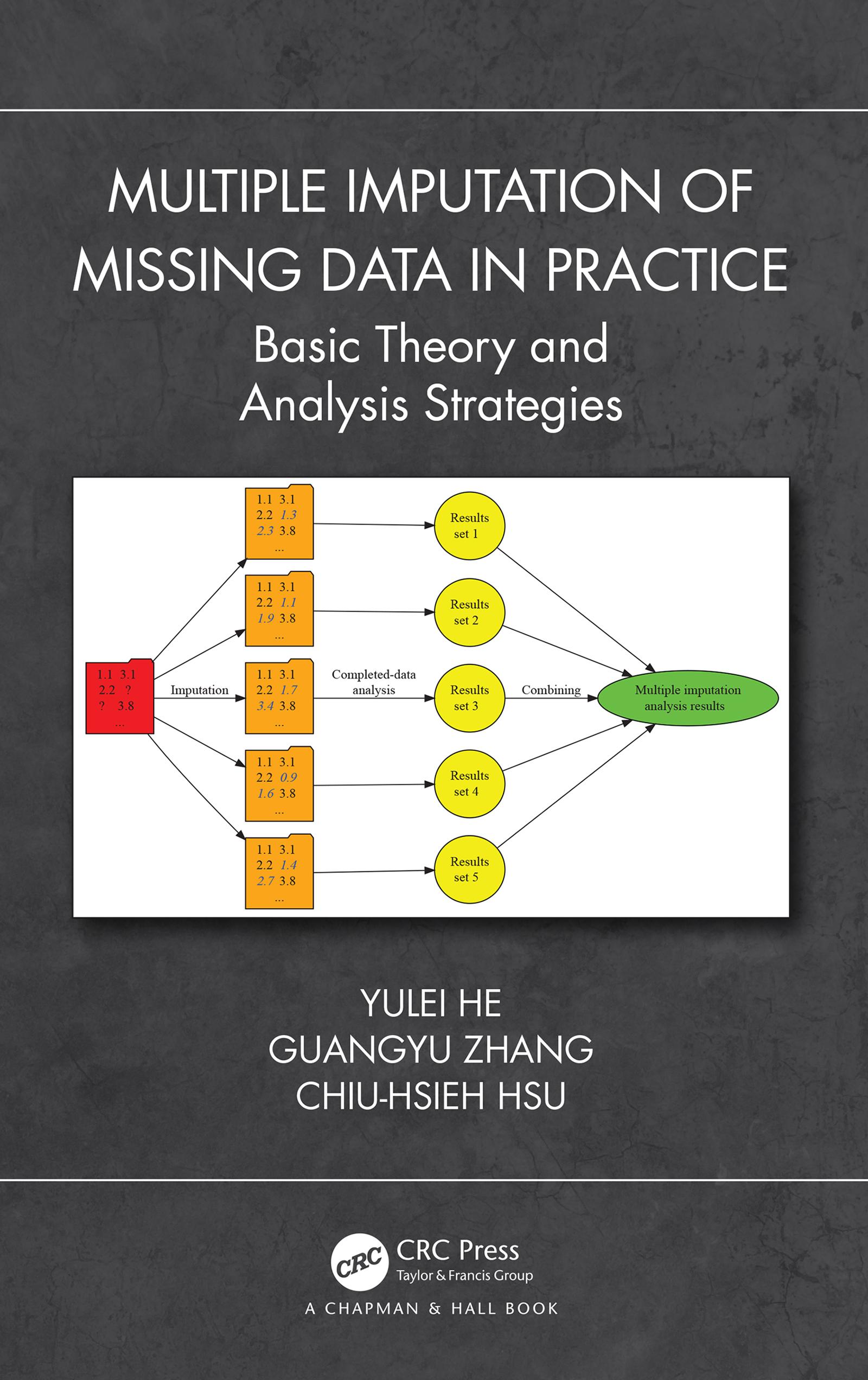
Multiple Imputation of Missing Data in Practice: Basic Theory and Analysis Strategies provides a comprehensive introduction to the multiple imputation approach to missing data problems that are often encountered in data analysis. Over the past 40 years or so, multiple imputation has gone through rapid development in both theories and applications. It is nowadays the most versatile, popular, and effective missing-data strategy that is used by researchers and practitioners across different fields. There is a strong need to better understand and learn about multiple imputation in the research and practical community.
Accessible to a broad audience, this book explains statistical concepts of missing data problems and the associated terminology. It focuses on how to address missing data problems using multiple imputation. It describes the basic theory behind multiple imputation and many commonly-used models and methods. These ideas are illustrated by examples from a wide variety of missing data problems. Real data from studies with different designs and features (e.g., cross-sectional data, longitudinal data, complex surveys, survival data, studies subject to measurement error, etc.) are used to demonstrate the methods. In order for readers not only to know how to use the methods, but understand why multiple imputation works and how to choose appropriate methods, simulation studies are used to assess the performance of the multiple imputation methods. Example datasets and sample programming code are either included in the book or available at a github site (https://github.com/he-zhang-hsu/multiple_imputation_book).
Key Features
- Provides an overview of statistical concepts that are useful for better understanding missing data problems and multiple imputation analysis
- Provides a detailed discussion on multiple imputation models and methods targeted to different types of missing data problems (e.g., univariate and multivariate missing data problems, missing data in survival analysis, longitudinal data, complex surveys, etc.)
- Explores measurement error problems with multiple imputation
- Discusses analysis strategies for multiple imputation diagnostics
- Discusses data production issues when the goal of multiple imputation is to release datasets for public use, as done by organizations that process and manage large-scale surveys with nonresponse problems
- For some examples, illustrative datasets and sample programming code from popular statistical packages (e.g., SAS, R, WinBUGS) are included in the book. For others, they are available at a github site (https://github.com/he-zhang-hsu/multiple_imputation_book)
Betal nemt med kort, Klarna, Apple Pay eller Google Pay. Ikke tilfreds? Du har altid 14 dages fortrydelsesret. Læs mere i vores vilkår. Har du spørgsmål, så send os en mail på hello@memmo.org.
Memmo gør det nemmere at studere – uanset hvor du er i verden. Hos os samler du dine kursusbøger og smarte studieværktøjer ét sted: resuméer, quizzer, podcasts og flashcards. Og så er der Ted, din studieven, der svarer på alt, du undrer dig over. Over 50 000 studerende studerer allerede her – bygget til at hjælpe dig med at lære hurtigere og stresse mindre.