
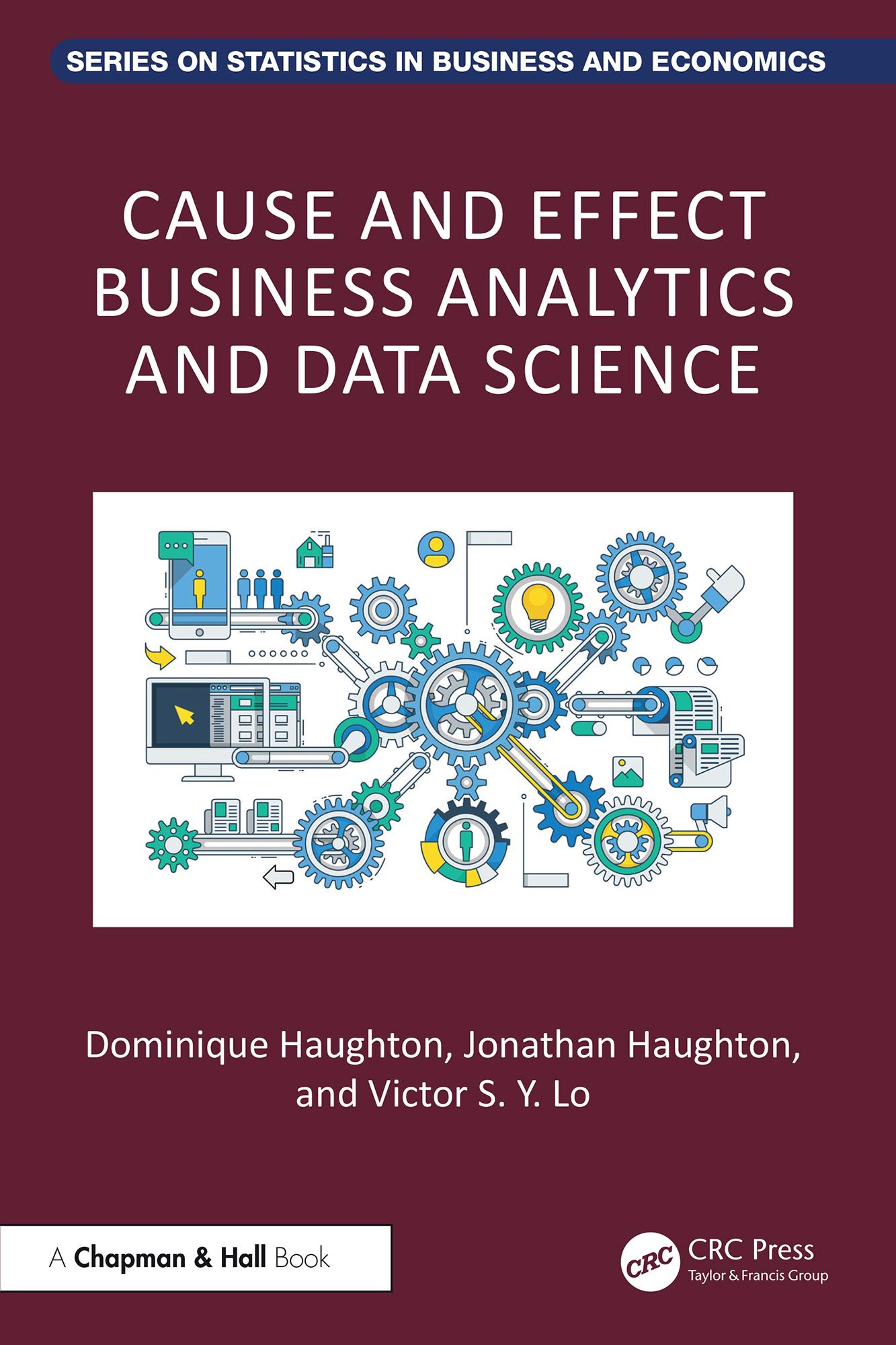
Among the most important questions that businesses ask are some very simple ones: If I decide to do something, will it work? And if so, how large are the effects? To answer these predictive questions, and later base decisions on them, we need to establish causal relationships.
Establishing and measuring causality can be difficult. This book explains the most useful techniques for discerning causality and illustrates the principles with numerous examples from business. It discusses randomized experiments (aka A/B testing) and techniques such as propensity score matching, synthetic controls, double differences, and instrumental variables. There is a chapter on the powerful AI approach of Directed Acyclic Graphs (aka Bayesian Networks), another on structural equation models, and one on time-series techniques, including Granger causality.
At the heart of the book are four chapters on uplift modeling, where the goal is to help firms determine how best to deploy their resources for marketing or other interventions. We start by modeling uplift, discuss the test-and-learn process, and provide an overview of the prescriptive analytics of uplift.
The book is written in an accessible style and will be of interest to data analysts and strategists in business, to students and instructors of business and analytics who have a solid foundation in statistics, and to data scientists who recognize the need to take seriously the need for causality as an essential input into effective decision-making.
Betal nemt med kort, Klarna, Apple Pay eller Google Pay. Ikke tilfreds? Du har altid 14 dages fortrydelsesret. Læs mere i vores vilkår. Har du spørgsmål, så send os en mail på hello@memmo.org.
Memmo gør det nemmere at studere – uanset hvor du er i verden. Hos os samler du dine kursusbøger og smarte studieværktøjer ét sted: resuméer, quizzer, podcasts og flashcards. Og så er der Ted, din studieven, der svarer på alt, du undrer dig over. Over 50 000 studerende studerer allerede her – bygget til at hjælpe dig med at lære hurtigere og stresse mindre.