
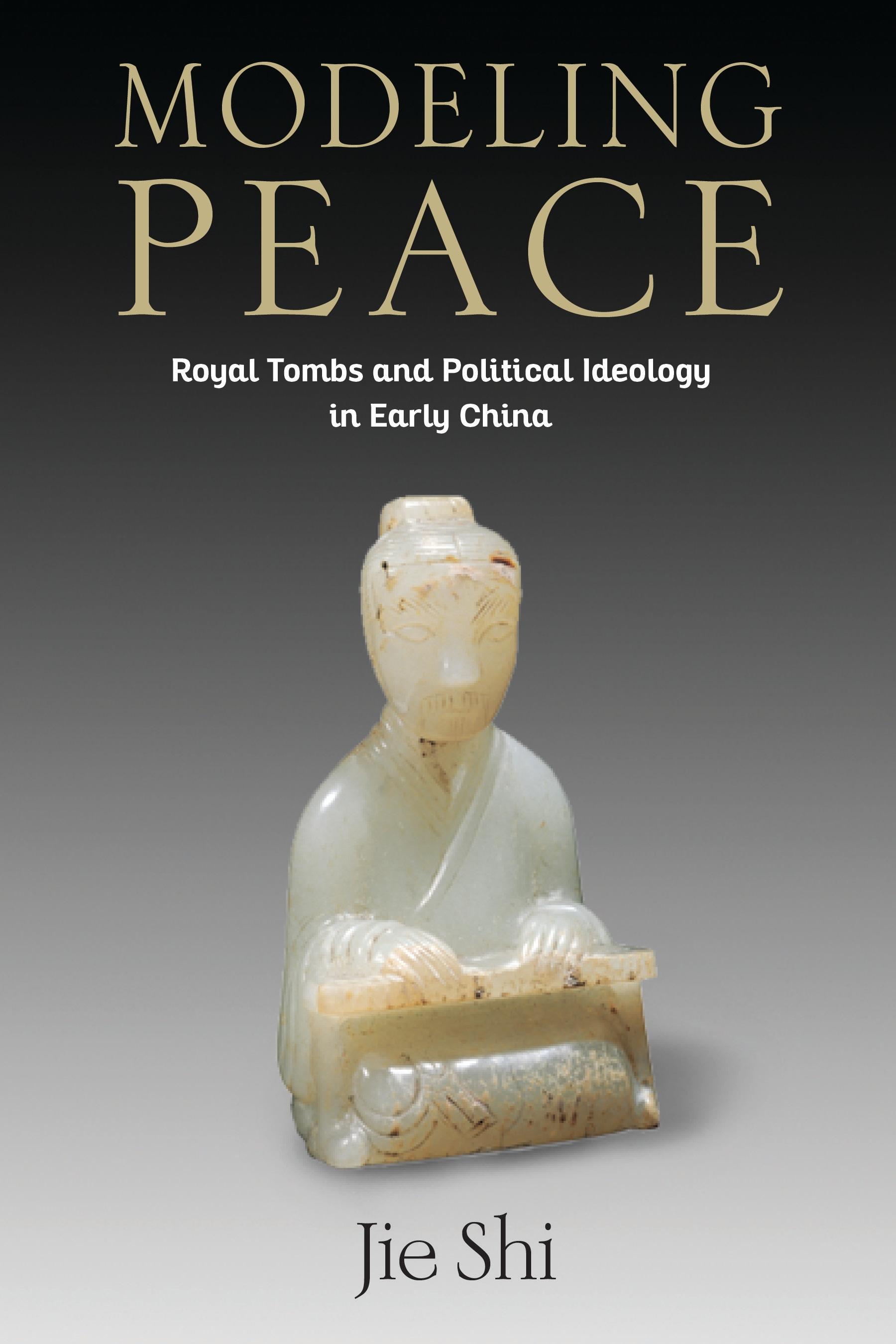
Among hundreds of thousands of ancient graves and tombs excavated to date in China, the Mancheng site stands out for its unparalleled complexity and richness. It features juxtaposed burials of the first king and queen of the Zhongshan kingdom (dated late second century BCE). The male tomb occupant, King Liu Sheng (d. 113 BCE), was sent by his father, Emperor Jing (r. 157–141 BCE), to rule the Zhongshan kingdom near the northern frontier of the Western Han Empire, neighboring the nomadic Xiongnu confederation.
Modeling Peace interprets Western Han royal burial as a political ideology by closely reading the architecture and funerary content of this site and situating it in the historical context of imperialization in Western Han China. Through a study of both the archaeological materials and related received and excavated texts, Jie Shi demonstrates that the Mancheng site was planned and designed as a unity of religious, gender, and intercultural concerns. The site was built under the supervision of the future occupants of the royal tomb, who used these burials to assert their political ideology based on Huang-Lao and Confucian thought: a good ruler is one who pacifies himself, his family, and his country. This book is the first scholarly monograph on an undisturbed and fully excavated early Chinese royal burial site.
Betal nemt med kort, Klarna, Apple Pay eller Google Pay. Ikke tilfreds? Du har altid 14 dages fortrydelsesret. Læs mere i vores vilkår. Har du spørgsmål, så send os en mail på hello@memmo.org.
Memmo gør det nemmere at studere – uanset hvor du er i verden. Hos os samler du dine kursusbøger og smarte studieværktøjer ét sted: resuméer, quizzer, podcasts og flashcards. Og så er der Ted, din studieven, der svarer på alt, du undrer dig over. Over 50 000 studerende studerer allerede her – bygget til at hjælpe dig med at lære hurtigere og stresse mindre.