
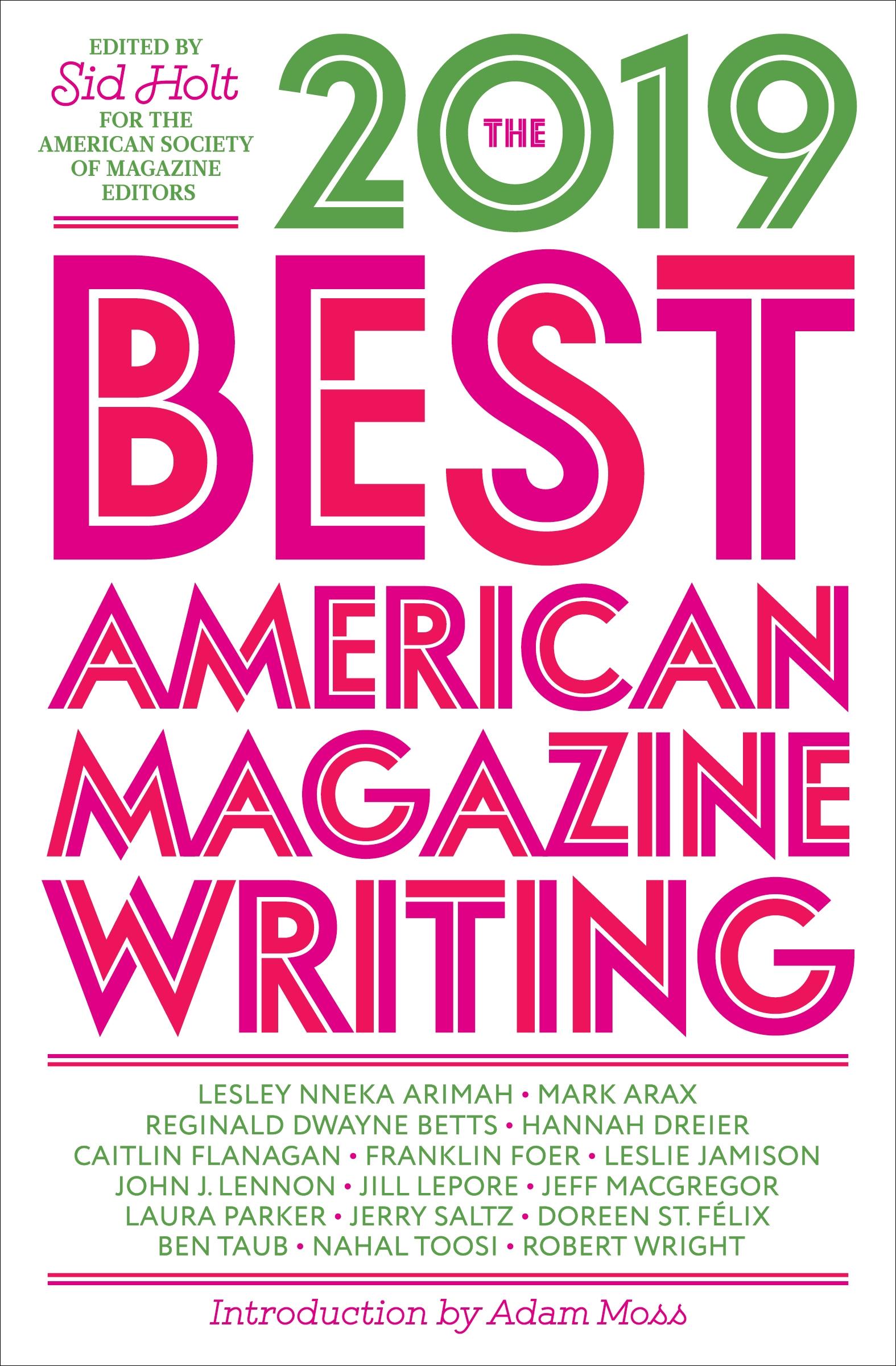
The Best American Magazine Writing 2019 presents articles honored by this year’s National Magazine Awards, showcasing outstanding writing that addresses urgent topics such as justice, gender, power, and violence, both at home and abroad. The anthology features remarkable reporting, including the story of a teenager who tried to get out of MS-13, only to face deportation (ProPublica); an account of the genocide against the Rohingya in Myanmar (Politico); and a sweeping California Sunday Magazine profile of an agribusiness empire. Other journalists explore the indications of environmental catastrophe, from invasive lionfish (Smithsonian) to the omnipresence of plastic (National Geographic).
Personal pieces consider the toll of mass incarceration, including Reginald Dwayne Betts’s “Getting Out” (New York Times Magazine); “This Place Is Crazy,” by John J. Lennon (Esquire); and Robert Wright’s “Getting Out of Prison Meant Leaving Dear Friends Behind” (Marshall Project with Vice). From the pages of the Atlantic and the New Yorker, writers and critics discuss prominent political figures: Franklin Foer’s “American Hustler” explores Paul Manafort’s career of corruption; Jill Lepore recounts the emergence of Ruth Bader Ginsburg; and Caitlin Flanagan and Doreen St. Félix reflect on the Kavanaugh hearings and #MeToo. Leslie Jamison crafts a portrait of the Museum of Broken Relationships (Virginia Quarterly Review), and Kasey Cordell and Lindsey B. Koehler ponder “The Art of Dying Well” (5280). A pair of never-before-published conversations illuminates the state of the American magazine: New Yorker writer Ben Taub speaks to Eric Sullivan of Esquire about pursuing a career as a reporter, alongside Taub’s piece investigating how the Iraqi state is fueling a resurgence of ISIS. And Karolina Waclawiak of BuzzFeed News interviews McSweeney’s editor Claire Boyle about challenges and opportunities for fiction at small magazines. That conversation is inspired by McSweeney’s winning the ASME Award for Fiction, which is celebrated here with a story by Lesley Nneka Arimah, a magical-realist tale charged with feminist allegory.
Betal nemt med kort, Klarna, Apple Pay eller Google Pay. Ikke tilfreds? Du har altid 14 dages fortrydelsesret. Læs mere i vores vilkår. Har du spørgsmål, så send os en mail på hello@memmo.org.
Memmo gør det nemmere at studere – uanset hvor du er i verden. Hos os samler du dine kursusbøger og smarte studieværktøjer ét sted: resuméer, quizzer, podcasts og flashcards. Og så er der Ted, din studieven, der svarer på alt, du undrer dig over. Over 50 000 studerende studerer allerede her – bygget til at hjælpe dig med at lære hurtigere og stresse mindre.