
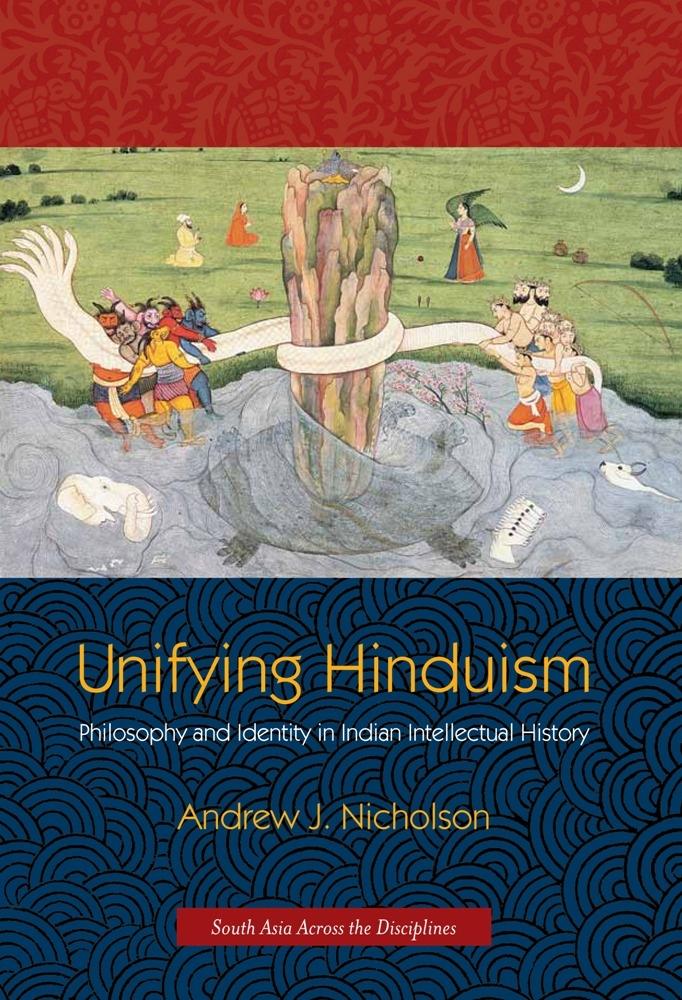
Some postcolonial theorists argue that the idea of a single system of belief known as "Hinduism" is a creation of nineteenth-century British imperialists. Andrew J. Nicholson introduces another perspective: although a unified Hindu identity is not as ancient as some Hindus claim, it has its roots in innovations within South Asian philosophy from the fourteenth to seventeenth centuries. During this time, thinkers treated the philosophies of Vedanta, Samkhya, and Yoga, along with the worshippers of Visnu, Siva, and Sakti, as belonging to a single system of belief and practice. Instead of seeing such groups as separate and contradictory, they re-envisioned them as separate rivers leading to the ocean of Brahman, the ultimate reality.
Drawing on the writings of philosophers from late medieval and early modern traditions, including Vijnanabhiksu, Madhava, and Madhusudana Sarasvati, Nicholson shows how influential thinkers portrayed Vedanta philosophy as the ultimate unifier of diverse belief systems. This project paved the way for the work of later Hindu reformers, such as Vivekananda, Radhakrishnan, and Gandhi, whose teachings promoted the notion that all world religions belong to a single spiritual unity. In his study, Nicholson also critiques the way in which Eurocentric conceptslike monism and dualism, idealism and realism, theism and atheism, and orthodoxy and heterodoxyhave come to dominate modern discourses on Indian philosophy.
Betal nemt med kort, Klarna, Apple Pay eller Google Pay. Ikke tilfreds? Du har altid 14 dages fortrydelsesret. Læs mere i vores vilkår. Har du spørgsmål, så send os en mail på hello@memmo.org.
Memmo gør det nemmere at studere – uanset hvor du er i verden. Hos os samler du dine kursusbøger og smarte studieværktøjer ét sted: resuméer, quizzer, podcasts og flashcards. Og så er der Ted, din studieven, der svarer på alt, du undrer dig over. Over 50 000 studerende studerer allerede her – bygget til at hjælpe dig med at lære hurtigere og stresse mindre.