
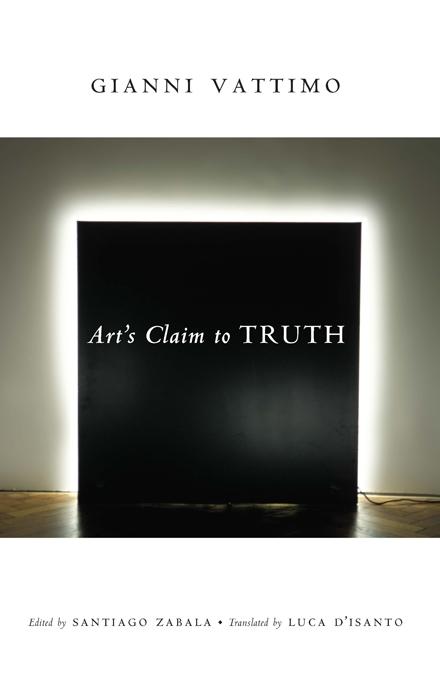
First collected in Italy in 1985, Art's Claim to Truth is considered by many philosophers to be one of Gianni Vattimo's most important works. Newly revised for English readers, the book begins with a challenge to Plato, Aristotle, Kant, and Hegel, who viewed art as a metaphysical aspect of reality rather than a futuristic anticipation of it. Following Martin Heidegger's interpretation of the history of philosophy, Vattimo outlines the existential ontological conditions of aesthetics, paying particular attention to the works of Kandinsky, which reaffirm the ontological implications of art.
Vattimo then builds on Hans-Georg Gadamer's theory of aesthetics and provides an alternative to a rationalistic-positivistic criticism of art. This is the heart of Vattimo's argument, and with it he demonstrates how hermeneutical philosophy reaffirms art's ontological status and makes clear the importance of hermeneutics for aesthetic studies. In the book's final section, Vattimo articulates the consequences of reclaiming the ontological status of aesthetics without its metaphysical implications, holding Aristotle's concept of beauty responsible for the dissolution of metaphysics itself. In its direct engagement with the works of Gadamer, Heidegger, and Luigi Pareyson, Art's Claim to Truth offers a better understanding of the work of Vattimo and a deeper knowledge of ontology, hermeneutics, and the philosophical examination of truth.
Betal nemt med kort, Klarna, Apple Pay eller Google Pay. Ikke tilfreds? Du har altid 14 dages fortrydelsesret. Læs mere i vores vilkår. Har du spørgsmål, så send os en mail på hello@memmo.org.
Memmo gør det nemmere at studere – uanset hvor du er i verden. Hos os samler du dine kursusbøger og smarte studieværktøjer ét sted: resuméer, quizzer, podcasts og flashcards. Og så er der Ted, din studieven, der svarer på alt, du undrer dig over. Over 50 000 studerende studerer allerede her – bygget til at hjælpe dig med at lære hurtigere og stresse mindre.