
Zanim poznałem Memmo, moje notatki były rozrzucone po PDF-ach. Teraz obszar roboczy zbiera wszystko w jednym miejscu — widzę dokładnie, co jeszcze muszę powtórzyć.
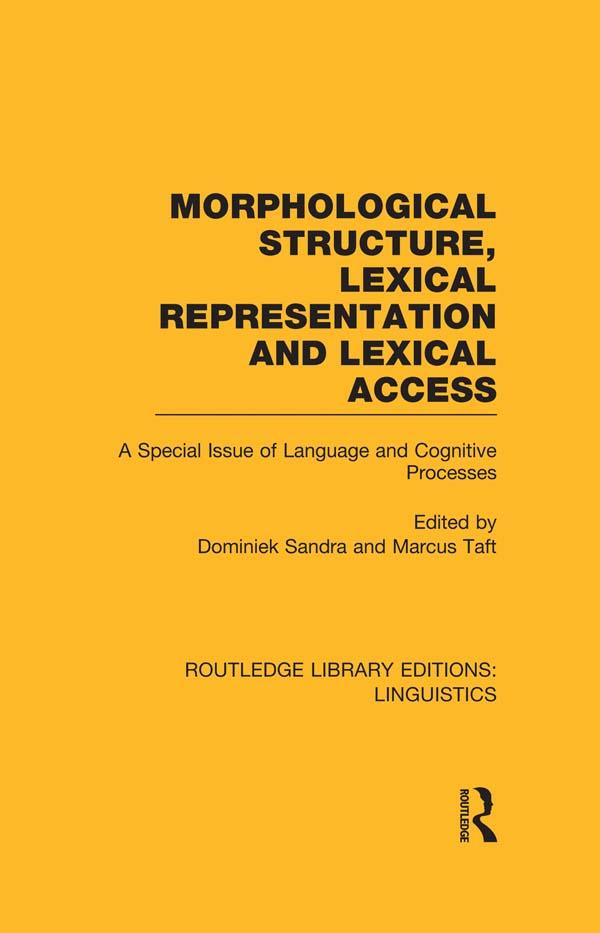
The main concern of this work is whether morphemes play a role in the lexical representation and processing of several types of polymorphemic words and, more particularly, at what precise representational and processing level. The book comprises two theoretical contributions and a number of empirical ones. One theoretical paper discusses several possible motivations for a morphologically organised mental lexicon (like the economy of representation view, and the efficiency of processing view), and lays out the weaknesses that are associated with some of these motivations. The other theoretical paper offers an interactive-activation reinterpretation of the findings that were originally reported within the lexical search framework. The empirical papers together cover a relatively broad array of language types and mainly deal with visual word recognition in normals in the context of lexical morphology (derived and compound words). Evidence is reported on the function of stems and affixes as processing units in prefixed and suffixed derivations. The role of semantic transparency in the lexical representation of compounds is studied, as is the effect of orthographic ambiguity on the parsing of novel compounds. The inflection-derivational distinction is approached in the context of Finnish, a highly agglutinative language with much richer morphology than the languages usually studied in psycholinguistic experiments on polymorphemic words. Two other contributions also approach the study object in the context of relatively uncharted domains: one presents data on Chinese, a language which uses a different script-type (logographic) from the languages that are usually studied (alphabetic script), and another one presents data on language production.
Zanim poznałem Memmo, moje notatki były rozrzucone po PDF-ach. Teraz obszar roboczy zbiera wszystko w jednym miejscu — widzę dokładnie, co jeszcze muszę powtórzyć.
Podsumowania Memmo to złoto przed egzaminami. Nie muszę czytać 800 stron dwa tygodnie wcześniej — tylko to, co najważniejsze.
Czat AI uratował mnie niejeden raz w noc przed egzaminem. Pytam, dopóki nie zrozumiem — i nie muszę czekać na odpowiedź od grupy studyjnej.
Quizy trafiają w punkt, jeśli chodzi o to, co muszę wiedzieć. Memmo śledzi, na czym się zacinam — więc ćwiczę tylko to, co naprawdę się liczy.
Fiszki z powtórkami rozłożonymi w czasie to magia. Memmo wie, kiedy mam coś zapomnieć i przypomina mi o tym.
Podcasty AI to mój faworyt. Słucham w drodze do szkoły i powtarzam materiał, nie siedząc przed komputerem.

Handbok i kvalitativa metoder
281 kr

Hållbar utveckling: en introduktion för ingenjörer och andra problemlösare
334 kr

Brymans Samhällsvetenskapliga metoder
390 kr

Projektledning
491 kr

Den orättvisa hälsan: om socioekonomiska skillnader i hälsa och livslängd
326 kr

Organizational Leadership
429 kr

Vetenskapsteori för nybörjare
196 kr

På väg mot läraryrket
172 kr

Det sociala livet i skolan: Socialpsykologiska perspektiv
253 kr

Betygsättningens didaktik
151 kr

Personality
402 kr

Studying Leadership
404 kr

Managing Innovation
477 kr

Introduktion till samhällsvetenskaplig metod
347 kr

The Psychology of Sex and Gender
698 kr

Introduction to Leadership
605 kr

Evidens och kunskap för socialt arbete
207 kr