
Voordat ik Memmo gebruikte, stonden mijn aantekeningen verspreid over allerlei PDF's. Nu brengt een werkruimte alles samen — ik zie precies wat ik nog moet studeren.
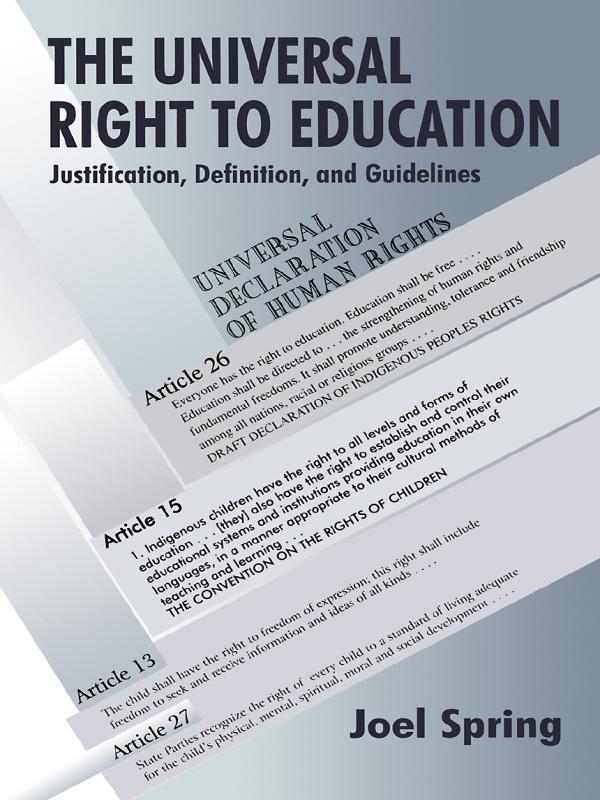
In this book, Joel Spring offers a powerful and closely reasoned justification and definition for the universal right to education--applicable to all cultures--as provided for in Article 26 of the United Nation's Universal Declaration of Human Rights.
One sixth of the world's population, nearly 855 million people, are functionally illiterate, and 130 million children in developing countries are without access to basic education. Spring argues that in our crowded global economy, educational deprivation has dire consequences for human welfare. Such deprivation diminishes political power. Education is essential for providing citizens with the tools for resisting totalitarian and repressive governments and economic exploitation. What is to be done? The historically grounded, highly original analysis and proposals Spring sets forth in this book go a long way toward answering this urgent question.
Spring first looks at the debates leading up to the Universal Declaration of Human Rights in 1948, to see how the various writers dealt with the issue of cultural differences. These discussions provide a framework for examining the problem of reconciling cultural differences with universal concepts. He next expands on the issue of education and cultural differences by proposing a justification for education that is applicable to indigenous peoples and minority cultures and languages. This justification is then applied to all people within the current global economy. Acknowledging that the right to an education is inseparable from children's rights, he uses the concept of a universal right to education to justify children's rights, and, in turn, applies his definition of children's liberty rights to the concept of education. His synthesis of cultural, language, and children's rights provides the basis for a universal justification and definition for the right to education -- which, in the concluding chapters, Spring uses to propose universal guidelines for human rights education, and instruction in literacy, numeracy, cultural centeredness, and moral economy.
Voordat ik Memmo gebruikte, stonden mijn aantekeningen verspreid over allerlei PDF's. Nu brengt een werkruimte alles samen — ik zie precies wat ik nog moet studeren.
De samenvattingen van Memmo zijn goud waard voor tentamens. Ik hoef geen 800 pagina's opnieuw te lezen twee weken van tevoren — alleen de belangrijke delen.
De AI-chat heeft me meer dan eens gered de avond voor een examen. Ik blijf gewoon vragen tot ik het snap — zonder te hoeven wachten op antwoord van een studiegroep.
De quizzen behandelen precies wat ik moet weten. Memmo houdt bij waar ik moeite mee heb — zo oefen ik alleen wat echt de moeite waard is.
Flashcards met gespreide herhaling zijn magisch. Memmo weet wanneer ik iets dreig te vergeten en laat het dan opnieuw zien.
De AI-podcasts zijn mijn favoriet. Ik luister onderweg naar school en krijg een samenvatting zonder achter de computer te zitten.

Handbok i kvalitativa metoder
281 kr

Hållbar utveckling: en introduktion för ingenjörer och andra problemlösare
334 kr

Brymans Samhällsvetenskapliga metoder
390 kr

Projektledning
491 kr

Den orättvisa hälsan: om socioekonomiska skillnader i hälsa och livslängd
326 kr

Organizational Leadership
429 kr

Vetenskapsteori för nybörjare
196 kr

På väg mot läraryrket
172 kr

Det sociala livet i skolan: Socialpsykologiska perspektiv
253 kr

Betygsättningens didaktik
151 kr

Personality
402 kr

Studying Leadership
404 kr

Managing Innovation
477 kr

Introduktion till samhällsvetenskaplig metod
347 kr

The Psychology of Sex and Gender
698 kr

Introduction to Leadership
605 kr

Evidens och kunskap för socialt arbete
207 kr